
Dioryctria banksiella
Mutuura, Munroe & Ross, 1969
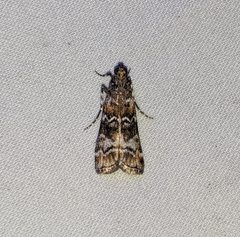
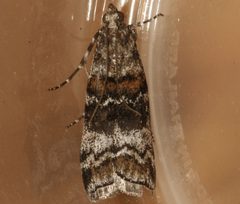
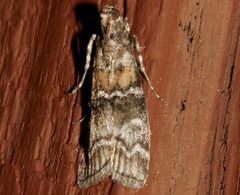
Dioryctria banksiella is a of snout moth in the Pyralidae, described in 1969 from Canadian specimens. The larvae develop within galls formed by the western gall rust fungus (Cronartium harknessii) on jack pine (Pinus banksiana) trunks. Early instars feed on gall tissue beneath the bark, while later instars mine deeper into the gall. The species is known only from western and central Canada.
Pronunciation
How to pronounce Dioryctria banksiella: //daɪ.ɔːrˈɪk.tɹi.ə bæŋkˈsiː.ɛl.lə//
These audio files are automatically generated. While they are not always 100% accurate, they are a good starting point.
Identification
are small pyralid moths typical of the Dioryctria, with wingspans likely in the 10-20 mm range based on congeneric . The species can be distinguished from other Dioryctria by its association with Cronartium harknessii galls on Pinus banksiana rather than conifer cones or shoots. Larval identification requires examination of the feeding site within fungal galls on jack pine trunks.
Images
Habitat
forest and jack pine woodlands where the tree Pinus banksiana occurs in association with the western gall rust fungus Cronartium harknessii. Larval is specifically the woody galls formed by this on tree trunks.
Distribution
Canada: Alberta, Northwest Territories, and eastward through the forest zone. The range corresponds to that of its pine and associated rust fungus.
Diet
Larvae feed on gall tissue of the fungus Cronartium harknessii. Early instars consume tissue beneath the bark surface; later instars mine deeper into the gall interior. feeding habits are unknown.
Host Associations
- Cronartium harknessii - food sourceWestern gall rust fungus; larvae feed in galls on Pinus banksiana
- Pinus banksiana - plantJack pine; galls on trunks serve as larval
Life Cycle
Larval development occurs within fungal galls on living pine trunks. Specific details of placement, site, number of , and stage are not documented.
Ecological Role
A consumer of fungal gall tissue, occupying a narrow in forest . The is part of the of organisms associated with Cronartium harknessii on jack pine.
Similar Taxa
- Dioryctria auranticellaAnother conifer-feeding Dioryctria , but develops in pine cones and twigs rather than fungal galls on trunks
- Dioryctria abietellaFeeds in fir and spruce cones; lacks association with rust fungus galls
- Dioryctria pryeriCone-feeding on pine; different larval and interaction
More Details
Taxonomic history
Described by Akira Mutuura, Eugene G. Munroe, and Douglas Alexander Ross in 1969. The specific epithet banksiella references both the tree Pinus banksiana and the rust fungus Cronartium harknessii (formerly Peridermium pini var. banksianae).
Biological note
This represents an unusual feeding strategy within Dioryctria, as most congeneric species are cone- or shoot-borers rather than gall inhabitants. The larval habit of mining fungal tissue within woody galls appears to be unique or rare within the .
Sources and further reading
- BugGuide
- Wikipedia
- GBIF taxonomy match
- iNaturalist taxon
- NCBI Taxonomy
- Catalogue of Life
- Baryscapus dioryctriae Archives - Entomology Today
- Baryscapus dioryctriae - Entomology Today
- Bug Eric: New Mexico Night Bugs
- Bug Eric: My Personal National Moth Week, 2017
- Bug Eric: September 2017
- New Wasp Species Discovered Parasitizing Pests of Pine Trees