
Prionyx foxi
Bohart & Menke, 1963
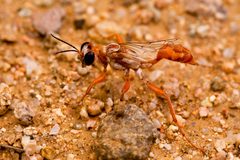
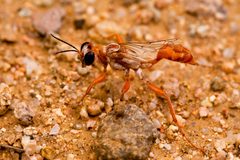
Prionyx foxi is a thread-waisted wasp in the Sphecidae. The Prionyx contains seven in the United States, all solitary that hunt grasshoppers (Acrididae) as prey for their larvae. Females construct underground burrows, paralyze grasshoppers with their venom, and provision each nest with a single prey item upon which they lay an . The species was described by Bohart & Menke in 1963 and is part of a group of morphologically similar wasps that can be difficult to distinguish without examining prey or detailed morphological features.
Pronunciation
How to pronounce Prionyx foxi: /ˈpraɪ.ə.nɪks ˈfɔk.saɪ/
These audio files are automatically generated. While they are not always 100% accurate, they are a good starting point.
Identification
Members of Prionyx are distinguished from similar thread-waisted wasps by their combination of globose , stout spiny legs, and prey. -level identification within Prionyx requires examination of specific morphological characters such as palp length and coloration patterns. P. foxi may be confused with P. thomae, P. parkeri, and P. canadensis; P. parkeri is identifiable by two pairs of long palps, while P. canadensis has distinct distribution and morphological differences. Accurate identification often requires expert examination or observation of prey type.
Images
Habitat
Open areas with sandy or well-drained soil suitable for burrow excavation. include degraded shortgrass prairie, arroyos, and other xeric environments where prey is abundant.
Distribution
North America and Middle America. Specific range details for P. foxi are poorly documented in available sources, though the Prionyx occurs across the entire United States and adjacent southern Canada.
Diet
are nectar-feeders. Females hunt grasshoppers ( Acrididae) as prey for larval development. Specific prey records for P. foxi are not documented in available sources, though related in the prey on various Acrididae including Conozoa, Amphitornus, Aulocara, Orphulella, Arphia, Dissosteira, Encoptolopus, and Paraidemona.
Life Cycle
Solitary nesting . Females excavate burrows in soil after securing prey. Burrows may be curved, linear, or L-shaped, terminating in a single chamber. Each chamber receives one paralyzed and a single . The larva consumes the provisioned prey and pupates underground. Developmental timing and number of per year are not documented for this .
Behavior
Females hunt grasshoppers, paralyze them with venom, and transport them to nest burrows. Prey is typically carried -first, with the running rapidly while grasping the . Nests are carefully sealed after provisioning, with soil packed into the tunnel entrance and surface evidence obliterated. Males are not involved in nesting or prey capture. Both sexes are vulnerable to kleptoparasitic satellite flies (Sarcophagidae: Miltogramminae) that larviposit on paralyzed prey.
Ecological Role
of grasshoppers, potentially contributing to regulation of Acrididae . Serves as for kleptoparasitic satellite flies. As a solitary , contributes to soil aeration through burrowing activities.
Human Relevance
Not of direct economic importance. Stings are possible if handled but unlikely given solitary, non-defensive . May be encountered in gardens, lawns, and open natural areas where grasshoppers are abundant and soil conditions permit nesting.
Similar Taxa
- Prionyx thomaeSimilar black and red coloration with silvery highlights; distinguished by geographic range and specific morphological characters
- Prionyx parkeriNearly identical in general appearance; reliably distinguished only by two pairs of long palps visible on close examination
- Prionyx canadensisSimilar overall ; separated by distribution and subtle morphological differences
- Prionyx atratusEntirely black coloration distinguishes this from the black-and-red pattern of most other Prionyx species
- Sphex lucaeSimilar thread-waisted appearance and color pattern (black with red in females), but has more oval abdomen and lacks silvery patches on and ; hunts katydids rather than grasshoppers
- Stizoides renicinctusSimilar black body with orange/red band on , but is a kleptoparasite of Prionyx and other rather than a ; does not carry prey
More Details
Taxonomic history
Described by Bohart & Menke in 1963. The Prionyx was revised by Bohart and Menke in their 1976 monograph Sphecid of the World.
Nesting behavior details
Based on congeneric , females pull soil from burrows using front legs rather than kicking sand backward. Nests are typically constructed in sandy soils in open, sunny areas.
Sources and further reading
- BugGuide
- Wikipedia
- GBIF taxonomy match
- iNaturalist taxon
- Catalogue of Life
- Bembicid Holdings | Entomology Research Museum
- Bug Eric: Wasp Wednesday: Stizoides renicinctus
- Bug Eric: Caught on Video: Prionyx atratus
- Bug Eric: Wasp Wednesday: Prionyx thomae
- Museum Collections and Notes Lead to the Rediscovery of a Grasshopper Not Seen in 60 Years
- Bug Eric: Wasp Wednesday: Sphex lucae