
Arphia
Stål, 1873
band-winged grasshoppers
Species Guides
10- Arphia behrensi(California Sulphur-winged Grasshopper)
- Arphia conspersa(Speckle-winged Rangeland Grasshopper)
- Arphia granulata(Southern Yellow-winged Grasshopper)
- Arphia pecos(Pecos Arphia)
- Arphia pseudonietana(red-winged grasshopper)
- Arphia ramona(California orange-winged grasshopper)
- Arphia saussureana(California red-winged grasshopper)
- Arphia simplex(Plains Yellow-winged Grasshopper)
- Arphia sulphurea(Sulphur-winged Grasshopper)
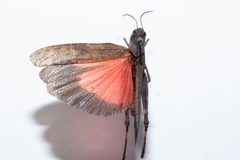
Arphia is a of band-winged grasshoppers in the Acrididae, containing at least 11 described distributed across western North America. The genus is characterized by species with brightly colored hind wings—typically red, yellow, or orange—that are concealed at rest but displayed during . Several species are notable for producing audible sounds by snapping their wings together during courtship and territorial displays. Members occupy diverse grassland from lowland prairies to high-elevation mountain meadows.
Pronunciation
How to pronounce Arphia: //ˈɑːrfiə//
These audio files are automatically generated. While they are not always 100% accurate, they are a good starting point.
Identification
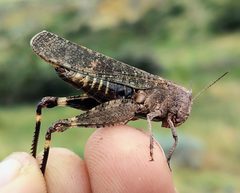
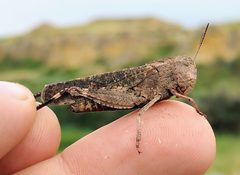
Arphia are distinguished from other band-winged grasshoppers by the combination of triangular or quadrilateral lateral foveolae on the , a low but distinct carina of the pronotum that is uniformly elevated and incised once in front of the middle, and hind wings with colored disks (red, yellow, or orange) that extend beyond the when folded. Long wings extending past the abdomen tip in both sexes separate them from short-winged . Species-level identification relies on hind wing color, body coloration, and seasonal timing of presence.
Images
Habitat
Grassland prairies, desert shrub with grassy understory, and mountain meadows up to 11,000 feet elevation. Inhabits areas where grasses form part of the vegetation structure, including shortgrass prairie, mixedgrass prairie, and montane grasslands.
Distribution
Western North America from Alaska to Mexico, including the Rocky Mountain region, Great Plains, and southwestern United States. Specific distribution varies by ; some have restricted ranges while others span the entire western region.
Seasonality
activity periods vary by and elevation. Low-elevation species such as Arphia conspersa are present as adults in spring (April onwards), while high-elevation may not emerge until July. Some species show autumn adult activity. Nymphs typically hatch in mid-summer and overwinter in late instars.
Diet
Feeds primarily on grasses and sedges. Specific plants include Kentucky bluegrass, prairie junegrass, western wheatgrass, needle-and-thread, blue grama, downy brome, threadleaf sedge, needleleaf sedge, sand dropseed, and sixweeks fescue. Small amounts of forbs, fungi, and arthropods are occasionally ingested.
Life Cycle
are laid in pods containing 20-21 eggs, deposited more than 2 inches into bare soil. duration varies with climate: one year in favorable temperature regimes, two years in colder . Nymphs develop through five instars, with fifth instars . Nymphs can survive freezing to -16°C. to adulthood occurs in early spring at lower elevations, potentially as late as July at high elevations.
Behavior
Males produce sounds by snapping wings together during appetitive lasting 1-3 seconds, describing arcs 6-10 feet long and 3 feet high. These flights function in courtship and mate location, occurring every 3-4 minutes at peak activity. Evasive flights range 4-45 feet and are accompanied by crepitation or may be silent. Courtship occurs on ground: males approach females in spurt-runs, stridulate with 1-3 chirps, wave , and mount from rear after a series of displays including stomping hind . Females may solicit males by presenting their side, lowering the near hindleg, and raising the opposite hindleg and tegmina to expose the . Feeding occurs from horizontal position on ground; standing leaves are cut at base and consumed on ground or dropped. Individuals bask by orienting sides to sun, become immobile at low temperatures, and assume stilt posture or seek shade at soil surface temperatures of 105°F.
Ecological Role
Herbivore in grassland . Low densities (typically 0.05-0.1 per square yard in prairies, 20-120 per acre in montane ) limit overall impact on vegetation. Serves as prey for vertebrate and . Thermal partitioning with co-occurring such as Trimerotropis suffusa reduces .
Human Relevance
Minimal economic impact on grazing land due to consistently low densities. Feeds on quality forage but does not reach pest levels. Occasionally monitored in rangeland management programs. Subject of behavioral and thermal research.
Similar Taxa
- TrimerotropisBoth are band-winged grasshoppers with colored hind wings, but Trimerotropis typically have different pronotal carina structure and wing venation patterns.
- DissosteiraLarge rangeland grasshoppers with long wings, but Dissosteira lacks the distinct pronotal carina incision and characteristic of Arphia.
- CircotettixBand-winged grasshoppers with crackling sounds, but Circotettix have different body proportions and pronotal shapes.
More Details
Thermal Ecology
Arphia conspersa exhibits eurythermic physiology with broad thermal breadth, maintaining activity across wider temperature ranges than co-occurring stenothermic . Males have lower mean body temperature, sexual display temperature, and minimum flying temperature than Trimerotropis suffusa in montane . Poorer thermoregulatory ability compared to Trimerotropis suffusa is offset by greater thermal .
Acoustic Communication
sounds are produced by wing snapping, though the exact mechanism remains disputed. Two distinct sound types are produced during different leg positions. Sounds function in intraspecific communication between sexes and within sexes, with visual and acoustical components combined in display.
Sources and further reading
- BugGuide
- Wikipedia
- GBIF taxonomy match
- iNaturalist taxon
- NCBI Taxonomy
- Catalogue of Life
- Grasshoppers of Colorado
- Grasshoppers of Colorado
- Specklewinged Grasshopper
- Grasshoppers of Colorado
- Grasshoppers of Colorado
- Species Records and Accounts
- Visual and Acoustical Social Displays by the Grasshopper Arphia Conspersa (Orthoptera: Acrididae)
- Thermal niche partitioning in the grasshoppers Arphia conspersa and Trimerotropis suffusa from a montane habitat in central Colorado