
Arphia conspersa
Scudder, 1875
Speckle-winged Rangeland Grasshopper, Speckled Rangeland Grasshopper
Arphia conspersa is a large band-winged grasshopper ( Acrididae, Oedipodinae) distributed across western North America from Alaska to Mexico. are active primarily in spring, distinguishing them seasonally from the related redwinged (Arphia pseudonietana) which appears in late summer and fall. The exhibits distinctive visual and acoustical , with males performing accompanied by crackling . It inhabits diverse grassland including prairies, desert shrub , and montane meadows up to 11,000 feet elevation.
Pronunciation
How to pronounce Arphia conspersa: //ˈɑːr.fi.ə kənˈspɜːr.sə//
These audio files are automatically generated. While they are not always 100% accurate, they are a good starting point.
Identification
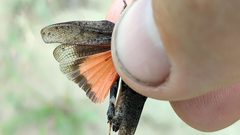
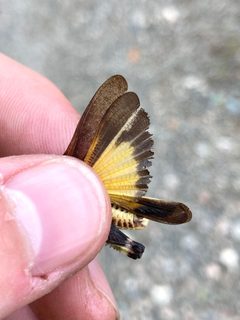
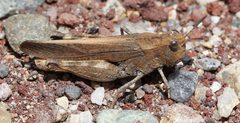
are large rangeland grasshoppers with females substantially larger than males. The body is brown with a yellow . Tegmina are brown with dark brown speckles, often forming a pale tan or yellow stripe when folded. The hind wing disk is usually red but may be yellow; the hind tibia is pale yellowish-green with a fuscous annulus at each end. The median carina of the pronotum is low but distinct, uniformly elevated, and incised once in front of the middle. Long wings extend beyond the abdomen in both sexes. Nymphs have distinctive color patterns by instar: Instar I has a black lateral pronotal lobe with a triangular light tan patch postero-ventrally and dark red hind tibia; Instars II-III have shiny black hind tibia; Instars IV-V have green and black hind tibia with brown-speckled body and green venter with brown spots.
Images
Habitat
Inhabits all grassland prairie types and penetrates desert shrub where grasses occur. Found in mountain meadows and open grasslands up to 11,000 feet elevation in Colorado and Idaho. Occupies diverse grassland including shortgrass, mixedgrass, and sand prairies, as well as bunchgrass prairie.
Distribution
Western North America from Alaska to Mexico. Documented in Arizona, Alaska, Colorado, and regions of central and northeastern Mexico.
Seasonality
Late-hatching with first instars appearing mid-July in mixedgrass prairie of eastern Wyoming and shortgrass prairie of eastern Colorado; hatching continues for about one month. Nymphs overwinter in fifth instar, becoming with onset of cold weather. emerge in early spring (April in eastern Wyoming mixedgrass prairie), with timing varying by latitude and altitude (July in high mountain of Colorado). Adults present from spring through summer; peak male display occur between 10 a.m. and noon.
Diet
Feeds primarily on grasses and sedges. Sixteen grass and three sedge species recorded in crop contents. Specific vary by : Kentucky bluegrass (50% of diet in southeastern North Dakota sand prairie), prairie junegrass (67% in central Nebraska mixedgrass prairie), western wheatgrass and needleandthread (58% combined in eastern Colorado mixedgrass prairie), blue grama, western wheatgrass, and downy brome (64% combined in northern Colorado shortgrass prairie). Also ingests small amounts of forbs (12 species recorded), fungi, and arthropods. Feeds from horizontal position on ground, consuming dry grass litter, recumbent attached leaves, or green leaves cut by itself.
Life Cycle
duration varies with climate: one year under favorable temperature regimes (laboratory conditions at 77°F), two years in plains of central Saskatchewan and mountains of Colorado. Females lay nondiapause that hatch in 40 days at 77°F. Eggs are light brown to brown, 4.5-5.2 mm long, deposited in pods 1 5/8 inches long containing 20-21 eggs; top 5/8 inch occupied by froth, bottom inch by eggs. Nymphal development proceeds through five instars, taking 42-56 days depending on environmental factors. Nymphs survive freezing at temperatures as low as -16°C.
Behavior
Males perform every 3-4 minutes at peak daily activity, accompanied by crackling (sound produced by wings). Appetitive flights last 1-3 seconds, describing an arc 6-10 feet long and 3 feet high. Courtship conducted on ground: male detects female from at least 2 feet, approaches in spurt-runs with stridulation (1-3 chirps), orients -to-face with waving, moves to female's side, butts her , places front on her middle , stomps ground rapidly with hind tarsi, produces 4-5 chirps, then mounts. Receptive females solicit attention by presenting side, lowering near hindleg, raising opposite hindleg and tegmina to expose . Copulation observed lasting 23 minutes. Evasive flights by both sexes begin ~3 hours after sunrise when soil temperatures exceed 60°F; flights range 4-45 feet, 6 inches to 2 feet high, sinuous with crepitation. Silent escape flights may extend 30 feet to several hundred feet with wind. Ground-dwelling; rests horizontally on ground at night, basks in morning orienting sides to sun, becomes immobile at high temperatures (stilt posture or shade-seeking at soil surface temperatures of 105°F). Flight possible at soil surface temperatures above ~60°F; jumping possible at 57°F.
Ecological Role
Minor herbivore in grassland . consistently low (0.05-0.1 per square yard in desert, mixedgrass, and shortgrass prairies; 40-120 adults per acre in mountain ), with limited impact on vegetation despite feeding on quality forage grasses. Serves as prey for various . Coexists with other through thermal partitioning (e.g., with Trimerotropis suffusa in montane Colorado habitats, occupying lower mean body temperatures and broader thermal niche).
Human Relevance
Minimal economic impact due to low densities throughout range. Feeds on valuable forage grasses but causes no serious losses; not known to reach densities. Classified as minor pest in western grasslands. Occasionally contributes to general rangeland damage during multi- outbreaks.
Similar Taxa
- Arphia pseudonietanaRedwinged is the only other Arphia with equally wide western distribution. are seasonally separated: A. conspersa present in spring, A. pseudonietana in late summer and fall. A. pseudonietana has dark brown to black body, darkly speckled tegmina, red hind wing disk with black marginal band, and dark brown or black hind tibia with yellow annulus in quarter.
- Trimerotropis suffusaCoexists in montane of central Colorado. Occupies different thermal : T. suffusa has higher mean body temperature, higher minimum flying temperature, higher maximum voluntarily tolerated temperature, narrower thermal niche breadth, and better thermoregulatory ability than A. conspersa.
Sources and further reading
- BugGuide
- Wikipedia
- GBIF taxonomy match
- iNaturalist taxon
- NCBI Taxonomy
- Catalogue of Life
- Grasshoppers of Colorado
- Specklewinged Grasshopper
- Grasshoppers of Colorado
- Grasshoppers of Colorado
- Species Records and Accounts
- Redwinged Grasshopper
- Visual and Acoustical Social Displays by the Grasshopper Arphia Conspersa (Orthoptera: Acrididae)
- Thermal niche partitioning in the grasshoppers Arphia conspersa and Trimerotropis suffusa from a montane habitat in central Colorado