
Arphia xanthoptera
(Burmeister, 1838)
Autumn Yellow-winged Grasshopper
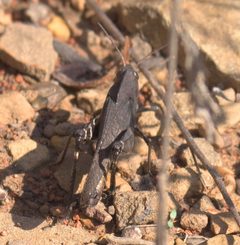
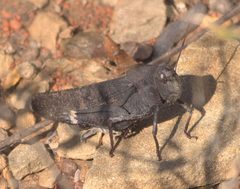
Arphia xanthoptera, commonly known as the autumn yellow-winged , is a band-winged grasshopper in the Acrididae. It is distinguished from primarily by its activity period in late summer and fall, contrasting with the spring of similar . The species has been documented as a prey item for the sphecid Prionyx thomae. It belongs to a of 16 North American species characterized by banded hind wings and crepitating displays.
Pronunciation
How to pronounce Arphia xanthoptera: /ˈɑːrfiə zænˈθɒptərə/
These audio files are automatically generated. While they are not always 100% accurate, they are a good starting point.
Identification
Distinguished from the sympatric Arphia conspersa (speckle-winged ) and Arphia pseudonietana (red-winged grasshopper) primarily by : of A. xanthoptera are present in late summer and fall, while A. conspersa and A. pseudonietana adults occur in spring. The 'autumn yellow-winged grasshopper' reflects this seasonal separation. Specific morphological differences from are not detailed in available sources.
Images
Appearance
As a band-winged grasshopper, possesses hind wings with a colored basal area and dark submarginal band. Wing coloration when folded at rest creates a distinctive pattern. Long wings extend beyond the in both sexes. Specific coloration and pattern details for this are not well documented in available sources.
Distribution
Documented from the southeastern United States, Iowa, Nebraska, and Pennsylvania. Broader North American distribution is indicated but not precisely defined in available sources. The Arphia is widespread in western North America, but this ' range appears to extend eastward.
Seasonality
active in late summer and autumn, in contrast to spring-active . This temporal separation is a key identifying feature.
Behavior
Males of related Arphia perform appetitive or accompanied by crackling sounds produced by the wings, used in courtship to attract females. Whether A. xanthoptera exhibits this specifically has not been documented.
Ecological Role
Serves as prey for , specifically documented as a for Prionyx thomae (Sphecidae), which paralyzes and provisions nests with this .
Similar Taxa
- Arphia conspersaSimilar band-winged grasshopper with overlapping range; distinguished by spring activity versus autumn activity in A. xanthoptera
- Arphia pseudonietanaSimilar band-winged grasshopper with wide western distribution; distinguished by spring activity versus autumn activity in A. xanthoptera
More Details
Predator relationship
Documented as prey for the thread-waisted wasp Prionyx thomae, which paralyzes grasshoppers and provisions underground burrows with them for its larvae
Nomenclature
Originally described as Oedipoda xanthoptera by Burmeister in 1838; currently classified in Arphia