
Proctotrupidae
Genus Guides
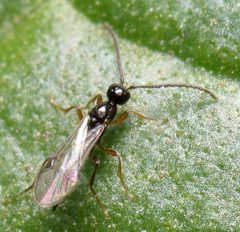
9is a of small in the superfamily Proctotrupoidea, comprising approximately 400 described across more than 30 with an estimated total diversity of around 675-1200 species. Members are primarily endoparasitoids of coleopteran larvae, particularly in families Carabidae, Staphylinidae, and Elateridae, though some genera parasitize fungus gnats (Mycetophilidae, Sciaridae) and concealer moths (Oecophoridae). Females in many species are wingless and soil-dwelling, capable of detecting larvae in burrows. The family has a distribution with notable Gondwanan relict elements in the Austroserphinae.
Pronunciation
How to pronounce Proctotrupidae: /ˌprɒktoʊˈtruːpɪdiː/
These audio files are automatically generated. While they are not always 100% accurate, they are a good starting point.
Identification
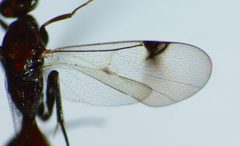
Distinguished from other Proctotrupoidea by combination of: wing venation with M arising close and to 1cu-a; Cu and m-cu joining at distance equal to length of 2cu-a; presence of long, sword-shaped ovipositor in some ; wingless females in soil-dwelling . Austroserphinae represents primitive lineage with Gondwanan distribution. Separation from Ceraphronidae and other proctotrupoid requires examination of wing venation and metasomal structure.
Images
Appearance
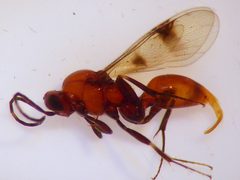
Small with body length typically 5-8 mm, ranging from 3 to 15 mm. Many have wingless females adapted for soil-dwelling. Long, sword-shaped ovipositor present in some , up to twice the length of the metasoma. Wing venation diagnostic: M arises very close and to 1cu-a; Cu and m-cu joining at distance equivalent to length of 2cu-a.
Habitat
Forest , particularly Nothofagus forests in southern South America and northern Iran. Soil and leaf litter , especially where larvae occur in burrows. Open mixed forest with old and young trees; glacially fragmented landscapes. Elevations 722-1495 m a.s.l. in sampled regions.
Distribution
: Palaearctic, Nearctic, Oriental, and Australasian regions. Southernmost record at ~55°S in Chile (Isla Navarino). Documented in Iran (Alborz, Tehran, Qazvin, Mazandaran, Gilan, Fars, Hormozgan, Khuzestan, Markazi, Golestan provinces), New Zealand, and southernmost South America. Distribution records from Denmark, Norway, and Sweden.
Seasonality
collected March through November in northern hemisphere; austral summer activity in southern South America.
Diet
Larval endoparasitoids primarily of Coleoptera larvae, specifically Carabidae, Staphylinidae, Elateridae, Curculionidae, Anthribidae, Coccinellidae, Cleridae, Erotylidae, Melandryidae, Nitidulidae, and Phalacridae. Some parasitize Diptera (Mycetophilidae, Sciaridae) or Lepidoptera (Oecophoridae: Tingena spp.). One record from Chilopoda (Lithobiidae).
Host Associations
- Coleoptera: Carabidae - larval endoparasitoidprimary
- Coleoptera: Staphylinidae - larval endoparasitoidprimary
- Coleoptera: Elateridae - larval endoparasitoidprimary
- Coleoptera: Curculionidae - larval endoparasitoid
- Coleoptera: Anthribidae - larval endoparasitoid
- Coleoptera: Coccinellidae - larval endoparasitoid
- Coleoptera: Cleridae - larval endoparasitoid
- Coleoptera: Erotylidae - larval endoparasitoid
- Coleoptera: Melandryidae - larval endoparasitoid
- Coleoptera: Nitidulidae - larval endoparasitoid
- Coleoptera: Phalacridae - larval endoparasitoid
- Diptera: Mycetophilidae - larval endoparasitoidsome
- Diptera: Sciaridae - larval endoparasitoidsome
- Lepidoptera: Oecophoridae - larval endoparasitoidFustiserphus intrudens on Tingena spp.
- Chilopoda: Lithobiidae - larval endoparasitoidsingle record
Life Cycle
Endoparasitoid development within larvae. Oviposition via ovipositor into host; ovipositor pointed, without notch, with only 10% exposed in some . with separate sexes.
Behavior
Wingless females dwell in soil and detect larvae in burrows. collected using light traps, sweeping nets, and . One observed flying during afternoon of austral summer.
Ecological Role
agents of coleopteran and dipteran larvae in forest . of soil-dwelling and leaf-litter inhabiting beetles and other .
Human Relevance
Potential agents for pest beetles and fungus gnats. No documented negative impacts.
Similar Taxa
- CeraphronidaeDifferent wing venation and metasomal structure; distinguished by M position relative to 1cu-a
- PlatygastridaeFormerly included in Proctotrupoidea but now separate superfamily Platygastroidea; different associations and
- ScelionidaeDifferent wing venation and typically parasitize rather than larvae
More Details
Taxonomic notes
Austroserphinae represents a primitive Gondwanan lineage distributed in Oceania and South America, with Austrocodrus gladiogeminus holding the southernmost distribution of any proctotrupid at nearly 55°S. The Pschornia was first recorded from Iran in 2022 with description of new P. persica.
Research gaps
of many remains unknown, including all newly described species. associations for Austroserphinae not documented. Male of Austrocodrus gladiogeminus unknown.
Sources and further reading
- BugGuide
- Wikipedia
- GBIF taxonomy match
- iNaturalist taxon
- NCBI Taxonomy
- Catalogue of Life
- REVIEW OF THE FAMILY PROCTOTRUPIDAE (HYMENOPTERA PROCTOTRUPOIDEA) IN IRAN
- A new species of Austrocodrus Ogloblin (Hymenoptera, Proctotrupidae, Austroserphinae), a Gondwanic relict from southernmost South America
- Catalogue of type specimens of the families Ceraphronidae, Platygastridae, Proctotrupidae and Scelionidae (Hymenoptera) deposited in the National Museum of the Czech Republic
- Fustiserphus (Hymenoptera: Proctotrupidae) parasitises Lepidoptera in leaf litter in New Zealand
- List of the North American species of the genus Brachyserphus (Hymenoptera, Proctotrupidae) with notes on distribution and synonymy