
Ceraphronidae
Haliday, 1833
ceraphronid wasps, ceraphronids
Genus Guides
2is a small of in the superfamily Ceraphronoidea, containing approximately 14 and 360 described , though many remain undescribed. The family is poorly known taxonomically and ecologically. Most species are believed to be primary parasitoids, particularly of flies, with some functioning as hyperparasitoids of other parasitoids. A significant number of species are found in soil, and winglessness has evolved in multiple lineages.
Pronunciation
How to pronounce Ceraphronidae: //sɛˌræfˈrɒnɪdiː//
These audio files are automatically generated. While they are not always 100% accurate, they are a good starting point.
Identification
Distinguished from the closely related Megaspilidae by three characters: (1) very small stigma in the wing, (2) very broad metasomal petiole, and (3) single groove in the mesoscutum. Within , -level identification relies on the structure of the Waterston's evaporatorium on metasomal tergite 6, male genitalia , and antennal structure. identification often requires detailed examination of male genitalia and, increasingly, .
Images
Appearance
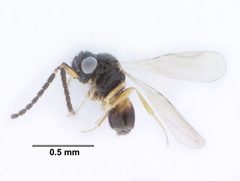
Small-bodied , typically 1-5 mm in length. Winged have reduced wing venation with a very small stigma (pterostigma) in the forewing. The metasoma is connected to the mesosoma by a very broad petiole. The mesoscutum bears a single groove. Many species, particularly soil-dwelling ones, are wingless with reduced and pale coloration. The Waterston's evaporatorium—a cuticular modification surrounding an opening on metasomal tergite 6—provides species-specific characters for identification.
Habitat
Diverse including soil, leaf litter, and vegetation. Many are associated with soil environments, where wingless forms are common. Others occur in above-ground habitats including agricultural systems, forests, and greenhouses.
Distribution
Worldwide distribution with records from all major biogeographic regions. Documented from the Western Palaearctic (including Germany, Georgia, and across Europe), Kenya, Syria, Iran, the Dominican Republic (fossil), and the Neotropics. The is considered extremely understudied even in historically well-surveyed regions.
Host Associations
- Aphidoletes aphidimyza - Primary of this predatory gall midge, a agent of aphids
- Aphidius spp. - hyperparasitoidLygocerus testaceimanus and L. cameroni are hyperparasitoids of Aphidius primary of aphids
- Prorops nasuta - hyperparasitoidAphanogmus dictynna is a primary of this bethylid , which is itself a parasitoid of the
- Cephalonomia stephanoderis - hyperparasitoidProbable for Aphanogmus dictynna
- Hypothenemus hampei - indirect; ceraphronids affect its through hyperparasitism of its
- Tuta absoluta - Aphanogmus clavicornis recorded as larval of this tomato
- Feltiella acarisuga - Aphanogmus feltiellophagus is a of this acarivorous gall midge
- Apanteles taragamae - hyperparasitoidAphanogmus fijiensis is a hyperparasitoid through this braconid primary of Diaphania indica
- Diaphania indica - indirectTarget pest of biocontrol; affected by ceraphronid hyperparasitism
Life Cycle
Development is typically rapid. In Lygocerus , larval development lasts approximately six days with four larval instars and three moults, followed by within the remains for approximately two weeks. Multiple per season are likely. are laid and post-embryonic development occurs outside the host body, with larvae consuming the host during development.
Behavior
Larvae of at least some exhibit active defensive movements when disturbed, which may provide protection against secondary . This has been observed in Lygocerus species, where larvae and pupae respond to external stimuli with active movements within their cocoons.
Ecological Role
Primarily function as and hyperparasitoids in . As parasitoids, they attack various dipteran and hymenopteran . As hyperparasitoids, they may disrupt programs by attacking primary parasitoids of pest insects. Their role in soil food webs is poorly understood but likely significant given the abundance of wingless soil-dwelling .
Human Relevance
Significant relevance to programs, both as potential biocontrol agents and as disruptive hyperparasitoids. Aphanogmus have been documented interfering with mass-rearing of Aphidoletes aphidimyza for biocontrol and affecting -based control of lepidopteran pests and the . The has been subject to taxonomic revision due to misidentifications in biocontrol contexts.
Similar Taxa
- MegaspilidaeClosely related in Ceraphronoidea; distinguished by larger wing stigma, narrow metasomal petiole, and absence of single groove on mesoscutum
More Details
Taxonomic challenges
The is extremely understudied with many undescribed species. The Aphanogmus fumipennis group alone contains at least 23 species in the Western Palaearctic, 14 of which were described in 2024. Historical misidentifications are common, particularly in biocontrol literature. The Waterston's evaporatorium provides the first reliable morphological characters for matching males to females, resolving a long-standing taxonomic obstacle.
Evolutionary history
The fossil record includes Ceraphron ceuthonymus from Early Miocene (Burdigalian) Dominican amber, representing the first described fossil of the . The Trassedia has been described as an evolutionary relict with an unusual distribution pattern.
Morphological innovations
Research on Ceraphronoidea has revealed a novel abdominal pulsatory organ for , associated with modifications of the abdominal musculature and vessel. The Waterston's evaporatorium, a cuticular modification surrounding an , provides a morphological 'barcode' for identification.
Sources and further reading
- BugGuide
- Wikipedia
- GBIF taxonomy match
- iNaturalist taxon
- NCBI Taxonomy
- Catalogue of Life
- A ceraphronid wasp in Early Miocene amber from the Dominican Republic (Hymenoptera: Ceraphronidae)
- Revision ofTrassedia(Hymenoptera: Ceraphronidae), an Evolutionary Relict With an Unusual Distribution
- The Waterston’s evaporatorium of Ceraphronidae (Ceraphronoidea, Hymenoptera): A morphological barcode to a cryptic taxon
- Biology ofAphanogmus fijiensis (Fernere) (Hymenoptera: Ceraphronidae) a hyperparasite ofDiaphania indica (Saunders) (Lepidoptera: Pyralidae) throughApanteles taragamae Viereck (Hymenoptera: Braconidae)
- Known unknowns at our doorstep: Description of 14 Western Palaearctic species within the newly defined Aphanogmus fumipennis species group (Hymenoptera, Ceraphronoidea, Ceraphronidae)
- APHANOGMUS FULMEKI ASHMEAD (HYMENOPTERA: CERAPHRONIDAE), A PARASITOID OF APHIDOLETES APHIDIMYZA RONDANI (DIPTERA: CECIDOMYIIDAE)
- Recent occurrence of Aphanogmus dictynna (Waterston) (Hymenoptera: Ceraphronidae) in Kenya an important hyperparasitoid of the coffee berry borer Hypothenemus hampei (Ferrari) (Coleoptera: Curculionidae)
- Ceraphronidae and Megaspilidae (Hymenoptera: Ceraphronoidea) of Poland: current state of knowledge with corrections to the Polish checklist
- Catalogue of type specimens of the families Ceraphronidae, Platygastridae, Proctotrupidae and Scelionidae (Hymenoptera) deposited in the National Museum of the Czech Republic
- On the Bionomics and Development of Lygocerus testaceimanus, Kieffer, and Lygocerus cameroni, Kieffer (Proctotrypoidea-Ceraphronidae), parasites of Aphidius (Braconidae)
- Taxonomic problems in the Aphanogmus hakonensis species complex; (Hymenoptera: Ceraphronidae) common hyperparasitoids in biocontrol programmes against lepidopterous pests in the tropics
- Aphanogmussp. (Hymenoptera: Ceraphronidae): a hyperparasitoid of the coffee berry borer parasitoidProrops nasuta(Hymenoptera: Bethylidae) in Kenya
- New record of aphanogmus clavicornis Thomson (Hymenoptera: Ceraphronidae) as a larval parasitoid of tomato leaf miner Tuta absoluta (Meyrick) in Syria
- Aphanogmus feltiellophagus sp. nov. (Hymenoptera: Ceraphronidae), a parasitoid of the acarivorous gall midge, Feltiella acarisuga Vallot (Diptera: Cecidomyiidae) in Iran
- Update on the enigmatic Pteroceraphron mirabilipennis Dessart, 1981 (Hymenoptera, Ceraphronidae): description of male and first record from the Neotropics, including first DNA barcodes.