
Megaspilidae
Genus Guides
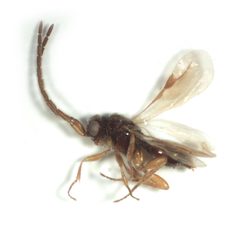
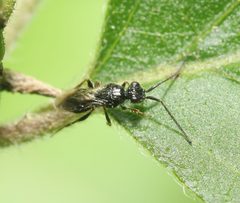
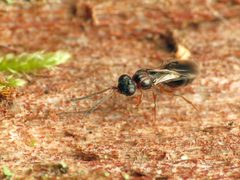
2is a small of in the superfamily Ceraphronoidea, comprising approximately 450 described across 13 in two . The family remains poorly known biologically, though most species are believed to be parasitoids of sternorrhynchan Hemiptera (particularly aphids), with some functioning as hyperparasitoids attacking other parasitoids. Many species inhabit soil, and several are wingless. The largest genus is Dendrocerus, followed by Conostigmus.
Pronunciation
How to pronounce Megaspilidae: /ˌmɛɡəˈspaɪlɪdiː/
These audio files are automatically generated. While they are not always 100% accurate, they are a good starting point.
Identification
can be distinguished from the closely related Ceraphronidae by three key morphological features: a very large stigma in the wing, a relatively constricted metasomal petiole, and three grooves in the mesoscutum. The Dendrocerus scutellaris possesses a unique mesoscutellar comb—raised projections on the scutellum—and lacks pointed , instead using these spines to saw open bodies during .
Images
Habitat
Many are found in soil. The occupies diverse environments including temperate and tropical regions, with species recorded from forest and agricultural landscapes.
Distribution
Worldwide distribution with records from Europe (including Poland, Denmark, Norway, Sweden), North America (United States including Vermont), Central America ( Rica), South America (Argentina, Brazil with first record of Trichosteresis), and Asia (China including Chongqing and Xizang Autonomous Region). The Neotropical fauna comprises 20 in four but remains poorly sampled.
Host Associations
- Hemiptera (Sternorrhyncha: aphids, occasionally psyllids) - primary primary
- Hymenoptera (Aphidiidae, Aphelinidae, Encyrtidae, Pteromalidae, Braconidae, Figitidae) - secondary hyperparasitoid — and of Hemiptera
- Diptera (pupae) - hyperparasitoid
- Coleoptera - hyperparasitoid
- Neuroptera - hyperparasitoid
- Mecoptera - hyperparasitoid
- ants - associatedsome associated with ants
Life Cycle
Development occurs through complete with , larval, pupal, and stages. In Dendrocerus carpenteri, females oviposit on of primary (such as Aphidius ervi) developing within mummies. The larva develops inside the , with the adult emerging by cutting through the host body. In D. scutellaris, the adult uses a mesoscutellar comb to saw open the host rather than chewing .
Behavior
discrimination has been documented in Dendrocerus carpenteri: females accept already parasitized hosts within unparasitized mummies but reject unparasitized hosts within previously parasitized mummies. Host marking occurs via contact applied to the mummy after oviposition. The search template is primarily defined by the mummy structure rather than the primary itself. Some exhibit interspecific host discrimination, providing competitive benefits.
Ecological Role
As and hyperparasitoids, function as regulators of sternorrhynchan Hemiptera , with potential agricultural benefit through of pests. Hyperparasitoid occupy the fourth , attacking primary parasitoids of aphids and thereby influencing dynamics in agricultural and natural .
Human Relevance
in this may benefit agriculture by controlling pest insects such as aphids that damage crops. The family has been subject to extensive taxonomic research due to its poorly understood status, with ongoing efforts to describe new and clarify associations.
Similar Taxa
- CeraphronidaeSister in superfamily Ceraphronoidea; distinguished by smaller wing stigma, less constricted metasomal petiole, and absence of three mesoscutal grooves
- PlatygastridaeAlso contains small of similar size and habits; distinguished by morphological features of and wing venation
More Details
Taxonomic status
The is considered poorly known as a whole, with many still undescribed. Recent taxonomic work has described new species from China, Rica, and other regions, with semantic phenotypic data being compiled to facilitate future systematic efforts.
Research significance
Studies of Dendrocerus have contributed to understanding discrimination mechanisms in hyperparasitoids, including chemical marking of hosts and competitive interactions between species.
Sources and further reading
- BugGuide
- Wikipedia
- GBIF taxonomy match
- iNaturalist taxon
- NCBI Taxonomy
- Catalogue of Life
- parasitoids | Blog - Part 2
- new wasp | Blog
- Costa Rica | Blog
- larvae | Blog
- Entomology Outreach: Tips for Making an Impact and Sharing Your Science
- Pensoft blog - Part 86
- Inventory of the Megaspilidae family (Insecta: Hymenoptera)
- First record of Trichosteresis Förster (Hymenoptera: Megaspilidae) from South America
- Annotated keys to the species of Megaspilidae (Hymenoptera: Ceraphronoidea) of the Neotropical Region
- Ceraphronidae and Megaspilidae (Hymenoptera: Ceraphronoidea) of Poland: current state of knowledge with corrections to the Polish checklist
- Host discrimination and ovicide by aphid hyperparasitoids Asaphes suspensus (Hymenoptera: Pteromalidae) and Dendrocerus carpenteri (Hymenoptera: Megaspilidae)
- MARKING THE PACKAGE OR ITS CONTENTS: HOST DISCRIMINATION AND ACCEPTANCE IN THE ECTOPARASITOID DENDROCERUS CARPENTERI (HYMENOPTERA: MEGASPILIDAE)
- Unique extrication structure in a new megaspilid, Dendrocerus scutellaris Trietsch & Mikó (Hymenoptera: Megaspilidae)
- Development and parasitization of an aphid’s secondary parasitoid, Dendrocerus laticeps (Hymenoptera: Megaspilidae), on Aphidius colemani (Hymenoptera: Braconidae)
- Competition for hosts between two hyperparasitoids of aphids,Dendrocerus laticeps andDendrocerus carpenteri (Hymenoptera: Megaspilidae): The benefit of interspecific host discrimination
- Interspecific Parasitism between Two Aphid Hyperparasitoids, Dendrocerus carpenteri (Hymenoptera: Megaspilidae) and Asaphes lucens (Hymenoptera: Pteromalidae)
- Five new species and three new country records of Megaspilidae from Xizang Autonomous Region, China (Hymenoptera, Ceraphronoidea).
- Description of two new species of Conostigmus Dahlbom, 1858 (Hymenoptera, Megaspilidae) from Yintiaoling Nature Reserve, Chongqing, China.
- Characterization of the Mitogenome of the Genus Dendrocerus Ratzeburg (Hymenoptera: Megaspilidae) with the Specific Designed Primers.
- Dendroceruslui (Hymenoptera, Ceraphronoidea, Megaspilidae): a new species of Dendroceruscarpenteri species-group from China.