
Sciaridae
dark-winged fungus gnats, black fungus gnats
Genus Guides
10- Bradysia(darkwinged fungus gnats)
- Corynoptera(fungus gnats)
- Epidapus(fungus gnats)
- Eugnoriste(black fungus gnat)
- Odontosciara(dark-winged fungus gnats)
- Phytosciara
- Pnyxia(dark-winged fungus gnats)
- Scatopsciara
- Sciara(fungus gnats)
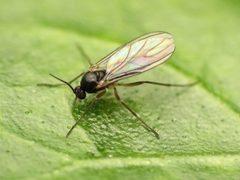
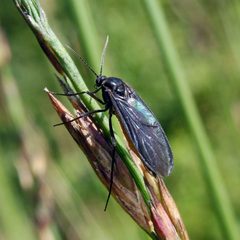
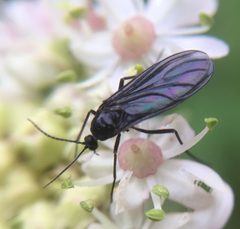
are a of small, dark-colored flies commonly known as dark-winged fungus gnats. range from 1–11 mm in length, typically under 5 mm. The family is among the least studied of the large Diptera families due to small size and taxonomic difficulty. Approximately 1,700 are described globally, with an estimated 20,000 species awaiting discovery, primarily in tropical regions. Larvae develop in moist, decaying organic matter and play significant roles in decomposition and nutrient cycling.
Pronunciation
How to pronounce Sciaridae: /ʃiˈærɪdiː/
These audio files are automatically generated. While they are not always 100% accurate, they are a good starting point.
Identification
Distinguished from similar fungus gnat Mycetophilidae by: meeting above (separated in Mycetophilidae); abdominal creeping welts lacking sclerotised spicules (present in Mycetophilidae); generally smaller size (typically under 5 mm versus 5–10 mm). Wing venation pattern with characteristic forked and reduced cross veins provides additional diagnostic features. Identification to level requires microscopic examination and knowledge.
Images
Habitat
Predominantly moist, shaded environments including forests, swamps, wet meadows, and leaf litter. Frequently found in decaying wood, under bark of fallen trees, animal , fungi, and soil of potted plants. Some occupy extreme : subantarctic islands, mountainous regions above 4,000 m, desert sands, and caves. species occur in greenhouses, mushroom farms, and household plant pots.
Distribution
distribution occurring worldwide. Documented from subantarctic islands to high-altitude mountain regions, deserts, and caves. Well-represented in Europe with over 600 ; Ukraine records 96 species across 17 with estimated total fauna of approximately 400 species. Colombia records 17 species across eight genera. occurs through wind, drifting on dead wood, and human transport via humus and soil.
Seasonality
exhibit characteristic dancing . Larval processions of Sciara militaris occur May–June in central Europe, with July–August. Adults live approximately five days, feeding only on liquids. Activity patterns vary by and climate; some active year-round in protected environments.
Diet
ingest only liquids. Larvae feed on decaying plant matter, fungal , and associated microorganisms. Specific documented associations include: Bradysia placida larvae in rotten wood; Corynoptera membranigera preimaginal stages in fruit bodies of fungi (Neoboletus luridiformis, Russula sp.) and Mycetozoa (Fuligo septica). Larvae of pest feed on mushroom mycelium and root systems of cultivated plants.
Host Associations
- Neoboletus luridiformis - fungal for larval developmentCorynoptera membranigera preimaginal stages
- Russula sp. - fungal for larval developmentCorynoptera membranigera preimaginal stages
- Fuligo septica - for larval developmentMycetozoa; Corynoptera membranigera preimaginal stages
- Termite nests - inquilinismAustrosciara termitophila
- Ant-plants (Rubiaceae) - guest association Vulagisciara
Life Cycle
Females deposit ~200 transparent (~1 mm each) into moist soil. Larvae hatch after approximately one week; approximately 90% of larvae are female. Larval densities can reach 2,500 per m². Some , notably Sciara militaris, form processions of thousands of individuals extending up to 10 metres. follows larval development; emerge, mate, and die within approximately five days. Entire cycle from egg to adult death can be completed rapidly under favorable warm, moist conditions.
Behavior
perform characteristic dancing and do not bite. Larvae of some exhibit processionary (migrating in coordinated groups). Some species demonstrate behavior, colonizing anthropogenic from natural . through wind and passive transport on materials such as dead wood or humus.
Ecological Role
Larvae are significant decomposers, converting forest leaf litter into soil and contributing to nutrient cycling. Role in fungal decomposition and soil formation in moist . Some serve as prey for beneficial (Steinernema feltiae) used in .
Human Relevance
Major pests of commercial mushroom : larvae tunnel mushroom stalks, sever mycelium causing browning and leatheriness, and fecal prevents mycelial of casing layer. Significant pests of greenhouse and protected-culture plants, where larvae damage root systems. are nuisance pests that can cause crop rejection in commercial operations. using Steinernema feltiae is effective. Common in household plant pots, often indicating overwatering. In Bali, larval emergences have spiritual significance and trigger landowner rituals.
Similar Taxa
- MycetophilidaeSimilar (fungus gnats), overlapping and . Distinguished by: not meeting above ; abdominal creeping welts with sclerotised spicules; generally larger size (5–10 mm versus typically <5 mm).
- ChironomidaeNon-biting midges of similar small size and suborder. Distinguished by: longer front ; longer, relatively narrower wings; males with thickly .
More Details
Genetic system
practice paternal elimination, a unique genetic mechanism where males pass only maternal genetic material to offspring, functionally similar to but achieved through different cellular mechanism.
Fossil record
Sciarids are fairly common in amber deposits, with earliest known fossils dating from the Cretaceous period. Green River Formation fossils (45–50 mya) include specimens assignable to or closely related .
Taxonomic challenges
One of the least studied large Diptera due to small size of specimens and morphological similarity among . Approximately 25% of estimated Ukrainian fauna documented; similar knowledge gaps expected globally.
Sources and further reading
- BugGuide
- Wikipedia
- GBIF taxonomy match
- iNaturalist taxon
- NCBI Taxonomy
- Catalogue of Life
- paleoentomology | Beetles In The Bush
- Diptera | Beetles In The Bush | Page 4
- Bug Eric: Compost Insects
- Bug Eric: Blacklighting Already?
- flies | Beetles In The Bush | Page 4
- Bug Eric: Beat The Winter Blues With An Indoor Bug Hunt
- FAMILY SCIARIDAE
- The genus Pnyxiopalpus gen.n. (Diptera: Sciaridae)
- Biodiversity of Sciaridae (Diptera) in Ukraine
- SCIARIDE GNAT (DIPTERA: SCIARIDAE): A LITERATURE REVIEW