
Arachnospila fumipennis
(Zetterstedt, 1840)
smoky-winged beetle bandit
Arachnospila fumipennis is a solitary ground-nesting spider wasp in the Pompilidae, widely known under its former name Cerceris fumipennis. The has gained significant attention as a biosurveillance tool for detecting emerald ash borer (Agrilus planipennis) and other Buprestidae beetles. Females construct nests in sandy, well-packed soil and provision them with paralyzed beetles as food for their larvae. The species is notable for its highly specialized prey preference, though it occasionally captures non-buprestid prey.
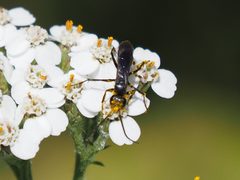
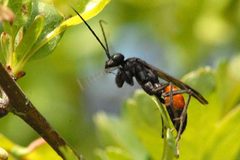
Pronunciation
How to pronounce Arachnospila fumipennis: //əˌræknoʊˈspaɪlə ˌfjuːmɪˈpɛnɪs//
These audio files are automatically generated. While they are not always 100% accurate, they are a good starting point.
Identification
Distinguished from similar ground-nesting by: circular, pencil-sized burrow entrances with symmetrical mounds of fine-textured diggings; presence of Buprestidae beetles near nest entrances (versus weevils for Cerceris bicornis or other prey types for different ); and slower, more straight-line when carrying prey compared to the erratic flight of unburdened wasps or other species. The three yellow facial markings in females are diagnostic. Burrows differ from tiger larval burrows (smaller, slightly D-shaped with beveled rim) and sand wasp burrows (angled entrance, asymmetric diggings).
Images
Appearance
Medium-sized with smoky or dark-tinted wings. Females possess three yellow facial markings; males have two. The body is adapted for digging, with modified structures for pushing soil from burrows. Wasps carrying prey appear 'thick-thoraxed' due to holding beetles upside down and -forward beneath the during .
Habitat
Prefers well-packed sandy or sandy-clay soils in sunny, open areas with sparse vegetation. Frequently nests in anthropogenic including baseball diamonds, practice fields, playgrounds, dirt roads, and campsites. Nests are typically found within flying distance of forested areas where buprestid prey occurs. Shows clear preference for certain fields within a site, with nest densities varying dramatically between adjacent areas.
Distribution
Native to North America. Present in Norway and Sweden according to GBIF distribution records. In North America, occurs across eastern U.S. and southeastern Canada, with documented in Connecticut, Missouri, Louisiana, North Carolina, Maine, Indiana, Michigan, and Ontario. Does not occur in western North America.
Seasonality
Activity period varies with latitude. In North Carolina: late May to early July. In Missouri: late May to late June, with activity dropping as buprestid activity declines. In Ontario: late June to early September. timing tied to prey availability.
Diet
of Buprestidae (jewel beetles or metallic wood-boring beetles). Documented prey includes Acmaeodera, Actenodes, Agrilus, Anthaxia, Buprestis, Chrysobothris, Dicerca, Poecilonota, and Spectralia. Occasionally captures non-buprestid prey including leaf beetles (Neochlamisus spp., Neochlamisus bebbiana) and weevils, though such records are rare.
Host Associations
- Buprestidae - preyPrimary prey ; nearly exclusive diet
- Agrilus planipennis - preyEmerald ash borer; key target for biosurveillance
- Neochlamisus platani - preyCase-bearing leaf beetle; rare non-buprestid record
- Neochlamisus bebbiana - preyLeaf beetle; documented by Careless et al.
Life Cycle
Solitary ground-nesting with one per year. Females excavate burrows 10–15 cm deep, angling to one side below the surface before leveling out. Each burrow contains one or more provisioned with paralyzed beetles. An is laid on the prey, and the cell is sealed with a plug of soil. Larva consumes the paralyzed , pupates, and emerges the following season. Nests may be provisioned with single large beetles (Buprestis, Dicerca) or multiple smaller beetles (Agrilus spp.; up to 13 recorded).
Behavior
Females hunt by capturing beetles in or vegetation, paralyzing them with a sting, and transporting them to the nest. Prey is held upside down and -forward beneath the during flight. drop prey when threatened and typically do not retrieve it, instead seeking new prey. Nests are often loosely aggregated in colonies of 5–500 individuals. Females spend time identifying their burrow among clustered nests, occasionally landing to search on foot. Males patrol nesting areas and seek mates.
Ecological Role
of buprestid beetles, potentially influencing local . Serves as an efficient sampling tool for buprestid biodiversity, with collecting beetles from difficult for human surveyors to access. May be parasitized by mutillid wasps (Dasymutilla scaevola confirmed).
Human Relevance
Primary value is as a biosurveillance tool for emerald ash borer and other or pest buprestids. The 'WaspWatchers' citizen science program trains volunteers to monitor nests and collect beetles, enabling early detection of EAB . Method provides greater effective range (1000–1500 meters) than -baited traps (~30 meters). Has facilitated discovery of new state records and rare buprestid . Does not sting humans even when handled. Proposed for use as mobile survey units through nest transplantation.
Similar Taxa
- Cerceris bicornisConstructs nearly identical burrows but is a weevil ; distinguished by presence of weevils rather than buprestids near nest entrances and faster, more powerful .
- Bembix americanaSand wasp with similar burrow appearance but burrow enters ground at angle with asymmetric diggings; no beetles found near entrance.
- Cicindelidia punctulataTiger larval burrows are smaller (~5 mm), slightly D-shaped with beveled rim, and lack diggings around entrance.
More Details
Taxonomic Note
Formerly classified as Cerceris fumipennis; transferred to Arachnospila based on phylogenetic revision of Pompilidae. The name Cerceris fumipennis remains in widespread use in applied entomology and citizen science literature.
Foraging Range
Study by Rutledge (2023) using land cover data demonstrated highest correlation between prey composition and forest composition at 1000–1500 meters from nest sites, establishing effective biosurveillance range.
Nest Architecture
Burrows are perfectly circular, pencil-sized entrances surrounded by symmetrical mounds of fine-textured diggings. Depth 10–15 cm with angled turn below surface. Distinguishable from similar burrows by prey type at entrance and female facial markings.
Sources and further reading
- BugGuide
- GBIF taxonomy match
- iNaturalist taxon
- Catalogue of Life
- Working with Cerceris fumipennis—Part 2 | Beetles In The Bush
- Working with Cerceris fumipennis—Part 1 | Beetles In The Bush
- Hymenoptera | Beetles In The Bush | Page 6
- Predatory Wasps and Citizen Scientists are Taking on the Emerald Ash Borer
- Wasp, Geographic Data Improve Surveillance for Emerald Ash Borer