
Dasymutilla scaevola
(Blake, 1871)
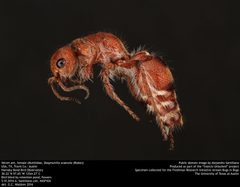
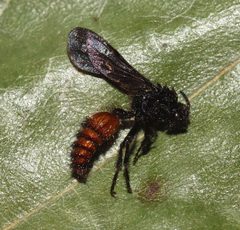
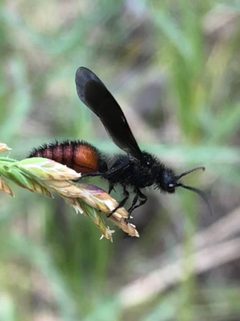
Dasymutilla scaevola is a velvet ant native to North America, widely distributed across the eastern half of the continent. Like other mutillids, females are wingless while males possess wings. The species is a that develops within the cocoons of other ground-nesting Hymenoptera. Research has demonstrated that females locate nests primarily through contact chemoreception of chemical cues from host cocoons and nest materials, rather than visual cues.
Pronunciation
How to pronounce Dasymutilla scaevola: //ˌdæsɪmjuːˈtɪlə skaiˈvoʊlə//
These audio files are automatically generated. While they are not always 100% accurate, they are a good starting point.
Images
Habitat
Associated with nests of ground-nesting Hymenoptera; occurs in environments where construct subterranean nests.
Distribution
Eastern half of North America; described as widely distributed and common across this range.
Host Associations
- Ground-nesting Hymenoptera (unidentified species) - Specific not definitively identified; development occurs within host cocoons. Research indicates strong attraction to cocoons, suggesting potential intraspecific or use of related mutillid hosts.
Life Cycle
development occurs within cocoons; females emerge from host nests and seek new host nests for oviposition. -laying is triggered by recognition of host cocoon chemical signatures.
Behavior
Females exhibit nest recognition mediated by contact chemoreception; they antennate and drum on substrate to detect chemical signals. Strong attraction to chemical cues from host cocoons and nest materials has been demonstrated experimentally, with visual cues playing no detectable role in host location.
Ecological Role
of other ; contributes to of species within ground-nesting Hymenoptera .
More Details
Chemical Recognition Research
Experimental studies have shown that Dasymutilla scaevola females use learned or innate recognition of -specific chemical signatures to locate suitable hosts. This contact chemoreception-based system allows precise targeting of host nests even when visual cues are absent.
Taxonomic Note
Only one mutillid , Dasymutilla scaevola, has been confirmed to use Cerceris fumipennis as a , though researchers suspect additional mutillid species may also parasitize this crabronid .
Sources and further reading
- BugGuide
- Wikipedia
- iNaturalist taxon
- NCBI Taxonomy
- Insect FAQs | Entomology Research Museum
- Working with Cerceris fumipennis—Part 1 | Beetles In The Bush
- Bug Eric: Wasp Wednesday: Dasymutilla bioculata
- The gloriously dichromatic Dasymutilla gloriosa | Beetles In The Bush
- A sting to kill a cow? Red velvet ant, a.k.a. cow killer, Dasymutilla occidentalis — Bug of the Week
- Mutillidae | Beetles In The Bush
- Host Nest Recognition by the Parasitoid Wasp Dasymutilla scaevola1