
Neochlamisus platani
(Brown, 1952)
sycamore leaf beetle
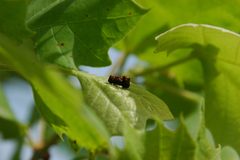
Neochlamisus platani, commonly known as the sycamore leaf beetle, is a small leaf beetle in the Chrysomelidae. are bronze to brown in color with a rough, bumpy that provides camouflage against bark and debris. The is tightly associated with its plant, the American sycamore (Platanus occidentalis), where it feeds, mates, and oviposits. Both adults and larvae consume sycamore foliage, and heavy can reduce foliage mass and damage ornamental value.
Pronunciation
How to pronounce Neochlamisus platani: /ˌniːoʊˈklæmɪˌsʌs ˈplætəˌnaɪ/
These audio files are automatically generated. While they are not always 100% accurate, they are a good starting point.
Identification
measure 3.5–4 mm in length with bronze to brown coloration. The is notably rough and bumpy, an for camouflage. The bright coppery coloration is distinctive and can help distinguish this from other Neochlamisus. When disturbed, adults retract their and fold legs and into grooves, resembling caterpillar or small bark debris. Larvae are case-bearing, constructing protective cases from their own .
Images
Habitat
Found on American sycamore (Platanus occidentalis), with a preference for young trees. Occurs in woodland edges and areas where sycamore grows.
Distribution
North America; associated with the range of its plant Platanus occidentalis, which occurs in eastern North America.
Diet
Folivore; both and larvae feed on foliage of American sycamore (Platanus occidentalis).
Host Associations
- Platanus occidentalis - obligate plant for feeding, mating, and oviposition; prefers young trees
Behavior
exhibit a distinctive defensive : when disturbed, they retract the and fold legs and into precisely matched grooves, becoming nearly indistinguishable from caterpillar or small debris. This camouflage mimicry is highly effective and may cause the to roll off leaves when fully retracted. Females oviposit on plant foliage.
Ecological Role
Herbivore on American sycamore; heavy can reduce foliage mass. Has been documented as occasional prey for the Cerceris fumipennis, a of jewel beetles (Buprestidae), though this represents a rare non-buprestid record.
Human Relevance
Considered a pest of ornamental American sycamore trees when are high, as heavy reduce foliage mass and aesthetic value.
Similar Taxa
- Neochlamisus bebbianaCongeneric in the same , also a leaf beetle with similar case-bearing larval ; distinguished by association and coloration
- Exema spp.Other warty leaf beetles in tribe Chlamisini with similar -mimicry defensive and case-bearing larvae; Exema are smaller (2–3 mm vs. 3.5–4 mm) and often associated with Asteraceae rather than Platanus