
Poecilonota
Eschscholtz, 1829
Species Guides
8- Poecilonota bridwelli
- Poecilonota californica(western poplar buprestid)
- Poecilonota cyanipes(eastern poplar buprestid)
- Poecilonota ferrea
- Poecilonota fraseri
- Poecilonota montana
- Poecilonota salixi
- Poecilonota thureura
Poecilonota is a of jewel beetles ( Buprestidae) comprising approximately 12 described distributed primarily across North America. The genus is characterized by metallic coloration and association with woody in the family Salicaceae, particularly poplars (Populus) and willows (Salix). Several species, including P. cyanipes and P. thureura, have been documented as prey of the crabronid Cerceris fumipennis, which has facilitated recent biosurveillance and collection efforts. The genus includes both widespread species and localized endemics, with P. variolosa exhibiting a broader global distribution but fragmented structure.
Pronunciation
How to pronounce Poecilonota: /ˌpɔɪ.sɪ.ləˈnoʊ.tə/
These audio files are automatically generated. While they are not always 100% accurate, they are a good starting point.
Identification
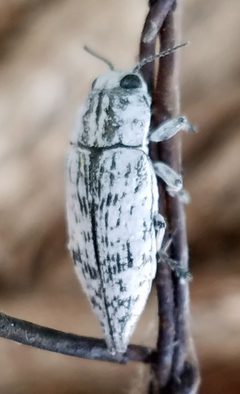
Members of Poecilonota can be distinguished from similar Buprestidae by their generally robust, somewhat flattened body form and metallic coloration ranging from coppery to bluish-green. P. cyanipes is specifically characterized by blue legs (referenced in its specific epithet) and non-angulate pronotal sides, which distinguish it from P. ferrea. P. thureura is recognized by coppery coloration with distinctly reddish, elongate elytral apices. Accurate -level identification typically requires examination of pronotal shape, elytral color patterns, and genitalia.
Images
Habitat
are defined by presence of plants in Salicaceae. P. cyanipes occurs in association with cottonwoods (Populus deltoides) and willows (Salix spp.), often in riparian or lakeside settings with trees exhibiting branch dieback. P. variolosa in Sweden shows strong preference for aspen (Populus tremula) on clear-cuts, with occurrence positively correlated with thick bark and high sun exposure; exit holes predominantly located on south-facing tree surfaces. Other occupy similar woody habitats with Populus and Salix hosts.
Distribution
North America is the primary distribution center, with ranging across much of the continent east of the Rocky Mountains and into the southwestern United States. Specific records include: Oklahoma (Beaver Dunes State Park), Missouri, Louisiana, southwestern Oklahoma (Gloss Mountains, Alabaster Caverns), northwestern Oklahoma, and California (P. viridicyanea from Yermo and Palo Verde). P. variolosa has wide global distribution including Sweden, where are classified as near threatened. GBIF records indicate presence in Norway, Sweden, Vermont (USA), and additional US locations.
Seasonality
activity occurs primarily from late May through early July, coinciding with the main activity period for North American Buprestidae. Peak abundance at specific sites (e.g., Oklahoma in early June) appears linked to seasonal timing of plant condition and rainfall patterns. Activity declines precipitously by late June to early July in Missouri.
Host Associations
- Populus - larval Primary ; includes P. deltoides (cottonwood), P. tremula (aspen), and P. trichocarpae
- Salix - larval Primary ; includes S. nigra (black willow) and other willow
- Chilopsis linearis - possible larval Desert willow; single tentative record for P. viridicyanea with disputed identification
- Robinia pseudoacacia - association onlyBlack locust; listed as in some references but considered erroneous, representing incidental presence rather than larval development
Life Cycle
Larvae develop in dead or dying branches of plants, often in association with galls made by other wood-boring beetles such as Saperda concolor in poplar or Agrilus criddlei in willow. emerge through exit holes; in P. variolosa, exit hole placement on south-facing bark surfaces suggests thermoregulatory influences on .
Behavior
are known to be dropped by Cerceris fumipennis at nest entrances when disturbed, a that has enabled efficient collection by entomologists. The wasps retrieve new prey rather than recovering dropped individuals. Adult beetles may be found on plant foliage and branches, with beating of lower branches being an effective collection method.
Ecological Role
Larvae function as wood-borers in dead and dying branches of Salicaceae, contributing to nutrient cycling in riparian and woodland . As prey of Cerceris fumipennis, Poecilonota serve as a significant food source supporting wasp , with the wasp- relationship now utilized for biosurveillance of buprestids such as emerald ash borer.
Human Relevance
in this are valued by coleopterists for their metallic appearance and have been the subject of biosystematic research. P. cyanipes was notably elusive to collectors for decades despite its purported widespread distribution, highlighting challenges in detecting even relatively common buprestid species. The genus has contributed to development of Cerceris fumipennis-based biosurveillance methods for detecting forest pests. P. variolosa is classified as near threatened in Sweden due to decline linked to changes.
Similar Taxa
- ChrysobothrisBoth contain metallic, flattened buprestids associated with woody plants; Poecilonota distinguished by more robust body form and specific associations with Salicaceae
- AgrilusBoth are common prey of Cerceris fumipennis; Poecilonota generally larger with more pronounced metallic coloration and different pronotal structure
- DicercaSimilar size and wood-boring habit; Poecilonota distinguished by coloration patterns and specificity to Salicaceae versus Dicerca's broader host range
More Details
Collection history
P. cyanipes was notably difficult to detect despite being described as the best-known American of the ; one collector failed to encounter it in 30 years of Missouri fieldwork despite extensive beating of appropriate , finally collecting it in numbers only through Cerceris fumipennis sampling and Oklahoma fieldwork during drought-stressed conditions
Taxonomic notes
The was revised by Evans (1957); Nelson (1997) described P. viridicyanea from southern California. Some records in standard references appear erroneous and have propagated through subsequent literature.
Sources and further reading
- BugGuide
- Wikipedia
- GBIF taxonomy match
- iNaturalist taxon
- NCBI Taxonomy
- Catalogue of Life
- Why did it take 30 years to collect these beetles? | Beetles In The Bush
- ID Challenge #19 | Beetles In The Bush
- Working with Cerceris fumipennis—Part 1 | Beetles In The Bush
- Working with Cerceris fumipennis—Part 2 | Beetles In The Bush
- The one that got away! | Beetles In The Bush
- iReport | Beetles In The Bush | Page 2
- Habitat preferences and conservation of the marbled jewel beetle Poecilonota variolosa (Buprestidae)