
Anthaxia
Eschscholtz, 1829
Species Guides
17Anthaxia is a large of jewel beetles ( Buprestidae, tribe Anthaxiini) containing numerous distributed across the Palearctic, Nearctic, Afrotropical, and Indomalayan regions. The genus is divided into seven subgenera: Anthaxia (Anthaxia), Haplanthaxia, Melanthaxia, Cratomerus, Merocratus, Thailandia, and Richteraxia. Species are primarily associated with woody plants, with larvae developing in dead branches or living stems of various trees and shrubs. are frequently observed visiting flowers, where they feed on pollen and nectar.
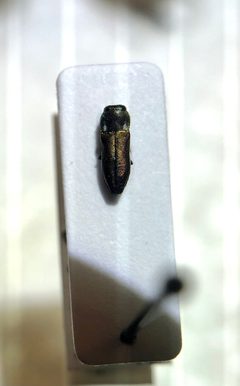
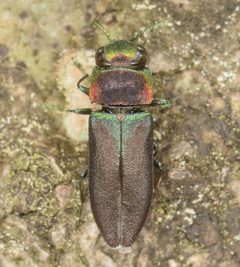
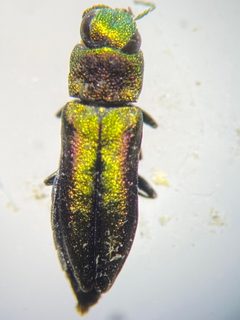
Pronunciation
How to pronounce Anthaxia: //ænˈθæk.sɪ.ə//
These audio files are automatically generated. While they are not always 100% accurate, they are a good starting point.
Identification
Anthaxia are small to medium-sized buprestids, typically measuring 4–12 mm in length. They exhibit metallic coloration ranging from green, blue, and to red or golden, often with distinctive patterns on the . The can be distinguished from related genera by a combination of characters including antennal structure, pronotal shape, and elytral . Specific identification usually requires examination of aedeagal and detailed microsculpture patterns, particularly on the pronotum. Species groups within the genus are often defined by characteristic color patterns and body proportions.
Images
Habitat
occur in diverse including deciduous and mixed forests, woodlands, meadows with scattered shrubs, riparian corridors, and glades. Many species are associated with specific plant , occurring in oak woodlands, riparian forests with birch and hornbeam, or Mediterranean scrub with various shrubs. Elevation ranges vary by species, with some restricted to lowland areas below 800 m and others occurring in hilly or lower mountain zones.
Distribution
Widespread across the Palearctic region (Europe, North Africa, temperate Asia), Nearctic (North America), Afrotropical (Sub-Saharan Africa, particularly associated with Acacia), and Indomalayan (tropical Asia including Vietnam, Indonesia, Philippines) regions. European distribution excludes the Scandinavian Peninsula and British Islands for some groups. Specific distribution patterns vary considerably among subgenera and species groups.
Seasonality
activity periods vary by region and , with most temperate zone species active from late spring through summer (May–August). Peak activity often coincides with flowering periods of -associated plants. Some species have been documented as active in June in North American .
Diet
feed on pollen and nectar from flowers. Larvae are wood-borers, developing in dead branches, twigs, or living stems of woody plants.
Host Associations
- Acer - larval Acer undulatum confirmed for A. midas midas
- Betula - larval Betula nigra for A. (Haplanthaxia) cyanella
- Ostrya - larval Ostrya virginiana
- Carpinus - larval Carpinus caroliniana
- Cercocarpus - larval Mountain mahogany; A. (Melanthaxia) porella and A. (Melanthaxia) simiola associated exclusively
- Crataegus - association on flowers
- Rosa - association on flowers
- Fragaria - associationA. suzannae on Fragaria vesca flowers
- Acacia - larval Afrotropical associated with Acacia (Fabaceae)
- Ulmus - larval Implied by A. ulmi epithet
- Cupressus - larval Implied by A. cupressi epithet
Life Cycle
Larvae develop as wood-borers in plants, typically in dead branches or twigs, though some tunnel in living stems or main roots. Larval development duration varies by species and climate. emerge through characteristic exit holes in the bark. Specific details on -laying and sites are poorly documented for most species.
Behavior
are and frequently observed visiting flowers, where they feed on pollen and nectar. They are capable of rapid, agile . When disturbed on branches, individuals typically dodge to the backside of the branch and will quickly fly away if alarmed. Some are extremely wary and difficult to approach for observation or photography. Flower-visiting is particularly well-documented in the subgenera Haplanthaxia and Melanthaxia.
Ecological Role
As larvae, Anthaxia contribute to wood decomposition and nutrient cycling in forest . As , they may function as during flower visitation. Their specialized associations make them indicators of particular plant types and conditions.
Human Relevance
Some are considered minor pests of fruit trees (Malus, Pyrus, Prunus) and forestry trees, though damage is generally limited. The is of significant interest to coleopterists and biodiversity researchers due to its and complex . Several species are rare or have restricted distributions, making them of conservation concern in some regions.
Similar Taxa
- AcmaeoderaAlso flower-visiting buprestids with metallic coloration; Acmaeodera typically has more elongate body form and different elytral punctation patterns
- AgrilaxiaSimilar small size and flower-visiting ; distinguished by antennal and pronotal characters
- ChrysobothrisLarger buprestids with some overlap; Chrysobothris generally more robust with different antennal structure and larval galleries in cambium rather than deep wood
More Details
Subgeneric classification
The contains seven subgenera: Anthaxia (Anthaxia) Eschscholtz, 1829; Haplanthaxia Reitter, 1911; Melanthaxia Richter, 1944; Cratomerus Solier, 1833; Merocratus Bílý, 1989; Thailandia Bílý, 1990; and Richteraxia Bílý, 2019. Subgenera are distinguished by combinations of morphological characters including body form, antennal structure, and male genitalia.
Taxonomic complexity
Anthaxia is taxonomically challenging due to high , subtle morphological differences among , and extensive synonymy. Many species groups have been revised in recent decades, including the midas, manca, candens, salicis, and winkleri groups. Accurate identification often requires examination of and detailed study of genitalic .
Collection and observation
are best collected by beating foliage and branches of plants, or by sweeping flowers during peak bloom periods. Rearing from dead branches collected in winter and held in chambers is productive for obtaining series of specimens and confirming host associations. Some are extremely rare in collections, known only from or very few records.
Sources and further reading
- BugGuide
- Wikipedia
- GBIF taxonomy match
- iNaturalist taxon
- NCBI Taxonomy
- Catalogue of Life
- A flower visiting jewel beetle that is not an Acmaeodera | Beetles In The Bush
- Winter Botany Quiz #6 – answers and a checklist | Beetles In The Bush
- The perfectly polyphagous Chrysobothris purpureovittata | Beetles In The Bush
- Hiking at Don Robinson State Park | Beetles In The Bush
- Let’s make a deal! | Beetles In The Bush
- One-shot Wednesday: The “other” hibiscus jewel beetle | Beetles In The Bush
- A revision of the Anthaxia (Anthaxia) midas Kiesenwetter, 1857 species-group (Coleoptera: Buprestidae: Anthaxiini)
- Two new species in the Anthaxia (Anthaxia) manca (Linnaeus, 1767) species-group from China (Coleoptera: Buprestidae)
- Revision of Anthaxia salicis Species Complex in Romania, with the first record of Anthaxia Suzannae (Coleoptera: Buprestidae)
- Two new species in the Anthaxia (Anthaxia) candens (Panzer, 1793) species-group from Iran and Turkey, with taxonomic notes on the group (Coleoptera: Buprestidae)
- The Anthaxia (Anthaxia) manca (Linnaeus, 1767) species-group in Iran, with description of a new species and a new synonymy (Coleoptera: Buprestidae)
- Description of a new species of <i>Anthaxia</i> Eschscholtz, 1829 from Jordan, with notes on the <i>Anthaxia winkleri</i> species-group (Coleoptera, Buprestidae)
- Taxonomic notes on the genus Anthaxia Eschscholtz, 1829 (Coleoptera: Buprestidae: Anthaxiini) 1.
- A NEW ANTHAXIA FROM THE AEOLIAN ISLANDS (COLEOPTERA, BUPRESTIDAE)
- Three new species of Anthaxia Eschscholtz, 1829 from Iran (Coleoptera: Buprestidae)
- DESCRIPTION OF TWO NEW SPECIES FROM THE ANTHAXIA WINKLERI SPECIES-GROUP (COLEOPTERA, BUPRESTIDAE)
- A new species of the genus Anthaxia Eschscholtz, 1829 from Mauritania (Coleoptera: Buprestidae: Anthaxiini)
- A study on the genus Anthaxia (Merocratus) Bílý 1989 (Coleoptera: Buprestidae: Anthaxiini)
- Two New Species of the Genus Philanthaxia Deyrolle, 1864, from Hainan Province, China (Coleoptera, Buprestidae, Thomassetiini).
- A new species of Anthaxia (Merocratus) Bílý, 1989 (Coleoptera, Buprestidae, Anthaxiini) from Vietnam.