
Agrilaxia
Kerremans, 1903
Species Guides
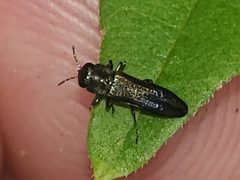
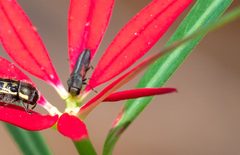
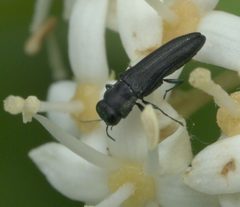
4Agrilaxia is a of jewel beetles ( Buprestidae) containing approximately 80 described distributed primarily in the Neotropical region. The genus was established by Kerremans in 1903 and belongs to the tribe Anthaxiini. Species are typically small, often metallic beetles. Several species have been documented visiting flowers, a that is relatively uncommon among buprestid beetles. The genus has been subject to taxonomic revision, with recent work describing new species from French Guiana and clarifying relationships with related genera such as Anthaxia.
Pronunciation
How to pronounce Agrilaxia: /ˌæɡrɪˈlæksiə/
These audio files are automatically generated. While they are not always 100% accurate, they are a good starting point.
Identification
Agrilaxia are small buprestid beetles, typically under 10 mm in length. They can be distinguished from the closely related Anthaxia by subtle differences in antennal structure and male genitalia . Species within Agrilaxia often exhibit metallic green, blue, or coloration. Accurate identification to species level generally requires examination of male genitalia and comparison with . The genus was historically confused with Anthaxia, and some species were transferred between these genera based on revised taxonomic understanding.
Images
Distribution
The is primarily Neotropical in distribution, with records from Mexico, Central America, South America, and the Caribbean. Specific distributional records include French Guiana, Argentina, Brazil, Peru, Ecuador, Bolivia, Colombia, Rica, Panama, and Oklahoma (USA). The northernmost records in North America appear to be limited to the southern Great Plains region of the United States.
Behavior
Several in this have been observed visiting flowers, including Agrilaxia flavimana which has been collected from flowers of Torilis arvensis and other herbaceous plants. This flower-visiting is notable as it is relatively uncommon among Buprestidae, which are predominantly associated with woody vegetation. of at least some species feed on pollen and floral tissues.
Human Relevance
Agrilaxia are of interest to coleopterists studying buprestid diversity and flower-visiting in jewel beetles. The has been involved in taxonomic nomenclatural discussions, particularly regarding species transferred from Anthaxia. Some species are known from designated by Antonio Cobos Sánchez, a prolific 20th-century student of Buprestidae.
Similar Taxa
- AnthaxiaHistorically confused with Agrilaxia; have been transferred between these . Anthaxia species also visit flowers and share similar small size and metallic coloration. Distinguished by antennal structure and male genitalia .
- AcmaeoderaAnother of flower-visiting buprestids with similar habits, but Acmaeodera is more diverse in western North America and typically exhibits more pronounced yellow or red elytral patterning.
- AgrilusLarger of wood-boring buprestids; some Agrilus also visit flowers but are generally larger and associated with different larval .
More Details
Taxonomic history
The has undergone significant taxonomic revision. Antonio Cobos Sánchez described numerous in this genus between 1972 and 1986. The species Anthaxia monrosi Cobos, 1972 was subsequently transferred to Agrilaxia. Recent taxonomic work by Bílý and Westcott (2005) and others has continued to clarify species boundaries.
Research significance
A 2016 study in Zootaxa described four new from French Guiana (A. angustiptera, A. antennata, A. nigra, and A. nigropurpurea) and provided the first illustration of male genitalia for A. chrysifrons, demonstrating ongoing discovery of new diversity in this .
Sources and further reading
- BugGuide
- Wikipedia
- GBIF taxonomy match
- iNaturalist taxon
- NCBI Taxonomy
- Catalogue of Life
- ID Challenge #19 | Beetles In The Bush
- A flower visiting jewel beetle that is not an Acmaeodera | Beetles In The Bush
- 2019 Arkansas/Oklahoma Insect Collecting Trip iReport | Beetles In The Bush
- Buprestidae type specimens at Fundación Miguel Lillo, Argentina | Beetles In The Bush
- A study of the genus Agrilaxia Kerremans, 1903 from French Guiana (Coleoptera: Buprestidae: Anthaxiini)