
Brochymena
Amyot & Serville, 1843
Rough Stink Bugs, Tree Stink Bugs, Four-humped Stink Bugs
Species Guides
16- Brochymena affinis(rough stink bug)
- Brochymena arborea(rough stink bug)
- Brochymena barberi(rough stink bug)
- Brochymena cariosa
- Brochymena carolinensis(Carolina rough stink bug)
- Brochymena chelonoides(rough stink bug)
- Brochymena dilata
- Brochymena diluta
- Brochymena florida
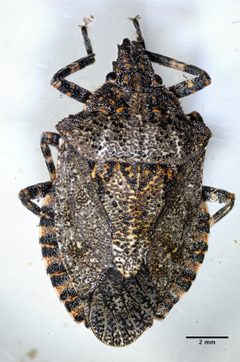
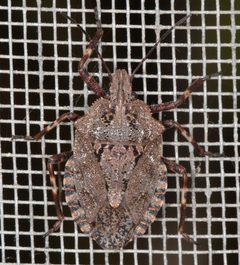
Brochymena is a of native North American stink bugs commonly called rough stink bugs or tree stink bugs. are cryptically colored to resemble lichen-mottled bark, with gray coloration and black and white or ivory speckling. They are frequently confused with the brown marmorated stink bug (Halyomorpha halys), but can be distinguished by the absence of white antennal bands and the presence of fine teeth along the leading edge of the pronotum. The genus currently contains approximately 20 following taxonomic revision that split some former members into the related genus Parabrochymena.

Pronunciation
How to pronounce Brochymena: //broʊˈkɪmɪnə//
These audio files are automatically generated. While they are not always 100% accurate, they are a good starting point.
Identification
Distinguished from the brown marmorated stink bug (Halyomorpha halys) by two key characters: (1) are uniformly dark without the white bands present on the last two antennal segments of BMSB, and (2) the leading edge of the pronotum has fine teeth in Brochymena but is smooth in BMSB. Brochymena also lacks the distinctive black and white banding on the legs seen in BMSB nymphs. -level identification within Brochymena is difficult and typically requires microscopic examination of dead specimens.
Images
Habitat
Primarily arboreal; associated with trees and shrubs. overwinter beneath loose bark on trees, in woodpiles, rodent nests, and other sheltered outdoor . Unlike the brown marmorated stink bug, they rarely enter buildings in large numbers, though individuals may occasionally be transported indoors with firewood.
Distribution
to the New World; found throughout North America north of Mexico. Individual have more restricted ranges. Some species also occur in Central America, with records from Africa and Oceania for at least one species (B. quadripustulata) according to some sources.
Seasonality
are active in spring and fall when emerging from and entering hibernation. They may be observed on warm, sunny winter days. One per year in temperate climates; development from to adult is relatively long.
Life Cycle
are laid in small clusters on twigs of trees. Nymphs progress through four instars before reaching adulthood. Development from egg to is surprisingly long, resulting in a single annually in temperate regions. Adults overwinter and resume activity in spring.
Behavior
fly well and may alight on fences, sidewalks, or other contrasting substrates where they become visible. They are capable of withstanding freezing temperatures; specimens have been observed to survive extended periods in freezing conditions and revive when warmed. When disturbed, they can deploy to emit a defensive odor. They are gregarious in winter, aggregating beneath bark and in other sheltered locations.
Ecological Role
Suspected to feed on sap of trees and shrubs. There are persistent observations suggesting occasional predatory or scavenging on other insects, which would be consistent with opportunistic feeding habits seen in many true bugs. Serve as prey for various including the sand wasp Bicyrtes quadrifasciata, birds, and fence lizards. Subject to by tachinid flies (Trichopoda spp.) and including platygastrid (Trissolcus brochymenae, Telenomus spp.) and eupelmid wasps (Anastatus reduvii).
Human Relevance
Not considered an agricultural or structural pest. Occasionally enters homes with firewood but does not establish indoor . Frequently mistaken for the brown marmorated stink bug, leading to unnecessary concern. No economic damage reported; considered innocuous native insects of non-economic importance.
Similar Taxa
- Halyomorpha halys (Brown Marmorated Stink Bug) from Asia; distinguished by white-banded , smooth pronotal margin without teeth, and tendency to aggregate in large numbers on buildings in fall. Brochymena has uniformly dark antennae, toothed pronotal margin, and rarely enters structures.
- ParabrochymenaFormerly included in Brochymena; separated based on morphological characters in taxonomic revision. Ten transferred to this new .
- Other native stink bug generaVarious native Pentatomidae may resemble Brochymena superficially, but Brochymena is distinguished by its rough, bark-like texture and specific pronotal and antennal characters.
Misconceptions
Frequently mistaken for the brown marmorated stink bug due to general similarity in body shape and size. This confusion leads to misidentification of harmless native insects as pests. The '' applied to both groups contributes to this misconception, though Brochymena poses no economic or nuisance threat comparable to BMSB.
More Details
Taxonomic History
The underwent significant revision in 1994, when the new genus Parabrochymena was erected to accommodate 10 formerly placed in Brochymena. Four synonymies were established within Brochymena, and the genus was redefined to contain 20 species. Species-level identification remains challenging and typically requires microscopic examination.
Cold Hardiness
Brochymena demonstrates remarkable cold . Specimens have survived extended freezing periods and revived when removed from frozen conditions, an that facilitates beneath bark in temperate climates.
Research Limitations
As insects of no economic importance, relatively little research has been conducted on Brochymena and natural history compared to pest . Basic questions about feeding habits, plant associations, and remain incompletely documented.
Sources and further reading
- BugGuide
- Wikipedia
- GBIF taxonomy match
- iNaturalist taxon
- NCBI Taxonomy
- A different stink bug on the move in the kitchen: four-humped stink bug, Brochymena quadripustulata — Bug of the Week
- Bug Eric: Rough Stink Bugs
- Bug Eric: Wasp Wednesday: Neorileya
- Bug Eric: Indoor Insects of Autumn (part 3 of 4)
- Bug Eric: October 2009
- Bug Eric: 2009
- Life History and Laboratory Rearing of Brochymena quadripustulata with Descriptions of Immature Stages and Additional Notes on Brochymena arborea (Hemiptera: Pentatomidae)1
- PARABROCHYMENA LARIVIÈRE (HEMIPTERA: PENTATOMIDAE): SYSTEMATICS, NATURAL HISTORY, CHOROLOGICAL AFFINITIES, AND EVOLUTIONARY RELATIONSHIPS, WITH A BIOGEOGRAPHIC ANALYSIS OF PARABROCHYMENA AND BROCHYMENA AMYOT AND AUDINET-SERVILLE
- DESCRIPTION OFPARABROCHYMENA, NEW GENUS, AND REDEFINITION AND REVIEW OFBROCHYMENAAMYOT AND AUDINET-SERVILLE (HEMIPTERA: PENTATOMIDAE), WITH CONSIDERATIONS ON NATURAL HISTORY, CHOROLOGICAL AFFINITIES, AND EVOLUTIONARY RELATIONSHIPS