
Trichopoda
Berthold, 1827
feather-legged flies, hairy-legged flies
Species Guides
5- Trichopoda indivisa(feather-legged fly)
- Trichopoda lanipes(feather-legged fly)
- Trichopoda pennipes(feather-legged fly)
- Trichopoda plumipes(feather-legged fly)
- Trichopoda subdivisa(fringe-legged tachinid fly)
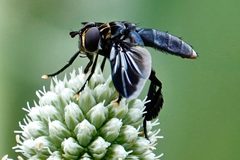
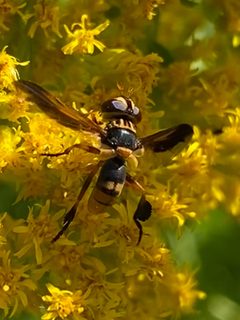
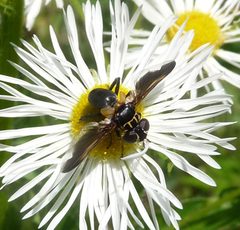
Trichopoda is a of tachinid flies in the Phasiinae, native to the Americas. are small, brightly colored flies that feed on nectar and are distinguished by yellow-scaled and a fringe of flattened, feather-like hairs on the hind legs. The genus comprises approximately 25 valid divided into two subgenera: Galactomyia and Trichopoda sensu stricto. Larvae are of true bugs (Hemiptera), particularly stink bugs (Pentatomidae) and leaf-footed bugs (Coreidae), making several species important agents.
Pronunciation
How to pronounce Trichopoda: /trɪˈkɒpəda/
These audio files are automatically generated. While they are not always 100% accurate, they are a good starting point.
Identification
Distinguished from other tachinid by the combination of yellow-scaled and the distinctive fringe of flattened, feather-like hairs on the hind legs. The subgenera Galactomyia and Trichopoda s. str. can be separated by morphological characters of the male and female terminalia. -level identification requires examination of genitalia and is complicated by historical synonymies and misidentifications.
Images
Habitat
frequent flowers, particularly goldenrods and other late-season nectar sources. Larval is within the bodies of true bugs.
Distribution
Native to North and South America (Neotropical and Nearctic regions). Some , notably Trichopoda pennipes and T. pictipennis, have been introduced to Europe and the western Palearctic region for of pest stink bugs.
Seasonality
active during warmer months, with peak activity in late summer and autumn when they congregate on flowering plants to feed on nectar before winter.
Diet
feed on nectar from flowers. Larvae develop internally within true bugs, feeding on host tissues.
Host Associations
- Nezara viridula - Southern green stink bug, major for
- Halyomorpha halys - Brown marmorated stink bug, pest in North America and Europe
- Anasa tristis - Squash bug, significant agricultural pest
- Piezodorus guildinii - Redbanded stink bug, unusual record
- Leptoglossus spp. - Leaf-footed bugs
- Acanthocephala spp. - Leaf-footed bugs
Life Cycle
Females deposit on the surface of true bugs, typically behind the where the cannot groom them off. Eggs hatch and larvae bore through the egg shell and host to develop internally as . Larval development is completed within the host, after which mature larvae exit the host, drop to the ground, and pupate in the soil. Adults emerge from to feed, mate, and seek new hosts. Development time from egg to adult varies by and temperature.
Behavior
locate by exploiting produced by true bugs for mating and defense. Females have been observed responding to these chemical cues to find suitable hosts for oviposition. Adults are and frequently observed feeding on nectar at flowers, particularly composites in the Asteraceae .
Ecological Role
Important of pestiferous true bugs, particularly stink bugs and leaf-footed bugs. Several serve as significant agents in programs for agricultural pests. The introduction of T. pennipes and T. pictipennis to Europe for control of Nezara viridula represents a program.
Human Relevance
Valued as agents against agricultural pests including stink bugs and squash bugs. Trichopoda pennipes has been introduced to Europe and is being evaluated for control of the brown marmorated stink bug in North America. are harmless to humans and beneficial in gardens and agricultural settings.
Similar Taxa
- EutrichopodaRelated in the same tribe (Trichopodini), distinguished by morphological characters of the terminalia and leg chaetotaxy
- EctophasiopsisRelated in the same tribe, also of Hemiptera but with different morphological features
- HomogeniaFormerly included now placed in this separate ; distinguished by wing venation and body shape
More Details
Taxonomic History
The has undergone significant revision, with many synonymized and others transferred to different genera. A 2021 revision recognized 25 valid species, described 12 new species, and redefined subgeneric compositions. Historical misidentifications have complicated programs.
Subgeneric Classification
Two subgenera are recognized: Galactomyia (primarily Neotropical with modified terminalia) and Trichopoda s. str. (including T. pennipes and related species). The subgeneric placement of Nearctic species remains stable, while Neotropical species were largely reassigned to Galactomyia.
Insecticide Sensitivity
Laboratory studies indicate T. pennipes is highly susceptible to spinosad and , but can survive exposure to . This has implications for in organic and conventional agriculture.
Sources and further reading
- BugGuide
- Wikipedia
- GBIF taxonomy match
- iNaturalist taxon
- NCBI Taxonomy
- Catalogue of Life
- Bugs better beware of feisty feather-legged flies, Trichopoda pennipes — Bug of the Week
- Archive — Bug of the Week
- Squash Bugs Still Making Growers Crazy After All These Years
- Bug Eric: Rough Stink Bugs
- Amborella trichopoda
- Feeding Responses of Trichopoda pennipes (F.) (Diptera: Tachinidae) to Selected Insecticides
- Laboratory Effects of Two Organically-Certified Insecticides on Trichopoda pennipes (Diptera: Tachinidae)
- First report of Trichopoda pictipennis (Diptera, Tachinidae) for the Canary Islands
- Taxonomic revision of the genus Trichopoda Berthold, 1827 (Diptera: Tachinidae: Phasiinae), with emphasis on the Neotropical fauna
- Piezodorus guildinii (Hemiptera: Pentatomidae): An Unusual Host of the Tachinid Trichopoda pennipes
- Distribución actualizada y fenología de Trichopoda pennipes (Fabricius, 1781) (Diptera: Tachinidae) en la Península Ibérica
- Parasitic Castration of Anasa tristis DeG. by Trichopoda pennipes Fab., and Its Effect on Reproduction12
- Polymorphism on Nezara viridula (L.) and its parasitoid Trichopoda pennipes Fabr.
- Insights into Genetics of Floral Development in Amborella trichopoda Baill through Genome-wide Survey and Expression Analysis of MADS-Box Transcription Factors
- Susceptibility of Pest Nezara viridula (Heteroptera: Pentatomidae) and Parasitoid Trichopoda pennipes (Diptera: Tachinidae) to Selected Insecticides
- Trait coordination, mechanical behaviour and growth form plasticity ofAmborella trichopodaunder variation in canopy openness