
Trichopoda lanipes
(Fabricius, 1805)
feather-legged fly
Trichopoda lanipes is a tachinid fly distributed across North America, from Canada through the United States to Mexico. As a member of the feather-legged fly Trichopoda, it is a of true bugs (Hemiptera), including stink bugs (Pentatomidae) and leaf-footed bugs (Coreidae). The species has been documented as a parasitoid of several specific species including Acanthocephala femorata, Archimerus alternatus, Nezara viridula, and Podisus maculiventris.
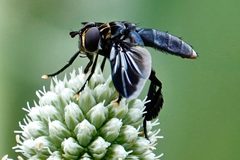
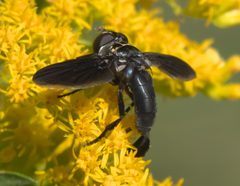
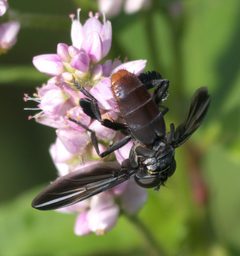
Pronunciation
How to pronounce Trichopoda lanipes: //ˌtrɪkoʊˈpoʊdə ˈlæniˌpiːz//
These audio files are automatically generated. While they are not always 100% accurate, they are a good starting point.
Identification
Distinguished from other tachinid flies by the prominent feather-like setae on the hind legs. Separated from the similar and widespread Trichopoda pennipes by geographic and associations, though precise morphological distinctions between these require expert examination. The orange and black coloration is shared with other Trichopoda species. Identification to species level typically requires reference to specialized taxonomic keys for the .
Images
Appearance
possess the characteristic feather-like fringe of setae on the hind tibiae and that gives the its . The body is typically orange and black in coloration. Like other Trichopoda , females have a flattened, somewhat triangular adapted for depositing on . The overall body form is compact with a rounded and large typical of tachinid flies.
Habitat
Associated with where true bugs occur, including agricultural fields, gardens, and natural areas with flowering plants. frequent flowers, particularly goldenrods (Solidago spp.) and other late-season nectar sources. The occurs in diverse environments across its broad North American range, from temperate to subtropical conditions.
Distribution
North America: Canada, United States, and Mexico. Records indicate presence across a broad geographic range spanning from northern Canada to southern Mexico.
Seasonality
are active during late summer and autumn, coinciding with the seasonal availability of nectar sources such as goldenrods and the presence of adult . This timing aligns with the period when hosts are preparing for and when activity is critical for .
Diet
feed on nectar and pollen, particularly from late-blooming flowers such as goldenrods. Larvae are internal that develop within the bodies of true , feeding on host tissues.
Host Associations
- Acanthocephala femorata - Leaf-footed bug (Coreidae)
- Archimerus alternatus -
- Nezara viridula - Southern green stink bug (Pentatomidae), major agricultural pest
- Podisus maculiventris - Spined soldier bug (Pentatomidae), a predatory beneficial
Life Cycle
Females deposit directly on the exterior of true . Eggs hatch and larvae bore through the host to develop internally, feeding on host tissues. Mature larvae exit the host, drop to the soil, and pupate within a formed from the larval skin. Adults emerge from soil puparia to feed, mate, and locate new hosts. Host death typically results from .
Behavior
Females actively seek for oviposition, likely using chemical cues including produced by host true bugs. are strong fliers and visit flowers for nectar feeding. The exhibits kleptoparasitic associations indirectly through its host-finding , though the flies themselves are not kleptoparasites.
Ecological Role
Acts as a agent of pest true bugs, including stink bugs that damage crops. By parasitizing both pest (Nezara viridula) and beneficial predatory species (Podisus maculiventris), it functions as a with complex trophic interactions. Contributes to natural suppression of true in agricultural and natural .
Human Relevance
Potential value as a native agent for agricultural pests such as stink bugs. The Trichopoda pennipes is well-documented in biological control programs; T. lanipes likely serves similar functions within its range. Not known to cause direct harm to humans or domestic animals.
Similar Taxa
- Trichopoda pennipesExtremely similar with overlapping geographic range and preferences; distinguished by subtle morphological features and potentially by host associations, though precise field identification is difficult
- Other Trichopoda speciesShared characteristics including feathery hind legs and orange-black coloration; -level identification requires expert examination
More Details
Taxonomic note
The variety Trichopoda lanipes var. tropicalis Townsend, 1897 is now considered a synonym of the nominate .