
Trichopoda pennipes
(Fabricius, 1781)
feather-legged fly
Trichopoda pennipes is a tachinid fly native to North and South America that has been introduced to Europe and other regions as a agent. feed on nectar and are active from late spring through autumn. Females deposit on true bugs, particularly stink bugs and squash bugs, and the developing larvae act as internal that eventually kill their . The is notable for its feather-like hind leg fringes and is considered a valuable natural enemy of agricultural pests, though its effectiveness varies by region and host species.
Pronunciation
How to pronounce Trichopoda pennipes: /ˌtraɪkəˈpoʊdə ˈpɛnɪˌpiz/
These audio files are automatically generated. While they are not always 100% accurate, they are a good starting point.
Identification
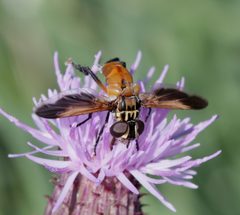
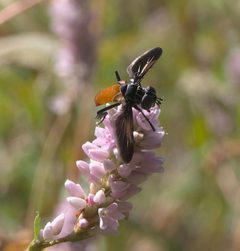
Medium-sized fly approximately 10.5 mm in length, comparable to a large housefly. velvety black with large brown showing yellow between them. black or brown with yellow stripes. slender and variable in color from bright orange to completely black; females typically have a dark-tipped abdomen while males show a dark orange apex. Wings transparent and smoky with prominent ; females have evenly dusky wings with sub-hyaline margin, males display ferrugineous wing markings. notably large. Legs black with yellow feet; hind legs bear a prominent feather-like fringe of flattened hairs, the ' most distinctive feature.
Images
Habitat
Grasslands, hedgerows, and agricultural crops where true bugs are present. Strongly associated with flowering plants that provide nectar, particularly goldenrods, Anne's lace, and meadowsweet.
Distribution
Native to North America (United States, Mexico), Hawaiian Islands, and South America. Introduced to southern Europe including France, Italy, Spain, and subsequently recorded in Albania, Cyprus, Greece, Russia, Turkey, and Egypt. Expanding distribution in the Western Palearctic with new records from citizen science contributing to range mapping.
Seasonality
First appears in late spring or early summer. Active through autumn, with up to three per year in favorable conditions. Overwinters as second instar larva within the body of .
Diet
feed on nectar from flowers including Anne's lace (Daucus carota) and meadowsweet (Filipendula ulmaria). Larvae are obligate internal that consume tissues of true .
Host Associations
- Nezara viridula - primary southern green stink bug, principal with rates up to 93%
- Anasa tristis - squash bug, rates up to 80%
- Halyomorpha halys - brown marmorated stink bug, deposited but rarely successful
- Leptoglossus occidentalis - western conifer seed bug
- Largus succinctus - bordered plant bug, parasitized by northern California
- Piezodorus guildinii - redbanded stink bug, recorded as unusual
Life Cycle
Females deposit several small, pale, oval on large nymphs or , most commonly on the . Upon hatching, larvae burrow into the ; if multiple larvae enter, typically only one survives. Larva feeds internally on host tissues, causing reproductive organ by second instar. Cream-colored larva emerges from host, drops to ground, and pupates in reddish-brown formed from last larval skin. Host dies following larval . Adult emerges after approximately two weeks. Females may lay several hundred eggs total across their lifetime. Up to three per year; overwinters as second instar larva within host.
Behavior
hover over vegetation searching for suitable on which to oviposit. Females attracted to produced by male true bugs, resulting in higher rates of male hosts. Exhibits oviposition (multiple per host) though only one larva typically survives per host. Different across the United States show regional host preferences.
Ecological Role
of true bugs in Coreidae, Pentatomidae, Largidae, and Scutelleridae. Contributes to natural suppression of agricultural pest . Part of native enemy complex against stink bugs including brown marmorated stink bug.
Human Relevance
Used as agent for and squash bug pests in agriculture. Conservation of through reduced use, particularly avoiding spinosad and which are highly toxic to ; appears safer. Effectiveness limited by delayed mortality—parasitized continue feeding and reproducing, and transmission by like squash bug may continue. Most effective when nymphs are parasitized, as half die before adulthood.
Similar Taxa
- Other Trichopoda speciesshare feather-legged but differ in associations and distribution; T. pennipes distinguished by specific hind leg fringe structure and orange/black coloration pattern
- Other tachinid parasitoids of true bugslack the prominent feather-like hind leg fringes that give T. pennipes its
Sources and further reading
- BugGuide
- Wikipedia
- GBIF taxonomy match
- NCBI Taxonomy
- Bugs better beware of feisty feather-legged flies, Trichopoda pennipes — Bug of the Week
- Squash Bugs Still Making Growers Crazy After All These Years
- Polymorphism on Nezara viridula (L.) and its parasitoid Trichopoda pennipes Fabr.
- Feeding Responses of Trichopoda pennipes (F.) (Diptera: Tachinidae) to Selected Insecticides
- Laboratory Effects of Two Organically-Certified Insecticides on Trichopoda pennipes (Diptera: Tachinidae)
- Piezodorus guildinii (Hemiptera: Pentatomidae): An Unusual Host of the Tachinid Trichopoda pennipes
- Distribución actualizada y fenología de Trichopoda pennipes (Fabricius, 1781) (Diptera: Tachinidae) en la Península Ibérica
- First detection of the Nearctic parasitoid species Trichopoda pennipes (Fabricius) (Diptera: Tachinidae) in Egypt
- Parasitic Castration of Anasa tristis DeG. by Trichopoda pennipes Fab., and Its Effect on Reproduction12
- The Biology of Trichopoda Pennipes Fab. (Diptera, Tachinidæ), aParasite of the Common Squash Bug
- Susceptibility of Pest Nezara viridula (Heteroptera: Pentatomidae) and Parasitoid Trichopoda pennipes (Diptera: Tachinidae) to Selected Insecticides
- Superparasitization of the Southern Green Stink Bug by the Tachinid Parasite Trichopoda pennipes pilipes and Its Effect on the Host and Parasite Survival123
- The Biology of Trichopoda Pennipes Fab. (Diptera, Tachinidæ),A Parasite of the Common Squash Bug
- Parasitism of the Invasive Brown Marmorated Stink Bug, Halyomorpha halys (Hemiptera: Pentatomidae), by the Native Parasitoid, Trichopoda pennipes (Diptera: Tachinidae)
- Filling the gaps in the distribution of an alien species: The case of the feather-legged fly Trichopoda pennipes (Diptera: Tachinidae) in the Western Palearctic
- First record of the feather-legged fly Trichopoda pennipes (Fabricius, 1781) (Diptera Tachinidae) a parasitoid of the southern green stink bug Nezara viridula (Linnaeus, 1758) (Hemiptera Pentatomidae) in Algeria
- Success of parasitism of Nezara viridula and Halyomorpha halys (Hemiptera: Pentatomidae) by Trichopoda pennipes (Diptera: Tachinidae) in the southeastern United States
- First Description of the Nuclear and Mitochondrial Genomes and Associated Host Preference of Trichopoda pennipes, a Parasitoid of Nezara viridula.