
Phasiinae
bug-killing flies
Tribe Guides
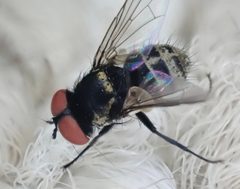
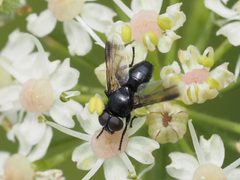
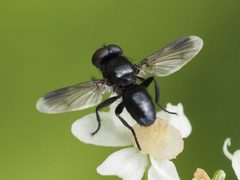
6Phasiinae is a of tachinid flies (Diptera: Tachinidae) comprising endoparasitoid that primarily attack Heteroptera (true bugs). Members are commonly known as "-killing flies" and include important agents of agricultural pests. The subfamily contains multiple tribes including Phasiini, Gymnosomatini, Trichopodini, Strongygastrini, and Parerigonini. Most species possess specialized adaptations for life, including piercing structures for direct insertion into tissues.
Pronunciation
How to pronounce Phasiinae: //fæˈsaɪ.ɪniː//
These audio files are automatically generated. While they are not always 100% accurate, they are a good starting point.
Identification
Phasiinae can be distinguished from other tachinid by the elongated medial plate of the hypandrium in males, a potential morphological synapomorphy. Some exhibit bright coloration and feather-like setae on the hind tibia (e.g., Trichopoda). The subfamily historically caused taxonomic confusion due to conflicting character states and convergent with other tachinid groups. Molecular now supports the placement of Strongygastrini and Parerigonini within Phasiinae, while Eutherini and Epigrimyiini have been excluded.
Images
Distribution
Worldwide distribution with representatives in the Neotropical, Nearctic, Palearctic, Afrotropical, Oriental, and Australasian regions. The Trichopoda is natively distributed in the Americas. Specific geographic ranges vary by tribe and genus.
Host Associations
- Heteroptera - primary True bugs; primary target for most Phasiinae except Strongygastrini
- Corecoris batatas - Coreidae; documented for Trichopoda
- Anasa tristis - squash bug; documented for Trichopoda
- Nezara viridula - southern green stink bug (Pentatomidae); documented for Trichopoda
- Brochymena spp. - Pentatomidae; documented for Trichopoda
- Largus californicus - Largidae; documented for Trichopoda
Behavior
females use piercing structures to insert directly into tissues; these structures have evolved independently in multiple lineages and have been lost or reduced in others. Some have been observed using host for host-finding.
Ecological Role
agents of agricultural pest Hemiptera, particularly Heteroptera. of true bugs in natural and agricultural .
Human Relevance
Important for programs targeting agricultural pests such as stink bugs (Pentatomidae) and squash bugs (Coreidae). of Trichopoda and related are utilized or studied for pest management. Taxonomic instability has historically hindered research into their practical application.
Similar Taxa
- DexiinaeHistorically confused with Phasiinae; Litophasia Girschner transferred from Phasiinae to Dexiinae based on molecular
- Strongygastrini (historically)Formerly placed elsewhere; now confirmed within Phasiinae by molecular data, though members do not attack Heteroptera unlike other Phasiinae
More Details
Taxonomic instability
Phasiinae classification has been unstable for over a century due to homoplastic morphological characters. Recent molecular phylogenetic analysis (2017) provided first robust including 128 worldwide and 80 , resolving placements of Eutherini, Epigrimyiini, Strongygastrini, and Parerigonini.
Tribal reclassification
Molecular analysis led to redistribution of Phasiini members: Cistogaster, Clytiomya, Ectophasia, Eliozeta, and Euclytia transferred to Gymnosomatini; Opesia to Strongygastrini; Xysta to Xystini. Parerigonini members distributed across Parerigonini, Cylindromyiini, and new tribe Zitini.
Piercing structure evolution
Ancestral state reconstruction indicates that piercing structures for insertion into evolved separately in multiple Phasiinae lineages, with subsequent loss or reduction in several groups.
Sources and further reading
- BugGuide
- Wikipedia
- iNaturalist taxon
- NCBI Taxonomy
- Catalogue of Life
- Taxonomic revision of the Neotropical genus Ectophasiopsis Townsend, 1915 (Diptera: Tachinidae: Phasiinae)
- Molecular phylogenetics and piercer evolution in the bug‐killing flies (Diptera: Tachinidae: Phasiinae)
- Taxonomic revision of the genus Trichopoda Berthold, 1827 (Diptera: Tachinidae: Phasiinae), with emphasis on the Neotropical fauna