
Trichopoda plumipes
(Fabricius, 1805)
feather-legged fly
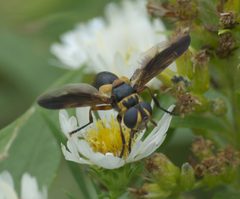
Trichopoda plumipes is a tachinid fly native to North America. are distinguished by prominent feather-like () hairs on the hind legs, a trait that gives the its . The species is a of true bugs (Hemiptera), particularly members of Pentatomidae and Coreidae. Females locate using produced by the themselves, then deposit externally on the host's body.
Pronunciation
How to pronounce Trichopoda plumipes: //tɹɪˈkoʊpədə ˈpluːmɪˌpiːz//
These audio files are automatically generated. While they are not always 100% accurate, they are a good starting point.
Identification
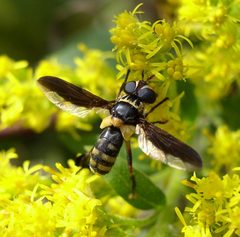
Distinguished from other tachinid flies by the combination of hind legs and the specific pattern of paired rectangular yellow spots on a black . The feather-legged appearance is shared with in the Trichopoda; T. pennipes is a similar but differs in abdominal spot shape and distribution. External placement on distinguishes Trichopoda from many other tachinids that deposit eggs internally or rely on host ingestion.
Images
Habitat
Associated with flowering plants, particularly goldenrods (Solidago spp.), which provide nectar sources for . include meadows, field edges, gardens, and other open areas where and nectar plants co-occur.
Distribution
North America, with confirmed records from the United States (including Vermont) and Mexico.
Seasonality
Active in late summer and autumn, with seeking nectar to build reserves for . Has been observed on goldenrod blooms during this period.
Diet
feed on nectar and pollen, particularly from goldenrods. Larvae are that develop within true bugs (Hemiptera), feeding on tissues.
Host Associations
- Pentatomidae - stink bugs
- Coreidae - leaf-footed bugs and squash bugs
Life Cycle
Females deposit externally on the body of . Larvae hatch, bore through the egg shell and host , then develop internally on host tissues. Mature larvae exit the host, drop to the soil, and pupate within a formed from the larval skin. emerge from soil to feed, mate, and locate new hosts.
Behavior
have been observed visiting goldenrod flowers for nectar. Females use to locate suitable for . Multiple may be deposited on a single host individual.
Ecological Role
agent of pest . Contributes to of stink bugs and leaf-footed bugs, including some agricultural pests. The relationship typically results in death.
Human Relevance
Potential biocontrol agent for stink bugs such as the brown marmorated stink bug (Halyomorpha halys). May help reduce of squash bugs and other agricultural pests, though parasitized can continue feeding and transmitting plant for some time before succumbing.
Similar Taxa
- Trichopoda pennipesSimilar feather-legged appearance and range, but differs in abdominal spot pattern (T. plumipes has rectangular spots; T. pennipes has different markings) and may show differences in seasonal activity and geographic distribution.
More Details
Host-finding mechanism
Research by Jeff Aldrich and colleagues demonstrated that Trichopoda exploit produced by true bugs to locate , effectively 'eavesdropping' on host chemical communication.
Parasitism impact
While eventually kills the , the delayed mortality means parasitized may continue feeding and transmitting plant for a period, limiting the immediate effectiveness of in management.
Sources and further reading
- BugGuide
- Wikipedia
- GBIF taxonomy match
- iNaturalist taxon
- NCBI Taxonomy
- Bugs better beware of feisty feather-legged flies, Trichopoda pennipes — Bug of the Week
- Squash Bugs Still Making Growers Crazy After All These Years
- Gardening for Solitary Bees - Buglife Blog - Buglife
- Spring is sprung… - Buglife Blog - Buglife
- Group mimicry in Cerambycidae… and more | Beetles In The Bush
- Bug Eric: Spider Sunday: Dewdrop Spiders