
Brochymena quadripustulata
(Fabricius, 1775)
Four-humped Stink Bug, Rough Stink Bug
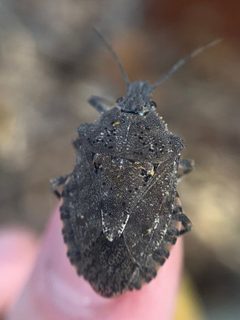
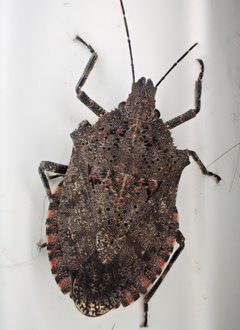
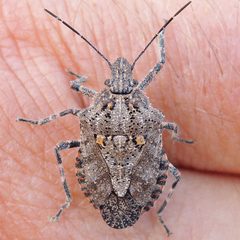
Brochymena quadripustulata is a native North American commonly known as the four-humped stink bug or rough stink bug. range from 10–19 mm in body length and display remarkable cryptic coloration resembling lichen-mottled tree bark. The is frequently confused with the brown marmorated stink bug (Halyomorpha halys), but can be distinguished by spiny projections on the pronotum and uniformly dark lacking white bands. It has one per year in temperate climates, with adults beneath loose bark or in firewood piles.
Pronunciation
How to pronounce Brochymena quadripustulata: /brɔˌkʰɪˈmɛnə ˌkwɑdɹɪˌpʰʊstuˈlɑːtə/
These audio files are automatically generated. While they are not always 100% accurate, they are a good starting point.
Identification
Distinguished from the brown marmorated stink bug (Halyomorpha halys) by: (1) dark without white bands (BMSB has white bands on last two antennal segments); (2) presence of fine teeth or spines along the margin of the pronotum (BMSB lacks these); (3) more robust, rough-textured body surface; (4) typically found in lower numbers and associated with trees rather than aggregating on buildings in large numbers. Distinguished from other Brochymena by specific hump configuration and pronotal spine patterns, though species-level identification often requires microscopic examination.
Images
Habitat
Primarily arboreal, associated with trees, shrubs, and woody vegetation. overwinter beneath loose bark, in tree crevices, or in firewood piles. Occasionally enters human dwellings when firewood is brought indoors. Found in both natural woodlands and suburban areas with mature trees.
Distribution
North America (native range), with records from the United States and Canada. Also reported in Central America, Africa, and Oceania according to some sources, though these extra-Nearctic records may represent introductions or taxonomic confusion. Within North America, found across much of the continent where suitable woody vegetation occurs.
Seasonality
active spring through fall. Overwinter as adults, becoming in cold months but capable of activity on warm winter days. One per year in temperate climates; -laying occurs in late spring to summer.
Diet
Primarily phytophagous, feeding on sap of trees and shrubs from more than a dozen plant . Occasionally predatory or scavenging on other insects including caterpillars, though this is not well-documented.
Host Associations
- Various trees and shrubs - Sap feeding on woody plants from multiple ; specific records limited in available literature
Life Cycle
One per year in temperate climates. laid in small clusters on twigs of trees. Nymphs pass through four instars before reaching adulthood. Development from egg to is prolonged, contributing to the cycle. Adults overwinter and resume activity in spring.
Behavior
are strong fliers and may be encountered on fences, sidewalks, or other contrasting surfaces when not on trees. adults often aggregate beneath bark. Capable of surviving freezing temperatures; specimens have recovered after extended freezing. When disturbed, may emit defensive compounds from like other stink bugs, though less prone to indoor than Halyomorpha halys.
Ecological Role
Native herbivore of woody vegetation; suspected occasional or scavenger. Serves as prey for various natural enemies including sand wasps (Bicyrtes quadrifasciata), birds, fence lizards, and . are parasitized by platygastrid wasps (Trissolcus brochymenae, Telenomus spp.) and eupelmid wasps (Anastatus reduvii). are for feather-legged tachinid flies (Trichopoda spp.) that attach eggs externally.
Human Relevance
Occasional nuisance when enter homes with firewood, but does not establish indoor breeding . Not an agricultural or horticultural pest. Frequently mistaken for the brown marmorated stink bug, causing unnecessary concern. Serves as indicator of native woodland quality.
Similar Taxa
- Halyomorpha halys brown marmorated stink bug; distinguished by banded , lack of pronotal spines, and tendency to aggregate in large numbers on buildings
- Parabrochymena spp.Formerly included in Brochymena; separated based on morphological characters including different pronotal and genitalic structures
- Other Brochymena speciesApproximately 20 in redefined ; require microscopic examination for reliable identification
Misconceptions
Frequently mistaken for the brown marmorated stink bug due to general shape and indoor winter appearances. Unlike BMSB, Brochymena quadripustulata is a native of no economic importance and does not cause significant damage to crops or ornamental plants.
More Details
Taxonomic history
originally described by Fabricius in 1775. Retained in redefined Brochymena following erection of Parabrochymena for 10 former Brochymena species (Rider et al., 2002).
Cold tolerance
Remarkable freeze documented; specimens survived extended freezing and recovered when warmed, an for beneath bark in temperate climates.
Firewood association
Modern residential encounters often linked to firewood storage; stacks of cut wood provide suitable analogous to natural bark crevices.
Sources and further reading
- BugGuide
- Wikipedia
- GBIF taxonomy match
- iNaturalist taxon
- NCBI Taxonomy
- A different stink bug on the move in the kitchen: four-humped stink bug, Brochymena quadripustulata — Bug of the Week
- Archive — Bug of the Week
- Bug Eric: Rough Stink Bugs
- Bug Eric: Wasp Wednesday: Neorileya
- Bug Eric: Indoor Insects of Autumn (part 3 of 4)
- Bug Eric: October 2009
- Life History and Laboratory Rearing of Brochymena quadripustulata with Descriptions of Immature Stages and Additional Notes on Brochymena arborea (Hemiptera: Pentatomidae)1
- DESCRIPTION OFPARABROCHYMENA, NEW GENUS, AND REDEFINITION AND REVIEW OFBROCHYMENAAMYOT AND AUDINET-SERVILLE (HEMIPTERA: PENTATOMIDAE), WITH CONSIDERATIONS ON NATURAL HISTORY, CHOROLOGICAL AFFINITIES, AND EVOLUTIONARY RELATIONSHIPS