
Brochymena myops
Stål, 1872
rough stink bug, tree stink bug
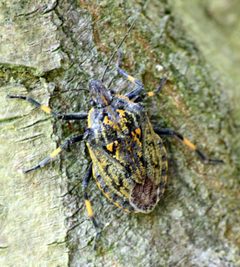
Brochymena myops is a of rough stink bug native to North America, belonging to the Brochymena commonly known as "tree stink bugs" for their bark-like camouflage. The species ranges from Quebec to Florida and westward through the central United States to Texas. are active during warm periods throughout the year, including winter sunny days, and are frequently mistaken for the brown marmorated stink bug. Like other Brochymena species, B. myops is not considered an agricultural or household pest.
Pronunciation
How to pronounce Brochymena myops: /brɔˈkɪmɪnə ˈmaɪɒps/
These audio files are automatically generated. While they are not always 100% accurate, they are a good starting point.
Identification
Brochymena myops can be distinguished from the brown marmorated stink bug (Halyomorpha halys) by its uniformly dark without white bands, and by the presence of fine teeth along the leading edge of the pronotum. The has much smaller eyespots compared to its B. quadripustulata, and is mostly slate gray in coloration rather than mottled with contrasting speckling. measure 19–42 mm in length. Species-level identification within Brochymena is difficult without microscopic examination of dead specimens.
Images
Habitat
Pine forests and wooded areas; and larvae occur under loose bark on pine trees, logs, and stumps. The overwinters outdoors in protected locations such as beneath bark or in other sheltered spots, rarely entering human structures.
Distribution
Eastern North America from Quebec and Ontario south to Florida, west to Manitoba, Minnesota, Kansas, and Texas. Most common in southern pine forests.
Seasonality
are active year-round when temperatures permit, often observed on warm, sunny winter days. Peak activity occurs in spring and fall during from and entry into hibernation. One per year in temperate climates.
Diet
Both and larvae are predatory. Larvae prey on other larvae and pupae in decaying wood.
Life Cycle
laid in small clusters on twigs. Nymphs progress through four instars before reaching adulthood. Development from egg to is prolonged, resulting in a single in temperate regions. Adults overwinter and can survive freezing temperatures for extended periods.
Behavior
fly well and may alight on contrasting surfaces such as fences or sidewalks, making them visible against backgrounds unlike tree bark. When not flying, they are remarkably cryptic and difficult to detect on bark. Adults and larvae both exhibit predatory rather than plant-feeding.
Ecological Role
of other insects in forest , particularly in decaying wood . Prey for sand wasps (Bicyrtes quadrifasciata), birds, fence lizards, and parasitized by tachinid flies (Trichopoda spp.) and platygastrid .
Human Relevance
Not a pest ; does not invade homes in large numbers like the brown marmorated stink bug. Occasionally enters structures individually but does not reproduce indoors. Often mistaken for the , leading to unnecessary concern.
Similar Taxa
- Halyomorpha halysBrown marmorated stink bug is easily confused with Brochymena myops; distinguished by white-banded , lack of pronotal teeth, and fall indoors.
- Brochymena quadripustulataLarger eyespots and more contrasting mottled pattern; B. myops has reduced eyespots and more uniform slate gray coloration.
- Brochymena arboreaSimilar bark-camouflaged appearance; -level identification requires microscopic examination.
Misconceptions
Often mistaken for the brown marmorated stink bug and killed unnecessarily; rough stink bugs are native, harmless, and do not invade structures in large numbers.