
Brochymena dilata
Ruckes, 1939
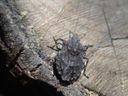
Brochymena dilata is a of rough stink bug in the Pentatomidae, described by Ruckes in 1939. It is one of 20 species retained in the Brochymena following the 1992 revision by Larivière, which redefined the genus and erected the new genus Parabrochymena for 10 related . As a member of the New World genus Brochymena, B. dilata exhibits the cryptic bark-like appearance typical of rough stink bugs. Like , it is not considered an agricultural pest and is primarily associated with woody vegetation.
Pronunciation
How to pronounce Brochymena dilata: //brɔˈkʰɪmɛnə daɪˈleɪtə//
These audio files are automatically generated. While they are not always 100% accurate, they are a good starting point.
Identification
-level identification of Brochymena dilata requires microscopic examination of structural characters. Within the , B. dilata can be distinguished using the diagnostic characters provided in Larivière's 1992 revision, which established species groups and provided the first comprehensive key to all Brochymena . The genus Brochymena is distinguished from the Brown Marmorated Stink Bug (Halyomorpha halys) by the absence of white bands on the last two antennal segments and the presence of fine teeth along the leading edge of the pronotum.
Images
Habitat
Associated with woody vegetation; are found on trees and shrubs where they blend with lichen-mottled bark.
Distribution
North America. Specific range details for B. dilata are not documented in the available sources, though the is confirmed present in the region.
Human Relevance
Not a pest . Rough stink bugs in the Brochymena are frequently mistaken for the Brown Marmorated Stink Bug, but unlike that species, Brochymena species do not invade structures in large numbers and generally remain outdoors.
Similar Taxa
- Halyomorpha halysEasily confused at first glance, but distinguished by white bands on the last two antennal segments and absence of teeth on the pronotum leading edge.
- Parabrochymena speciesFormerly included in Brochymena; separated based on new morphological characters at the generic level described in Larivière 1992.
Misconceptions
Rough stink bugs are often mistaken for the Brown Marmorated Stink Bug due to superficial similarity in size and general appearance. However, Brochymena are native, non-pest insects that do not exhibit the aggregative and structural invasion patterns of Halyomorpha halys.
More Details
Taxonomic History
Brochymena dilata was described by Ruckes in 1939. The Brochymena was comprehensively revised by Larivière in 1992, resulting in the erection of Parabrochymena as a new genus for 10 formerly included in Brochymena, and the retention of 20 in the redefined Brochymena, including B. dilata.
Identification Challenges
Identifying rough stink bugs to is difficult without microscopic examination. Larivière's 1992 monograph provides the only comprehensive key to species, with detailed illustrations of important structural characters.
Sources and further reading
- BugGuide
- Wikipedia
- GBIF taxonomy match
- iNaturalist taxon
- Bohart Museum Open House on 'Many Legged Wonders': How Many Legs Does an Isopod Have? | Bug Squad
- Bembicid Holdings | Entomology Research Museum
- Bug Eric: Rough Stink Bugs
- Bug Eric: Wasp Wednesday: Neorileya
- Bug Eric: Indoor Insects of Autumn (part 3 of 4)
- So, how big do insects get? - Buglife Blog - Buglife
- DESCRIPTION OFPARABROCHYMENA, NEW GENUS, AND REDEFINITION AND REVIEW OFBROCHYMENAAMYOT AND AUDINET-SERVILLE (HEMIPTERA: PENTATOMIDAE), WITH CONSIDERATIONS ON NATURAL HISTORY, CHOROLOGICAL AFFINITIES, AND EVOLUTIONARY RELATIONSHIPS