
Brochymena chelonoides
Ruckes
rough stink bug, tree stink bug
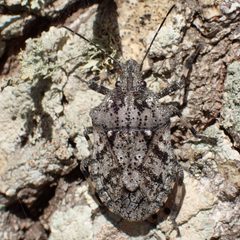
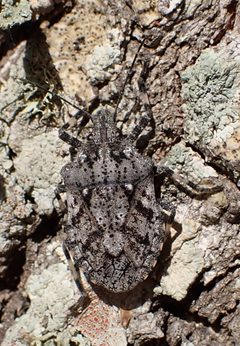
Brochymena chelonoides is a of rough stink bug native to North America. are characterized by a rough, mottled gray-brown with black and white or ivory speckling that provides effective camouflage against lichen-covered bark. The species is one of approximately 20 currently recognized in the redefined Brochymena, having been retained in this genus when Parabrochymena was erected as a separate genus for 10 other former Brochymena species. Like other rough stink bugs, it is not considered an agricultural or household pest.
Pronunciation
How to pronounce Brochymena chelonoides: /brɒkɪˈmɛnə kɛloʊˈnaɪdiːz/
These audio files are automatically generated. While they are not always 100% accurate, they are a good starting point.
Identification
Brochymena chelonoides can be distinguished from the brown marmorated stink bug (Halyomorpha halys) by two key characters: the lack white bands on the last two segments (present in H. halys), and the leading edge of the pronotum bears fine teeth (absent in H. halys). The has the typical rough, gray-brown, speckled appearance of the Brochymena, with body length likely falling within the 10–19 mm range typical for the genus. Species-level identification within Brochymena requires microscopic examination and is considered difficult; B. chelonoides was originally described by Ruckes.
Images
Habitat
Arboreal; associated with trees and shrubs where its cryptic coloration blends with lichen-mottled bark. overwinter beneath loose bark or in other sheltered outdoor locations, typically remaining outside rather than entering buildings.
Distribution
Central America and North America. Specific distribution details beyond this range are not documented in available sources.
Seasonality
are active in spring and fall during from and entry into hibernation. Adults may be seen on warm, sunny winter days. The has a single annually in temperate climates, with development from to adult taking an extended period.
Life Cycle
are laid in small clusters on twigs of trees. Nymphs progress through four instars before reaching adulthood. Development from egg to is surprisingly long, resulting in a single per year in temperate climates. Adults overwinter.
Ecological Role
Rough stink bugs are prey for various natural enemies including the sand wasp Bicyrtes quadrifasciata, which paralyzes them to provision nest burrows for larval offspring. They are also preyed upon by birds and fence lizards. Feather-legged tachinid flies in the Trichopoda parasitize them by gluing to the body that hatch into internal . Their eggs are parasitized by platygastrid including Trissolcus brochymenae and Telenomus , and by the eupelmid wasp Anastatus reduvii.
Human Relevance
Not a pest . Unlike the brown marmorated stink bug, Brochymena species do not invade homes in large numbers and are not considered economically important. They may occasionally be brought indoors with firewood but do not establish indoor .
Similar Taxa
- Brochymena quadripustulataAlso called four-humped stink bug or rough stink bug; shares the rough, gray-brown speckled appearance and spiny pronotal margins. B. chelonoides distinguished by -specific characters requiring microscopic examination.
- Halyomorpha halysBrown marmorated stink bug, an Asian easily confused with Brochymena at first glance. Distinguished by banded and lack of teeth on pronotal margin; also by aggregating in large numbers on buildings in fall.
- Parabrochymena speciesFormerly included in Brochymena, this was erected for 10 including P. arborea; distinguished by new morphological characters at the generic level. B. chelonoides was retained in Brochymena.
Sources and further reading
- BugGuide
- Wikipedia
- iNaturalist taxon
- A different stink bug on the move in the kitchen: four-humped stink bug, Brochymena quadripustulata — Bug of the Week
- Bug Eric: Rough Stink Bugs
- Bug Eric: Wasp Wednesday: Neorileya
- Bug Eric: Indoor Insects of Autumn (part 3 of 4)
- Bug Eric: October 2009
- Bug Eric: 2009
- DESCRIPTION OFPARABROCHYMENA, NEW GENUS, AND REDEFINITION AND REVIEW OFBROCHYMENAAMYOT AND AUDINET-SERVILLE (HEMIPTERA: PENTATOMIDAE), WITH CONSIDERATIONS ON NATURAL HISTORY, CHOROLOGICAL AFFINITIES, AND EVOLUTIONARY RELATIONSHIPS