
Brochymena affinis
Van Duzee, 1904
rough stink bug, tree stink bug
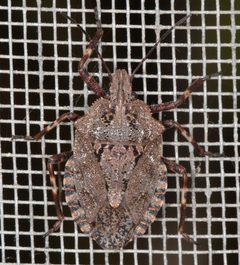
Brochymena affinis is a native North American in the Pentatomidae. Like other members of its , it is commonly known as a "rough stink bug" or "tree stink bug" due to its bark-like camouflage. The overwinters as an , typically remaining outdoors under loose bark rather than entering buildings. It produces one per year in temperate climates, with development from to adult taking an extended period.
Pronunciation
How to pronounce Brochymena affinis: /brɔˈkaɪmɛnə æˈfɪnɪs/
These audio files are automatically generated. While they are not always 100% accurate, they are a good starting point.
Identification
Distinguished from the Brown Marmorated Stink Bug (Halyomorpha halys) by two key features: (1) lack white bands on the last two segments (dark throughout in Brochymena), and (2) the leading edge of the pronotum has fine teeth (smooth in H. halys). -level identification within Brochymena requires microscopic examination of dead specimens and is considered difficult or impossible from photographs or casual observation.
Images
Habitat
Associated with trees and shrubs where its bark-like camouflage provides concealment. overwinter under loose bark or in other sheltered outdoor locations. Found in both natural and suburban wooded areas.
Distribution
North America. Records indicate presence across the continent, with specific observations from Oregon and other regions.
Seasonality
are active in spring and fall during from and entry into . Adults may be observed on warm, sunny winter days when they become temporarily active. One per year in temperate climates.
Diet
Suspected to feed on sap of trees and shrubs. Persistent but unconfirmed reports suggest occasional predatory on other insects.
Life Cycle
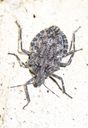
laid in small clusters on twigs of trees. Nymphs hatch and progress through four instars before reaching adulthood. Extended development period from egg to results in a single in temperate regions. Overwinters as adult.
Behavior
Overwinters in under loose bark, typically remaining outdoors and avoiding human structures. fly well and may alight on fences, sidewalks, or other contrasting substrates where they become visible. Can withstand freezing temperatures for extended periods; specimens have survived weeks in freezing conditions. Exhibits cryptic , remaining motionless to maintain bark-mimicking camouflage.
Ecological Role
Prey for several including the sand wasp Bicyrtes quadrifasciata, birds, and fence lizards. for parasitic tachinid flies (Trichopoda spp.) that attach externally, and for (Trissolcus brochymenae, Telenomus sp., Anastatus reduvii) that attack eggs. Part of native forest with minimal direct economic impact.
Human Relevance
Not a pest . Does not invade buildings in large numbers like the Brown Marmorated Stink Bug. Occasionally encountered indoors as incidental individual rather than . No agricultural or structural damage documented.
Similar Taxa
- Halyomorpha halys (Brown Marmorated Stink Bug) pest with white-banded and smooth pronotal margin; Brochymena affinis has uniformly dark antennae and toothed pronotal edge.
- Other Brochymena speciesApproximately 21-23 North American are morphologically similar; species identification requires microscopic examination.
More Details
Taxonomic note
identification within Brochymena is challenging and typically requires examination of genitalic structures under a microscope. The specimen illustrated in the Eric blog from Portland, Oregon was identified as likely B. affinis but with noted uncertainty.
Cold hardiness
Remarkable freeze has been documented anecdotally: specimens frozen for approximately one week recovered upon thawing.
Sources and further reading
- BugGuide
- Wikipedia
- GBIF taxonomy match
- iNaturalist taxon
- NCBI Taxonomy
- Meet 'Mantis Master Keeper' Andrew Pfeifer | Bug Squad
- Saving the Rusty-Patched Bumble Bee | Bug Squad
- Bug Eric: Rough Stink Bugs
- Take 2 on tropical tiger moths: Spotted oleander caterpillar moth, Empyreuma affinis — Bug of the Week
- Mason bees in peril when parasitic wasps arrive – Leucospid wasp, Leucospis affinis — Bug of the Week
- A Tick that Feeds on Birds May Increase the Range of Lyme Disease