
Cancer borealis
Stimpson, 1859
Jonah crab
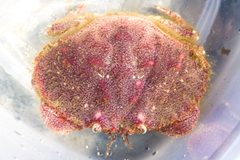
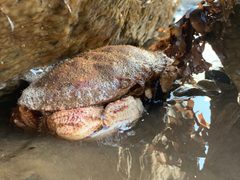
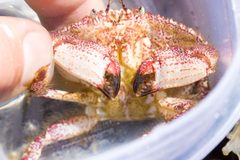
Cancer borealis, commonly known as the Jonah crab, is a marine brachyuran crab native to the western Atlantic Ocean. It inhabits waters from Newfoundland to Florida, primarily in rocky marine environments. The possesses a rounded, rough-edged with small light spots and robust claws with dark brown-black tips. Males reach larger sizes than females, with maximum carapace widths of 222 mm versus approximately 150 mm. The Jonah crab has been extensively studied as a model organism for neurophysiology, particularly for its , which has contributed to understanding neural circuit function and neuromuscular control.
Pronunciation
How to pronounce Cancer borealis: //ˈkænsər bɔːˈreɪəlɪs//
These audio files are automatically generated. While they are not always 100% accurate, they are a good starting point.
Images
Appearance
Rounded with rough, toothed edges and small light spots. Robust claws with dark brown-black tips. in size: males reach maximum carapace width of 222 mm, females rarely exceed 150 mm. Overall robust, heavy-bodied crab typical of the Cancridae.
Habitat
Rocky marine in the western Atlantic Ocean. Occurs in coastal waters with water temperatures ranging from approximately 3°C to 25°C, subject to pH fluctuations depending on depth, temperature, and tidal cycles.
Distribution
Western Atlantic Ocean from Newfoundland, Canada south to Florida, USA.
Behavior
Stomach muscles participate in food processing through grinding movements and filtration through the pylorus. Engages in with American lobster (Homarus americanus) and rock crab (Cancer irroratus) in rocky .
Human Relevance
Subject to commercial and recreational fisheries. Used extensively as a model organism in neurophysiological research, particularly for studies of stomatogastric ganglion function, neural circuit dynamics, and neuromuscular control. Research on this has advanced understanding of ion channel function, temperature and pH effects on muscle physiology, and mechanisms of neuronal identity.
Similar Taxa
- Cancer irroratusRock crab; co-occurs in rocky Atlantic and engages in competitive interactions with C. borealis
- Homarus americanusAmerican lobster; shares rocky and competes with Jonah crab for resources, though from different
Sources and further reading
- BugGuide
- GBIF taxonomy match
- iNaturalist taxon
- NCBI Taxonomy
- Catalogue of Life
- In the News: Hammock and Zhang Labs Target Obesity-Enhanced Colon Cancer | Bug Squad
- Harvard, UC Davis and Ionova Researchers: Hammock Lab Drug May Help Pancreatic and Liver Cancer Patients | Bug Squad
- Bruce Hammock: From Researching Insects to Helping Humankind | Bug Squad
- Exciting News from the Hammock Lab | Bug Squad
- Zombie bees, Apis mellifera, and their tormentor the humpbacked fly, Apocephalus borealis — Bug of the Week
- cancer | Blog
- The molecular underpinnings of neuronal cell identity in the stomatogastric ganglion of cancer borealis
- THE BEHAVIORAL ECOLOGY OF COMPETITION AMONG THREE DECAPOD SPECIES, THE AMERICAN LOBSTER, HOMARUS AMERICANUS; THE JONAH CRAB, CANCER BOREALIS AND THE ROCK CRAB, CANCER IRRORATUS IN ROCKY HABITATS
- Temperature and pH-dependent potassium currents of muscles of the stomatogastric nervous system of the crab, Cancer borealis.
- Temperature and pH-dependent Potassium Currents of Muscles of the Stomatogastric Nervous System of the Crab, Cancer borealis.