
Cancer irroratus
Say, 1817
Atlantic rock crab, peekytoe crab
A medium-sized marine crab native to the western North Atlantic, ranging from Iceland to South Carolina. reach 133 mm width and can live up to 8 years. The occupies depths from intertidal zones to 790 m. It has become commercially significant as the 'peekytoe crab' and has established non-native in Iceland via ballast water transport.
Pronunciation
How to pronounce Cancer irroratus: /ˈkaŋ.kɛr i.roʊˈrɑː.təs/
These audio files are automatically generated. While they are not always 100% accurate, they are a good starting point.
Identification
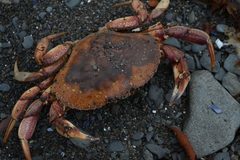
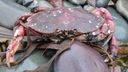
Distinguished from the sympatric Jonah crab (Cancer borealis) by purplish-brown spots on the (versus yellow in C. borealis) and smooth-edged marginal teeth on the carapace front (denticulate in C. borealis). Carapace width reaches 133 mm. Males range 8–127 mm, females up to 113 mm.
Images
Habitat
Marine rocky from above the low tide line to 790 m depth. Found on hard substrates including rocky areas and tilted pools. Reproductive move to shallow waters during breeding season.
Distribution
Native range: western North Atlantic from Labrador and Iceland to South Carolina. Non-native established in Iceland and eastern North Atlantic, where it has become the most abundant brachyuran in southwest Iceland as of 2014.
Seasonality
Molting occurs primarily April–July. Reproductive season June–September, with females laying during this period.
Diet
Feeds on mollusks (mussels, clams), worms, sea urchins, and other crabs. Mussels are a particularly important energy source due to content.
Life Cycle
Females lay 125,000–500,000 between June and September. Larval stage lasts approximately two months, after which juveniles transition to benthic and begin hunting. Sexual maturity in males indicated by size >101 mm; females <70 mm are in early ovarian development.
Behavior
Uses enlarged front claws to capture and manipulate prey. Engages in competitive interactions with American lobster and Jonah crab in rocky . Reproductive migrate to shallow waters for mating. Larvae exhibit behavioral responses to light, pressure, and gravity cues.
Ecological Role
and scavenger that contributes to energy recycling in benthic . Serves as prey for American lobsters, particularly during larval and soft-shell stages. May help regulate of shrimp and other crabs.
Human Relevance
Commercially harvested as 'peekytoe crab,' a culinary market that developed after 1997. Previously considered a nuisance to lobster fisheries due to theft. Subject to fishery regulations including minimum size limits (102 mm) and prohibition on harvesting females.
Similar Taxa
- Cancer borealisOverlaps in size and coloration; distinguished by yellow (not purplish-brown) spots and denticulate (not smooth) marginal teeth.
- Carcinus maenas green crab with which C. irroratus interacts competitively in Newfoundland and other areas; differs in shape and color pattern.
Sources and further reading
- BugGuide
- Wikipedia
- GBIF taxonomy match
- iNaturalist taxon
- NCBI Taxonomy
- Catalogue of Life
- Recruitment of the rock crab, Cancer irroratus: The influence of larval supply, settlement and post-settlement processes to benthic distribution patterns
- THE BEHAVIORAL ECOLOGY OF COMPETITION AMONG THREE DECAPOD SPECIES, THE AMERICAN LOBSTER, HOMARUS AMERICANUS; THE JONAH CRAB, CANCER BOREALIS AND THE ROCK CRAB, CANCER IRRORATUS IN ROCKY HABITATS
- Peer Review #3 of "A field-based investigation of behavioural interactions between invasive green crab (Carcinus maenas), rock crab (Cancer irroratus), and American lobster (Homarus americanus) in southern Newfoundland (v0.2)"
- Predation behaviour of Cancer irroratus and Carcinus maenas during conspecific and heterospecific challenges
- Peer Review #1 of "A field-based investigation of behavioural interactions between invasive green crab (Carcinus maenas), rock crab (Cancer irroratus), and American lobster (Homarus americanus) in southern Newfoundland (v0.1)"
- Peer Review #2 of "A field-based investigation of behavioural interactions between invasive green crab (Carcinus maenas), rock crab (Cancer irroratus), and American lobster (Homarus americanus) in southern Newfoundland (v0.1)"
- Peer Review #3 of "A field-based investigation of behavioural interactions between invasive green crab (Carcinus maenas), rock crab (Cancer irroratus), and American lobster (Homarus americanus) in southern Newfoundland (v0.1)"
- Effects of oil on behavioral responses to light, pressure and gravity in larvae of the rock crab Cancer irroratus
- Peer Review #1 of "A field-based investigation of behavioural interactions between invasive green crab (Carcinus maenas), rock crab (Cancer irroratus), and American lobster (Homarus americanus) in southern Newfoundland (v0.2)"
- Peer Review #2 of "A field-based investigation of behavioural interactions between invasive green crab (Carcinus maenas), rock crab (Cancer irroratus), and American lobster (Homarus americanus) in southern Newfoundland (v0.2)"