
Carcinus maenas
(Linnaeus, 1758)
European green crab, green crab, shore crab, green shore crab, European shore crab
Carcinus maenas is a highly littoral crab native to the northeast Atlantic Ocean and Baltic Sea. Listed among the world's 100 worst invasive , it has established across temperate coastlines worldwide including North America, Australia, South America, and South Africa. The species exhibits remarkable phenotypic plasticity, with color morphs ranging from green to red that differ in aggression and stress . Its successful global occurs through multiple mechanisms including ballast water, ship hull fouling, and aquaculture transfers.
Pronunciation
How to pronounce Carcinus maenas: //ˈkɑːr.sɪ.nəs ˈmiː.næs//
These audio files are automatically generated. While they are not always 100% accurate, they are a good starting point.
Identification
Distinguished from the closely related Carcinus aestuarii by three undulations between the that protrude beyond the eye margin (C. aestuarii lacks bumps and extends forward smoothly). Male curve outward in C. maenas but are straight and parallel in C. aestuarii. Five short teeth behind each eye characteristic of C. maenas.
Images
Appearance
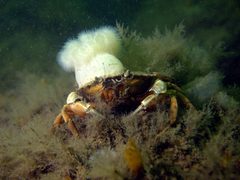
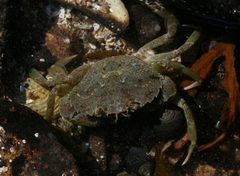
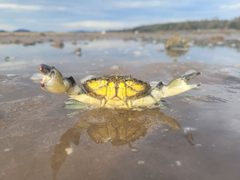
up to 60 mm long and 90 mm wide in native range, reaching 100 mm in some invaded areas. Carapace features five short teeth behind each and three distinct undulations between the eyes that protrude beyond the eye margin. Coloration highly variable: green, brown, grey, or red. Red coloration develops in individuals that delay moulting. Juveniles display greater patterning than .
Habitat
Protected and semi-protected marine and estuarine with mud, sand, or rock substrates; submerged aquatic vegetation; emergent marsh. Soft bottoms preferred. Cannot tolerate wave-swept open shores. Found in wave-protected sheltered bays, estuaries, and harbors. Euryhaline as (4–52 ‰ salinity); early life stages more restricted. Temperature 0–30 °C for adults; larvae require 12–27 °C.
Distribution
Native: northeast Atlantic Ocean, Baltic Sea, European and North African coasts from Iceland and Central Norway southward, east to Baltic Sea. Introduced: Atlantic and Pacific coasts of North America (first observed Massachusetts 1817; California 1989), Australia (late 1800s), South Africa (1983), South America (Patagonia by 2003), Argentina (San Matías Gulf). Isolated appearances in Brazil, Panama, Hawaii, Madagascar, Red Sea, Pakistan, Sri Lanka, Myanmar without established .
Seasonality
Reproductive activity peaks May to July in some , but -bearing females present nearly year-round in recently established populations. Larvae develop offshore; juveniles settle in intertidal zone. Activity primarily but tide-dependent.
Diet
feeding on bivalve molluscs (clams, oysters, mussels—up to 40 clams per day), polychaete worms, and small crustaceans including conspecifics up to own size. Soft-shell clam (Mya arenaria) preferred prey. Preys on young of bivalves and fish. Feeding rates reduced in colder water.
Life Cycle
Females produce over 400,000 . Larval development occurs offshore in multiple stages before final moult to in intertidal zone. Young crabs inhabit seaweeds and seagrasses until adulthood. Extended reproductive period with nearly year-round egg-bearing females observed in some invaded .
Behavior
Primarily with activity modulated by tides; can be active at any time. Uses -specific camouflage: mudflat crabs match substrate color, rock pool crabs use . Red color morph individuals more aggressive and in contests over food, but less tolerant of low salinity and hypoxia. Higher temperatures disrupt established based on size and color morph.
Ecological Role
with documented impacts on native bivalve , including decline of native clams (Nutricola spp.) in California and destruction of soft-shell clam fisheries in eastern North America. Competes with native crabs for resources and shelter. Consumes Zostera marina, affecting for Dungeness crab and salmon. Preys on young of commercially important including oysters and Dungeness crab.
Human Relevance
Major economic and ecological threat as ; implicated in fisheries declines and damage. Subject to control efforts including trapping and bounties. Small- fishery in native range (~1200 tonnes annually, mainly France and UK). Culinary use in native range for soups and sauces; soft-shell preparation adapted from Mediterranean methods in New England. Experimental products include green crab stock, empanadas, patties, and distilled spirits. sequenced 2025 for invasion research.
Similar Taxa
- Carcinus aestuariiMediterranean green crab; distinguished by smooth lacking undulations between , and straight parallel male versus curved gonopods in C. maenas. Also in some regions.
- Hemigrapsus oregonensisNative Pacific shore crab; competes with C. maenas for shelter on west coast of North America.
- Callinectes sapidusNative blue crab in eastern North America; appears to limit C. maenas through or competition, with negative correlation between abundances.
More Details
Invasion mechanisms
Disperses via ballast water, ship hull fouling, packing materials (seaweed), aquaculture transfers of bivalves, rafting, larval transport on ocean currents, and movement of submerged aquatic vegetation for coastal management.
Phenotypic plasticity
Different native vary in larval and thermal , larval salinity tolerance, and body mass at hatching and . Red and green color morphs differ in aggression, stress tolerance, and dominance in contests.
Neurochemical sensitivity
in signaling are protonated by pH changes associated with climate change, altering peptide structure and including care and ventilation, which require ~10× normal peptide concentration under altered pH.
Sources and further reading
- BugGuide
- Wikipedia
- GBIF taxonomy match
- iNaturalist taxon
- NCBI Taxonomy
- Catalogue of Life
- PopulationDynamics of Green Crabs (Carcinus maenas) -- A Review
- Figure 2: Standard agonistic behaviors of the shore crab Carcinus maenas .
- PopulationDynamics of Green Crabs (Carcinus maenas) -- A Review
- Supplemental Information 2: Tissue distribution of neuropeptides and neuropeptide GPCRs in various tissues of Carcinus maenas .
- Fluctuations in native and invasive populations of the European green crab, Carcinus maenas: Habitat preferences, diet, and ecological interactions
- Moving northwards: Invasive Green Crab ( Carcinus maenas ) Expands into the Southwestern Atlantic
- Alteration of camouflage and behaviour in two marine invertebrates, Sepia officinalis and Carcinus maenas, by antidepressant medication
- Behaviour of Sacculinized Shore Crabs (Carcinus maenas Pennant)
- Figure 1: Global distribution of European green crab ( Carcinus maenas ) and sampling locations for green crab populations used in this study.