
Carcinus
Leach, 1814
Green crabs
Species Guides
1- Carcinus maenas(European green crab)
Carcinus is a of crabs in the Carcinidae, comprising two recognized : C. maenas (the European green crab or shore crab) and C. aestuarii (the Mediterranean shore crab). The genus is notable for containing one of the world's most successful marine , C. maenas, which has established across temperate coastlines on multiple continents. Both species share similar ecological roles as opportunistic in coastal marine systems. C. aestuarii is to the Mediterranean Sea and has been implicated in at least one invasion event in Japan.
Pronunciation
How to pronounce Carcinus: /kɑːrˈsiːnəs/
These audio files are automatically generated. While they are not always 100% accurate, they are a good starting point.
Identification
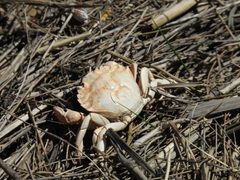
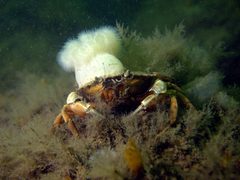
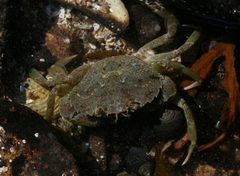
The two in this can be distinguished by the of the front between the : C. maenas has a short, toothed front, while C. aestuarii has a longer, smoother front. C. maenas reaches a maximum carapace width of approximately 90 mm. Color exist within C. maenas, with red and green forms documented; the red morphotype is typically associated with larger body size.
Images
Habitat
in this inhabit wave-protected sheltered bays, estuaries, and harbors. They cannot tolerate wave-swept open shores. are eurythermal and euryhaline, but breeding and larval development require more restrictive temperature conditions, limiting the genus to temperate coastlines.
Distribution
C. maenas is native to the northeast Atlantic Ocean and Baltic Sea. It has been introduced to and established in Australia, South Africa, South America, and both Atlantic and Pacific coasts of North America. C. aestuarii is native to the Mediterranean Sea and has been recorded from the coastline of Japan, either as an invasion or as a hybrid with C. maenas.
Diet
C. maenas has been observed feeding on molluscs, worms, and small crustaceans. The diet is extensive and .
Behavior
C. maenas exhibits standard agonistic during intraspecific contests over food resources. Body size and color determine contest outcomes, with larger red morphotype individuals typically . Higher temperatures disrupt established dominance patterns, indicating behavioral plasticity.
Human Relevance
C. maenas is considered one of the world's 100 worst by the IUCN. It has impacted fisheries through on commercially valuable . Its successful global has occurred via ships' hulls, packing materials, bivalves moved for aquaculture, and rafting. The species has been the subject of over 1000 scientific publications in the past decade.
Similar Taxa
- Hemigrapsus takanoiNative crab in regions where C. aestuarii has invaded; comparative feeding studies have been conducted between these
More Details
Taxonomic status of C. aestuarii
C. aestuarii is sometimes considered to be a of C. maenas rather than a distinct . The taxonomic relationship between the two requires further clarification.
Hybridization potential
The Japanese invasion may involve hybrids of C. aestuarii and C. maenas, suggesting potential for interspecific hybridization within the .
Sources and further reading
- BugGuide
- Wikipedia
- iNaturalist taxon
- NCBI Taxonomy
- Catalogue of Life
- PopulationDynamics of Green Crabs (Carcinus maenas) -- A Review
- Figure 2: Standard agonistic behaviors of the shore crab Carcinus maenas .
- PopulationDynamics of Green Crabs (Carcinus maenas) -- A Review
- Comparative feeding behavior of invasive (Carcinus aestuarii) and native crabs (Hemigrapsus takanoi)
- Supplemental Information 2: Tissue distribution of neuropeptides and neuropeptide GPCRs in various tissues of Carcinus maenas .