
Metacarcinus magister
(Dana, 1852)
Dungeness Crab
Metacarcinus magister, commonly known as the Dungeness crab, is a commercially important of crab native to the west coast of North America. typically reach 20 cm across the and inhabit eelgrass beds and marine bottoms from Alaska to California. The species has a complex with planktonic larval stages (zoeae and megalopae) before settlement to benthic stages. It is highly valued as seafood and supports major commercial fisheries, particularly in Washington, Oregon, and California. Research indicates significant and maternal variation in sensitivity to environmental stressors including ocean acidification and hypoxia.
Pronunciation
How to pronounce Metacarcinus magister: /ˌmɛtəˈkɑːrsɪnəs ˈmædʒɪstər/
These audio files are automatically generated. While they are not always 100% accurate, they are a good starting point.
Identification
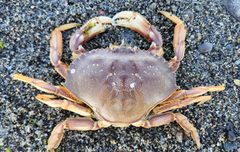
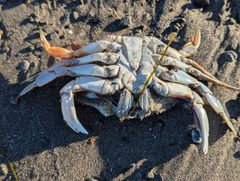
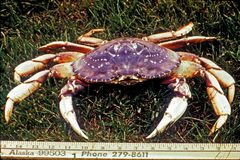
Distinguished from other west coast crabs by combination of: broad oval with 9-10 anterolateral teeth; large heavy claws with black tips; purple-brown coloration; and in marine waters (not exclusively estuarine). Distinguished from rock crabs (Cancer spp.) by more oval carapace shape and habitat preferences. Juveniles may be confused with other Canceridae but have characteristic claw even at small sizes.
Images
Habitat
Marine coastal waters, primarily inhabiting eelgrass beds (Zostera marina), sandy bottoms, and muddy substrates from the intertidal zone to depths of approximately 200 meters. Juveniles utilize structured including oyster beds and eelgrass meadows for . migrate seasonally, moving to deeper waters in winter and shallower waters in summer for molting and mating.
Distribution
Eastern Pacific Ocean from the Aleutian Islands, Alaska southward to Santa Barbara, California, USA. Core commercial fishing grounds centered on Washington, Oregon, and northern California. Disjunct occur in some estuarine systems.
Seasonality
Breeding occurs primarily in spring and early summer. Larval release typically peaks in winter months (December-March) in southern parts of range, with regional variation. Molting activity concentrated in late spring through summer. Commercial fishing season generally opens in late fall/winter when crabs have filled with meat post-.
Diet
Opportunistic omnivore and scavenger. Diet includes bivalve mollusks (clams, mussels), small crustaceans, polychaete worms, fish, and carrion. Juveniles selectively integrate and modify dietary , particularly requiring long-chain (LCPUFA) including DHA (docosahexaenoic acid) for survival and growth.
Life Cycle
Complex with multiple developmental stages: carried by female on → zoea larvae (5 stages, planktonic, 3-4 months) → megalopa (transitional stage) → crab (benthic settlement) → . Total larval duration approximately 3-4 months in plankton before settlement. Sexual maturity reached at 2-3 years. Maximum lifespan approximately 8-10 years.
Behavior
Highly mobile with mean cumulative movement distances of 11 km documented in telemetry studies. Exhibits behavioral response to hypoxia: shifts toward shallower waters and shows elevated activity levels rather than large- directional movement to escape low-oxygen conditions. Megalopae and early juveniles enter reversible tetany state when exposed to neonicotinoid , with delayed molting observed at high concentrations. Gregarious settlement observed in some contexts.
Ecological Role
Major benthic and scavenger in northeast Pacific coastal . Prey for fish, marine mammals, and seabirds. for nemertean predator Carcinonemertes errans, which settles on crab and migrates under abdominal flap. Juveniles serve as for quality in estuarine and nearshore systems. Oyster aquaculture and native oyster beds provide important habitat.
Human Relevance
One of the most commercially valuable crab in North America, supporting major fisheries in Washington, Oregon, and California. Highly prized for sweet, tender flesh. Recreational fishery also significant. Scientific research subject for studies on ocean acidification, hypoxia, pollution impacts, and fisheries management. Name derived from Dungeness, Washington, where commercial fishery established.
Similar Taxa
- Cancer productus (red rock crab)Overlapping range and similar ; distinguished by more rounded , red coloration, and preference for rocky substrates
- Romaleon antennarium (Pacific rock crab)Formerly Cancer antennarius; similar size and but with distinct tuberculation and different claw
More Details
Fisheries Management
Subject to intensive management including size limits, sex restrictions (males only in most areas), and seasonal closures. Management strategy evaluation indicates current strategies perform well under low illegal/incidental mortality but erode under scenarios of reproductive limitation or high unreported catch.
Environmental Sensitivity
Exhibits -level and maternal variation in CO2 sensitivity, suggesting adaptive capacity to ocean acidification. Hypoxia-induced behavioral changes (shoaling to shallower waters) increase vulnerability to fishing pressure.
Pesticide Sensitivity
Megalopae and early juveniles show reversible tetany response to neonicotinoid imidacloprid at concentrations relevant to proposed agricultural use, with delayed molting effects but no direct mortality at tested concentrations.
Sources and further reading
- BugGuide
- GBIF taxonomy match
- iNaturalist taxon
- NCBI Taxonomy
- Catalogue of Life
- Amazing Story About What Entomologist Lynn Kimsey Recorded in San Francisco Bay 50 Years Ago | Bug Squad
- Learn About Monarchs at Western Monarch Summit in San Luis Obispo | Bug Squad
- Meloidae Holdings | Entomology Research Museum
- Will the Pope’s intervention save us? - Buglife Blog - Buglife
- Eumastacidae | Beetles In The Bush
- Population and maternal variation in the sensitivity of Dungeness crab Metacarcinus magister zoeae to elevated CO2
- Larval settlement of the nemertean egg predator Carcinonemertes errans on the Dungeness crab, Metacarcinus magister
- Movement Patterns and Distributional Shifts of Dungeness Crab (Metacarcinus magister) and English Sole (Parophrys vetulus) During Seasonal Hypoxia
- Juvenile Dungeness crabs (Metacarcinus magister) selectively integrate and modify the fatty acids of their experimental diets
- A Comparison of the Juvenile Dungeness Crab Metacarcinus magister Habitat Provided by Contemporary Oyster Aquaculture Versus Historical Native Oysters in a U.S. West Coast Estuary
- When does hypoxia affect management performance of a fishery? A management strategy evaluation of Dungeness crab (Metacarcinus magister) fisheries in Hood Canal, Washington, USA
- Response of megalopae and early stage juveniles of the Dungeness crab, Metacarcinus magister Dana, 1852 (Decapoda: Brachyura: Cancridae), to a neonicotinoid pesticide