
Homarus americanus
H. Milne Edwards, 1837
American lobster, Atlantic lobster, Canadian lobster, true lobster, northern lobster, Canadian Reds, Maine lobster
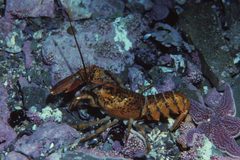
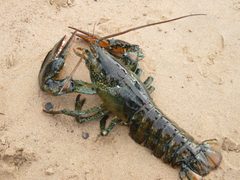
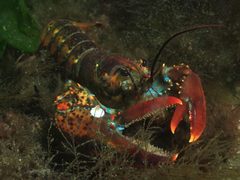
Homarus americanus is a large marine crustacean found on the Atlantic coast of North America. It is the heaviest crustacean in the world, capable of exceeding 20 kg and 64 cm body length. The is commercially important, supporting major fisheries from Labrador to New Jersey. It inhabits benthic environments from shallow coastal waters to depths exceeding 700 meters.
Pronunciation
How to pronounce Homarus americanus: /hoˈmaːrus æˌmɛrɪˈkeɪnəs/
These audio files are automatically generated. While they are not always 100% accurate, they are a good starting point.
Images
Habitat
Benthic marine environments including rocky substrates, cobble, and sediment bottoms. Found in coastal waters and continental shelf areas. Juveniles utilize structured including cobble fields and rocky crevices for shelter. range from intertidal zones to depths exceeding 700 meters, with highest densities typically in waters 4-50 meters deep. Temperature preferences range from 12-18°C, though the can tolerate broader ranges.
Distribution
Western Atlantic Ocean from Labrador, Canada south to New Jersey, USA. Center of abundance in the Gulf of Maine and Bay of Fundy. Records also exist from deeper waters off North Carolina and in European waters (France) from introductions or shipping-mediated transport.
Diet
and opportunistic feeder. Prey includes benthic such as crabs, sea urchins, mollusks, polychaete worms, and various crustaceans. Also consumes fish carrion and live fish when available. Diet varies with size, season, and . Postlarval and stages feed on small crustaceans and other planktonic organisms before transitioning to benthic foraging.
Life Cycle
Complex with planktonic larval stages. Females carry fertilized attached to pleopods for 9-11 months before hatching. Larvae pass through four distinct zoeal stages lasting 3-7 weeks, depending on temperature. Postlarvae (stage IV) undergo settlement transition to benthic . Juveniles frequently, with intermolt periods lengthening as size increases. Sexual maturity reached at approximately 5-7 years and 70-80 mm length for males, slightly later for females. Lifespan estimated at 50+ years in wild .
Behavior
forager, emerging from shelters to actively search for food after dusk. Exhibits behavioral , moving to preferred temperature ranges. are generally solitary and territorial, occupying and defending shelters in rocky or structured . Juveniles are more gregarious, often sharing shelter sites. Males engage in competitive interactions for access to females during mating season.
Ecological Role
Major benthic and scavenger in northwest Atlantic continental shelf . Controls of benthic including sea urchins and crabs. Serves as prey for large fish, seals, and other marine predators. and carrion feeding contribute to nutrient cycling. Burrowing and shelter construction activities modify benthic structure.
Human Relevance
One of the most economically valuable marine in North America, supporting commercial fisheries worth hundreds of millions of dollars annually. Subject to intensive management including minimum size limits, trap restrictions, and seasonal closures. Aquaculture research ongoing but commercial production limited. Listed as Least Concern by IUCN though regional pressure from overfishing, warming waters, and . Recreational fishery exists in some jurisdictions. Cultural icon of maritime New England and Atlantic Canada.
Similar Taxa
- Homarus gammarusEuropean lobster, distinguished by white spots on and , and different geographic range (eastern Atlantic from Norway to Morocco)
- Nephrops norvegicusNorway lobster or Dublin Bay prawn, much smaller with slender body, different preferences (muddy substrates), and distinct coloration (pale orange-pink)
More Details
Fishery Management
Subject to complex multi-jurisdictional management across US and Canadian waters. Regulations vary by region but commonly include minimum length (typically 83-127 mm depending on jurisdiction), prohibition on landing -bearing females, and trap limits. Some areas implement v-notching programs to mark and protect reproductive females.
Temperature Sensitivity
strongly influenced by bottom water temperature. Warming trends in southern portions of range (southern New England) associated with declines and increased of shell . Northern populations in Gulf of Maine currently experiencing warming-related distributional shifts.
Shell Disease
shell , caused by bacterial (primarily Aerococcus viridans), has emerged as significant threat in southern New England. Disease correlated with warming temperatures and appears to impair molting and increase mortality.
Sources and further reading
- BugGuide
- GBIF taxonomy match
- iNaturalist taxon
- NCBI Taxonomy
- Catalogue of Life
- A Funny Thing Happened on the Way to Bug Land | Bug Squad
- Congratulations, UC Davis Linnaean Games Team: National Champs! | Bug Squad
- Oklahoma is More than OK for Burying Beetles
- Bug Eric: A Couple of Weirdos
- Emerald Ash Borer Infestation of White Fringetree Found to be Widespread
- North America’s itsiest bitsiest longhorned beetle | Beetles In The Bush
- Biology of the lobster Homarus americanus
- Biology of the Lobster Homarus americanus
- Biology of the lobster Homarus americanus
- Behavioral thermoregulation and activity in Homarus americanus
- Feeding ecology of the postlarval lobster Homarus americanus
- Bay-scale habitat mapping of American lobster (Homarus americanus)
- EARLY LIFE HISTORY OF AMERICAN LOBSTERS (HOMARUS AMERICANUS) IN COASTAL SOUTHERN NEW ENGLAND WATERS
- Aerococcus viridans expression of Cpn60 is associated with virulence during infection of the American lobster, Homarus americanus Milne Edwards
- Growth and behavior during the settlement period of the American lobster, Homarus americanus
- Biochemical changes associated with embryonic and larval development in the American lobster Homarus americanus Milne Edwards
- EFFECT OF HABITAT BIOGEOCHEMICALS ON SURVIVAL OF LOBSTERS (HOMARUS AMERICANUS)
- Assessing the impact of habitat and stock enhancement for the American lobster (Homarus americanus), in Narragansett Bay, Rhode Island
- The bacterial community composition of American Lobster (Homarus americanus) embryos and recently hatched larvae held under experimental laboratory conditions.