
Andricus
Hartig, 1840
oak gall wasps
Species Guides
40- Andricus balanella
- Andricus brunneus(Clustered Gall Wasp)
- Andricus burnetti
- Andricus capillatus
- Andricus chinquapin(Small Oak Spindle Gall Wasp)
- Andricus chrysolepidicola(Irregular Spindle Gall Wasp)
- Andricus coconinoensis
- Andricus confertus(Convoluted Gall Wasp)
- Andricus cooki
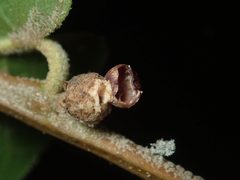
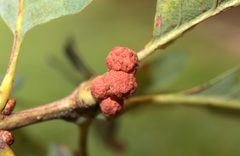
Andricus is a large and diverse of gall wasps in the Cynipidae, comprising approximately 375 —though many are considered taxonomically dubious. These tiny are obligate gall inducers on oaks (Quercus spp.), with each species typically restricted to one or a few closely related species. The genus exhibits complex involving alternation between sexual and , often on different oak hosts or plant organs. Andricus is the most diverse genus in the tribe Cynipini and has a distribution centered on the Northern Hemisphere, with species in Europe, Asia, North America, and Central America.

Pronunciation
How to pronounce Andricus: /ˈændrɪkəs/
These audio files are automatically generated. While they are not always 100% accurate, they are a good starting point.
Identification
Identification to level requires examination of gall , oak species, and microscopic features of . Galls are highly distinctive and often species-specific in shape, size, color, and location on the host plant (leaves, twigs, buds, or acorns). For adults, genitalic dissection is typically necessary for reliable identification. The can be distinguished from other Cynipini by the combination of: (1) gall induction on oaks, (2) , and (3) specific morphological characters of the metasomal and genitalia. Some (e.g., A. barriosi group in Central America) exhibit distinctive -reticulate on the second metasomal tergum.
Images
Habitat
Associated with oak-dominated forests, woodlands, and savannas. occupy diverse from Mediterranean scrub and temperate deciduous forests to tropical montane oak forests. Habitat specificity is largely determined by oak distribution and local climate conditions suitable for gall development.
Distribution
Widespread in the Northern Hemisphere with centers of diversity in the Palearctic (Europe, Mediterranean, western Asia) and Nearctic (eastern and western North America). Present in East Asia (China, Japan, Korea), Central America (first record from Panama in 2019), and introduced in some regions. Distribution patterns of individual often closely track their specific oak species.
Seasonality
Activity patterns vary by type. Sexual generations typically emerge and reproduce in spring (March–May in temperate regions), with galls developing through summer. generations often emerge in late summer to fall (August–November), with as or larvae in buds or twigs. Some exhibit extended periods or staggered cohorts depending on local climate and .
Host Associations
- Quercus - obligate gall inducerAll induce galls on oaks. specificity ranges from monophagous (single oak species) to oligophagous (closely related oak species, often within a single section). Different of the same species may use different host oak species or different plant organs on the same host.
- Quercus suber - for sexual Specifically for A. quercuslanigera; uses Q. canariensis
- Quercus canariensis - for Specifically for A. quercuslanigera; sexual uses Q. suber
- Quercus mongolica - for A. koreanus in Korea
- Quercus bumelioides - for A. barriosi in Panama
- Quercus insignis - for A. barriosi in Panama
- Quercus muhlenbergii - for A. dimorphus
- Quercus stellata - for A. pattoni
- Quercus alba - for some Andricus producing leaf or twig galls
Life Cycle
Heterogonic with obligate alternation between sexual and (agamic) . Sexual generation produces males and females that reproduce sexually; asexual generation produces only parthenogenetic females. Sex determination is haplodiploid: males develop from unfertilized (haploid) , females from fertilized () eggs. The two generations often differ morphologically and may induce structurally distinct galls on different oak or different plant organs. In some cases, the two generations were historically described as separate species until their life cycle connection was established through laboratory rearing or molecular data. Development occurs entirely within the gall, with larvae feeding on gall tissue and pupating in a specialized chamber before .
Behavior
Females use their ovipositor like a hypodermic needle to inject into actively growing oak tissues (leaves, buds, twigs, or acorns). Larvae do not feed directly on plant tissue but secrete plant growth-like substances that induce gall formation, creating a specialized structure that provides both food and shelter. typically emerge by chewing an exit hole through the gall wall. Some exhibit race formation through allochronic isolation and assortative mating associated with shifts to new host species.
Ecological Role
Gall induction creates novel plant structures that support complex . Galls serve as food and for specialized , , and . Some Andricus are resource-limited by competition for acorns or other structures. The contributes to oak reproductive dynamics and may influence acorn production in some species. Galls and their associated insects represent model systems for studying plant-insect , host race formation, and speciation.
Human Relevance
Some galls have traditional medicinal uses; extracts of A. quercustozae galls show strong antioxidant activity and high phenolic content, with potential applications in food, medicinal, and pharmaceutical industries. Galls generally cause minimal economic damage to oaks and rarely require management. The complex and associations make Andricus valuable for studying evolutionary , speciation, and ecological specialization. Some species have been introduced outside their native ranges.
Similar Taxa
- DisholcaspisAlso induces galls on oaks, but differs in : Disholcaspis often lack males entirely (), producing only females, whereas Andricus has alternating sexual and with both sexes present in the sexual generation. Gall also differs, with Disholcaspis often producing detachable twig galls.
- CynipsEuropean gall wasp with similar alternation, but differs in gall (often spherical or irregular leaf galls) and associations. Cynips are primarily Palearctic and have distinct morphological characters.
- AtruscaInduces distinctive galls on oaks, particularly in North America. Atrusca quercuscentricola produces colorful, volcano-shaped leaf galls on post oak, differing from typical Andricus galls in shape and gall wall structure.
More Details
Taxonomic Uncertainty
The of Andricus is notably unstable, with approximately 375 described but many considered dubious. Species descriptions have historically been based on single or gall alone, leading to inflated species counts. Modern integrative taxonomy combining morphology, molecular data, and studies has revealed numerous synonymies and cryptic .
Host Race Formation
Andricus mukaigawae provides a well-documented example of incipient speciation through race formation. Two host races exhibit allochronic isolation in their sexual due to differences in host oak , with assortative mating and genetic divergence in ovipositional preference.
Inquiline Associations
Some Andricus exhibit complex ecological relationships with —insects that inhabit galls without inducing them. A. katilmisi from Türkiye shows an unusual combination of gall induction and inquiline associations that may represent an evolutionary transition in life strategy.
Sources and further reading
- BugGuide
- Wikipedia
- GBIF taxonomy match
- iNaturalist taxon
- NCBI Taxonomy
- Catalogue of Life
- Gall darn it! Gall insects on hickory, oak, and elm, Phylloxera caryaecaulis, Andricus palustris, Colopha ulmicola — Bug of the Week
- Cynipidae | Beetles In The Bush
- The Insects Behind the Weird Growths on Plants
- Ted C. MacRae | Beetles In The Bush | Page 8
- A new species of Andricus Hartig (Hymenoptera: Cynipidae: Cynipini) from South Korea, Andricus koreanus sp. nov.
- ‘Closing the Life Cycle’ of Andricus quercuslanigera (Hymenoptera: Cynipidae)
- An integrative taxonomic approach to describe Andricus pseudomultiplicatus sp. nov. and establish new synonymies in Andricus Hartig, 1840 (Hymenoptera: Cynipidae: Cynipini)
- The population dynamics of the gall wasp Andricus quercuscalicis
- Investigation of the Antioxidant Activity and Phenolic Compounds of Andricus quercustozae Gall and Host Plant (Quercus infectoria)
- The Paths of the Galls: Differences in the Ecology and Distribution of Two European Oak Gall Wasps Andricus dentimitratus and Andricus pictus
- Another brushstroke on the cynipoid painting: a new species of Andricus (Hymenoptera: Cynipidae: Cynipini) from Türkiye
- Erratum to: “ ‘Closing the Life Cycle’of Andricus quercuslanigera (Hymenoptera: Cynipidae)”
- Andricus protuberans n. sp. (Hymenoptera: Cynipidae: Cynipini), a new species of oak gallwasp from Mexico
- EVOLUTIONARY SHIFTS BETWEEN HOST OAK SECTIONS AND HOST-PLANT ORGANS IN ANDRICUS GALLWASPS
- Two Host Races in Andricus mukaigawae (MUKAIGAWA) (Hymenoptera:Cynipidae)
- Correction to: ‘Closing the life cycle’ of Andricus quercuslanigera (Hymenoptera: Cynipidae)
- Host race formation in the gall wasp Andricus mukaigawae
- EVOLUTIONARY SHIFTS BETWEEN HOST OAK SECTIONS AND HOST-PLANT ORGANS IN ANDRICUS GALLWASPS
- Andricus Barriosi: a new species of oak gall wasp (Hymenoptera: Cynipidae: Cynipini) from Panama