
Andricus chrysolepidicola
Irregular Spindle Gall Wasp, irregular-spindle gall wasp
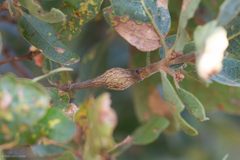
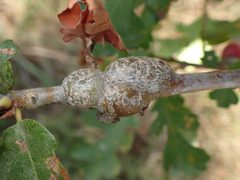
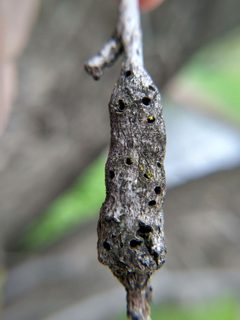
Andricus chrysolepidicola is a cynipid gall wasp that induces distinctive stem galls on several oak in western North America. The species exhibits a complex with alternating : first-year unisexual produce irregular spindle-shaped stem galls, while second-year bisexual wasps induce bud galls. The species is primarily documented from California but has been recorded elsewhere along the Pacific coast and eastward to Nevada.
Pronunciation
How to pronounce Andricus chrysolepidicola: /ˈæn.drɪ.kəs ˌkraɪ.soʊˌlɛp.ɪˈdɪ.kə.lə/
These audio files are automatically generated. While they are not always 100% accurate, they are a good starting point.
Identification
The galls of Andricus chrysolepidicola are irregular spindle-shaped stem galls found on blue oak, valley oak, scrub oak, and leather oak. These galls are produced by the first-year unisexual and differ from the bud galls formed by the second-year bisexual generation. The specific epithet 'chrysolepidicola' references association with golden-scaled oaks (Quercus chrysolepis group), though the has been documented on multiple white oak species.
Images
Habitat
Found in oak-dominated including oak woodlands, savannas, and scrublands where oak occur. Host oaks include blue oak (Quercus douglasii), valley oak (Q. lobata), scrub oak (Q. berberidifolia), and leather oak (Q. durata).
Distribution
Primarily known from California. Recorded elsewhere along the Pacific coast and inland to Nevada. The distribution corresponds with the range of its oak in western North America.
Host Associations
- Quercus douglasii - induces stem galls (first ) and bud galls (second generation)blue oak
- Quercus lobata - induces stem galls (first ) and bud galls (second generation)valley oak
- Quercus berberidifolia - induces stem galls (first ) and bud galls (second generation)scrub oak
- Quercus durata - induces stem galls (first ) and bud galls (second generation)leather oak
Life Cycle
Alternating with two distinct . First year: unisexual emerge and induce irregular spindle-shaped stem galls on oaks. Second year: bisexual wasps emerge from stem galls and induce bud galls. This pattern of alternating unisexual and bisexual generations is characteristic of many Andricus .
Ecological Role
As a gall inducer, manipulates oak tissue to create specialized structures that provide food and shelter for developing larvae. The galls represent a form of plant-insect interaction where the hijacks normal plant developmental processes through chemical secretions that influence plant and .
Similar Taxa
- Other Andricus speciesMany Andricus induce galls on oaks, but A. chrysolepidicola is distinguished by its specific associations with western oak species and the irregular spindle shape of its first- stem galls. The combination of host identity, gall , and geographic location in western North America helps differentiate this species from eastern Andricus species such as A. quercuscalifornicus or A. parmula.