
Andricus dimorphus
Beutenmuller, 1913
Clustered Midrib Gall Wasp
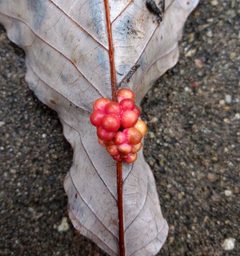
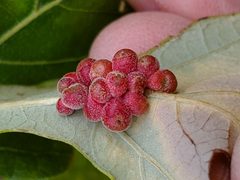
Andricus dimorphus, commonly known as the clustered midrib , is a cynipid that induces distinctive galls on oak leaves. The forms clusters of up to 50 globular, red-brown galls along the midrib on the abaxial (underside) surface of white oak leaves, beginning in late summer. emerge from galls the following year. The species was first described by William Beutenmuller in 1913 as Cynips dimorphus and later transferred to Andricus via the Adleria.
Pronunciation
How to pronounce Andricus dimorphus: //ænˈdraɪkəs daɪˈmɔːrfəs//
These audio files are automatically generated. While they are not always 100% accurate, they are a good starting point.
Identification
Distinguished from other oak gall wasps by the clustered arrangement of galls specifically along the leaf midrib on the abaxial surface. The globular shape with pointed base and red-brown coloration, combined with formation in late summer on white oak , separates this species from other Andricus species. Andricus pattoni, found on post oak (Quercus stellata), forms galls scattered across the leaf surface rather than clustered on the midrib. Disholcaspis species typically form twig galls rather than leaf galls.
Images
Habitat
Found in deciduous forests and woodlands where white oak occur. Galls develop on living oak leaves in late summer. The requires mature oak trees with adequate leaf tissue for gall formation.
Distribution
Central and eastern North America, throughout the range of its oak . Documented from Missouri and surrounding states where Quercus macrocarpa, Q. alba, Q. prinoides, and Q. bicolor occur.
Seasonality
Gall formation begins in late summer. emerge from galls the following year; specific timing not precisely documented but occurs after winter dormancy period.
Diet
Larvae feed on specialized gall tissue induced on oak leaves. likely feed on nectar or honeydew, though specific adult diet not documented.
Host Associations
- Quercus macrocarpa - bur oak, confirmed
- Quercus alba - white oak, confirmed
- Quercus prinoides - dwarf chinkapin oak, confirmed
- Quercus bicolor - swamp white oak, confirmed
- Quercus muhlenbergii - chinquapin oak, observed
Life Cycle
female lays in developing leaf tissue using ovipositor. Larva hatches and secretes plant growth inducing gall formation. Larva develops inside gall, feeding on specialized tissue. occurs within gall. Adult emerges by chewing exit hole. Gall clusters readily detach from leaf when mature. and may inhabit galls.
Behavior
Females use ovipositor to inject into leaf tissue; ovipositor functions like hypodermic needle but cannot sting humans. Gall induction involves chemical manipulation of plant to redirect plant growth. Galls detach readily when mature, potentially aiding in pupal development or .
Ecological Role
Galls provide microhabitat for and . The functions as a gall inducer that manipulates oak leaf development, creating specialized feeding structures. Role in broader not extensively documented.
Human Relevance
No direct economic importance. Galls may cause minor aesthetic damage to ornamental oaks but are not considered significant pests. Subject of ecological and evolutionary study due to specialized plant-insect interaction.
Similar Taxa
- Andricus pattoniAlso forms leaf galls on oaks, but galls are scattered across leaf surface rather than clustered on midrib; occurs on post oak (Quercus stellata) rather than white oak .
- Disholcaspis quercusglobulusForms round, detachable galls on oak twigs rather than leaves; single or small clusters rather than large midrib clusters.
More Details
Taxonomic History
Originally described as Cynips dimorphus by William Beutenmuller in 1913. The name was preoccupied (Cynips dimorphus Ashmead, 1889), but Beutenmuller's was retained. Transferred to Adleria, then subsequently included within Andricus.
Gall Characteristics
Galls are notable for their clustered arrangement specifically along the midrib, their pointed base, and their tendency to detach readily from the leaf. This detachment contrasts with many other cynipid galls that remain firmly attached.
Sources and further reading
- BugGuide
- Wikipedia
- iNaturalist taxon
- Cynipidae | Beetles In The Bush
- Ted C. MacRae | Beetles In The Bush | Page 8
- Arthropoda | Beetles In The Bush | Page 7
- Gall darn it! Gall insects on hickory, oak, and elm, Phylloxera caryaecaulis, Andricus palustris, Colopha ulmicola — Bug of the Week
- Sex Attraction Pheromone Improves Detection of a Threatened Beetle
- The Insects Behind the Weird Growths on Plants