
Disholcaspis quercusglobulus
(Fitch, 1859)
Round Bullet Gall Wasp
Disholcaspis quercusglobulus, commonly known as the round bullet gall wasp, is a of cynipid gall wasp that forms distinctive round, detachable galls on oak twigs. Unlike many gall wasps that affect leaves, this species targets twigs of white oak and related species. The species exhibits an unusual reproductive strategy: all galls produce only female , which emerge in fall and immediately lay in twigs to produce the next without males. This parthenogenetic has been documented across multiple Disholcaspis species.
Pronunciation
How to pronounce Disholcaspis quercusglobulus: //daɪˌsɒlkəsˈpɪs ˌkwɜːrkəsˈɡloʊbjələs//
These audio files are automatically generated. While they are not always 100% accurate, they are a good starting point.
Identification
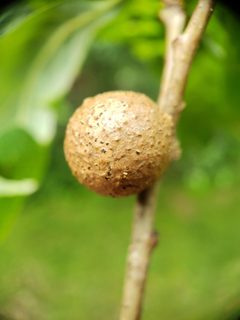
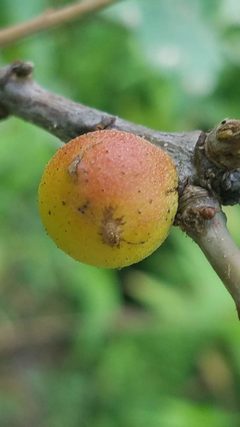
The round, detachable galls on oak twigs distinguish this from leaf-galling cynipids. The galls of D. quercusglobulus are specifically formed on twigs of Quercus alba (white oak) and Q. muhlenbergii (chinquapin oak), appearing as smooth, rounded, bullet-like structures. Similar twig-galling species in the may be distinguished by gall and specificity, though precise differentiating characters require knowledge.
Images
Appearance
The is small and typical of cynipid gall wasps in general . The galls are round, bullet-shaped structures attached to oak twigs, appearing singly or in small clusters. They are detachable from the twig and have a smooth, rounded exterior. Gall coloration and exact size are not explicitly documented in available sources.
Habitat
Found in deciduous forests where oaks occur, particularly dry-mesic upland oak forests. The has been observed in Missouri's Ozark region and similar eastern North American oak-dominated woodlands.
Distribution
Eastern United States, with documented records from Vermont and Missouri. The occurs where oaks (Quercus alba, Q. muhlenbergii) are present.
Seasonality
emerge from galls during fall. The galls themselves are present on twigs through the growing season and may persist into winter.
Host Associations
- Quercus alba - White oak; primary for gall formation on twigs
- Quercus muhlenbergii - Chinquapin oak; documented in Missouri
Life Cycle
The involves parthenogenetic . Female emerge from galls in fall and immediately oviposit into oak twigs. The developing larvae induce gall formation, with all resulting wasps being female. No male wasps are produced. This eliminates the need for mating and allows rapid establishment.
Behavior
females emerge in autumn and promptly lay in twigs of oaks. The does not exhibit complex behavioral repertoires beyond host location and oviposition.
Ecological Role
As a gall-former, the modifies plant tissue for larval development. The galls may provide microhabitat for other organisms, though specific or are not documented in available sources. The contributes to oak-associated biodiversity in eastern deciduous forests.
Human Relevance
No significant economic or medical importance. The galls are primarily of ecological and natural history interest. The is occasionally encountered during or entomological field work in oak forests.
Similar Taxa
- Other Disholcaspis speciesApproximately a dozen also form twig galls on oaks; distinguished by gall details and specificity
- Leaf-galling Cynipidae (e.g., Andricus, Neuroterus)Affect leaves rather than twigs; galls are typically flat, spherical, or irregular structures on leaf surfaces or midribs, not detachable bullet-shaped twig galls
More Details
Parthenogenesis
D. quercusglobulus belongs to a where all studied have eliminated males from their . This form of (thelytoky) is stable and obligate, with females producing only female offspring. This reproductive strategy is relatively uncommon among insects but has evolved independently in several cynipid lineages.