
Disholcaspis
Dalla Torre & Kieffer, 1910
Species Guides
17- Disholcaspis bassetti
- Disholcaspis canescens(Round Honeydew Gall Wasp)
- Disholcaspis cinerosa(Mealy oak gall wasp)
- Disholcaspis eldoradensis(Honeydew Gall Wasp)
- Disholcaspis globosa(Globular root gall)
- Disholcaspis lacuna
- Disholcaspis pedunculoides
- Disholcaspis perniciosa
- Disholcaspis prehensa(clasping twig gall wasp)
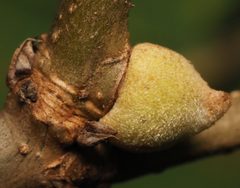
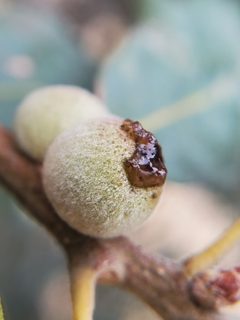
Disholcaspis is a of gall wasps in the Cynipidae containing more than 40 described . Species in this genus induce characteristic galls on oak trees (Quercus spp.), with gall varying by species and . Some species produce galls that secrete honeydew, establishing facultative mutualisms with ants that defend the galls from . The genus exhibits heterogony, with alternating sexual and parthenogenetic generations that typically produce different gall forms.
Pronunciation
How to pronounce Disholcaspis: //daɪˌhɒlˈkæspɪs//
These audio files are automatically generated. While they are not always 100% accurate, they are a good starting point.
Identification
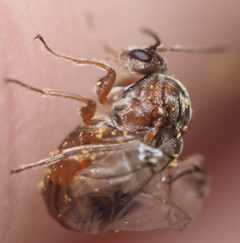
Galls induced by Disholcaspis are often spherical, detachable, or bullet-shaped structures on oak leaves, twigs, or stems. Specific identification to species level requires examination of gall , oak species, and type (sexual vs. ), as these are highly host-specific and generation-specific in gall form. wasps are small, typically 2–5 mm, with reduced wing venation characteristic of Cynipidae.
Images
Habitat
Associated with oak forests and woodlands, specifically with trees in the Quercus. have been documented in dry-mesic upland deciduous forests, scrub oak , and riparian zones with oaks. Gall location varies by species: leaf undersides, twigs, stems, or buds.
Distribution
North America (primary range), with documented from the western United States (California, Oregon), eastern and central United States, and Mexico. First records from the Neotropics include Panama and Rica, where species occur on Quercus bumelioides and Q. lancifolia. Specific distribution varies by species; D. erugomamma is known from Texas, D. costaricensis from Costa Rica.
Seasonality
Activity patterns follow the heterogonous : sexual typically emerge and reproduce in spring, with corresponding galls forming on new growth; (agamic) generations emerge in late autumn or winter, producing the more conspicuous hard galls. Exact timing varies by and geographic location.
Diet
Larvae feed on nutritive tissue within the galls they induce on oak plants. The gall tissue provides both shelter and food source for developing larvae.
Host Associations
- Quercus - primary plant for gall induction-level association; -specific relationships documented for individual Disholcaspis species including Q. gambelii, Q. lobata, Q. virens, Q. muhlenbergii, Q. bumelioides, Q. lancifolia, and others
- Quercus virens - for D. quercusvirensSexual develops in galls on live oak; generation produces spherical detachable galls on leaf undersides
- Quercus lobata - for D. eldoradensisGalls secrete sucrose; subject of mutualism studies
- Quercus gambelii - for multiple Disholcaspis Three documented on this in Colorado Front Range area
- Quercus bumelioides - for D. costaricensis and D. bettyannaeNeotropical
- Quercus lancifolia - for D. bisethiaeDocumented from Panama
Life Cycle
Heterogonous (): sexual with winged males and females produces one type of gall, typically smaller and on buds, flowers, or young leaves; parthenogenetic generation with wingless females produces larger, harder, more conspicuous galls on leaves, twigs, or stems. Larvae develop inside galls, pupate, and emerge as . Some require molecular or detailed morphological study to link sexual and asexual generations.
Behavior
Female inject substances from enlarged venom glands into plant tissue during oviposition, triggering gall formation. Some produce galls that actively secrete honeydew or sucrose from their surfaces while larvae are active. This secretion attracts ants, wasps, and bees that tend the galls and defend them against .
Ecological Role
Gall inducers that manipulate oak plant tissue to create protected larval . Some engage in facultative mutualisms with ants, where defense reduces attack rates by 36% and increases gall wasp success. These mutualisms can alter parasitoid composition, acting as selective filters on local parasitoid . Galls serve as microhabitats for and parasitoids.
Human Relevance
Galls generally cause cosmetic damage only and do not threaten tree health. Some may be of interest in research due to mutualisms. Alfred C. Kinsey, known for human sexuality research, began his scientific career with two decades of cynipid study.
Similar Taxa
- AndricusBoth are Cynipini inducing galls on oaks; Andricus often produce complex clustered or multi-chambered galls (e.g., hedgehog galls, artichoke galls) rather than the simpler spherical or bullet-shaped galls typical of many Disholcaspis
- AcraspisOak gallers with similar associations; Acraspis such as A. macrocarpae produce jewel-like spherical galls on bur oak leaves, distinguished by crystalline or highly polished surface texture not typical of Disholcaspis
- DiplolepisRose gallers in same ; induce structurally distinct galls on Rosa rather than oaks, with mossy rose galls and spiny bedeguar galls being characteristic forms
- TrichoterasWestern North American oak gallers; T. tubifaciens produces distinctive crystalline tube galls on Oregon oak, differing from Disholcaspis bullet galls in form and gall wall structure
Sources and further reading
- BugGuide
- Wikipedia
- GBIF taxonomy match
- iNaturalist taxon
- NCBI Taxonomy
- Catalogue of Life
- Gall-Inducing Wasps Have Enlarged Venom Glands, Study Finds
- Coccinelidae | Beetles In The Bush
- The Insects Behind the Weird Growths on Plants
- Bug Eric: Wasp Wednesday: Gall Wasps
- Contributions to Disholcaspis Dalla Torre And Kieffer (Hymenoptera: Cynipidae: Cynipini)
- A new species of Disholcaspis Dalla Torre and Kieffer oak gallwasp from Costa Rica (Hymenoptera: Cynipidae: Cynipini)
- Life Cycle ofDisholcaspis quercusvirens(Hymenoptera: Cynipidae) with a Description of the Sexual Generation
- The complex trophic community of Disholcaspis eldoradensis , a sucrose‐secreting cynipid gall wasp of Quercus lobata
- Ant mutualists alter the composition and attack rate of the parasitoid community for the gall wasp Disholcaspis eldoradensis (Cynipidae)
- Description and Biology of the Sexual Generation of Disholcaspis quercusmamma (Walsh and Riley) (Hymenoptera: Cynipidae), with Notes on Associated Parasitoids
- Life History, Natural Enemies, and Management of <I>Disholcaspis quercusvirens</I> (Hymenoptera: Cynipidae) on Live Oak Trees
- First record of the genus Disholcaspis Dalla Torre & Kieffer (Hymenoptera: Cynipidae: Cynipini) in the Neotropics, with description of two new species from Panama