
Andricus chinquapin
(Fitch, 1859)
Small Oak Spindle Gall Wasp
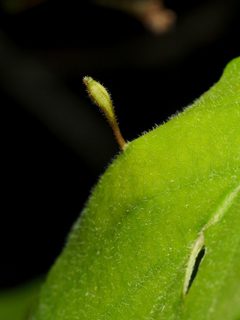
Andricus chinquapin is a cynipid gall wasp that induces distinctive spindle-shaped galls on oaks, particularly in the white oak group including Quercus muhlenbergii (chinquapin oak). The species was described by Fitch in 1859. Like other Andricus species, it exhibits high specificity, with galls forming on leaf tissues where larvae develop inside the protective structure. The are tiny, typically measuring only a few millimeters in length.
Pronunciation
How to pronounce Andricus chinquapin: //ænˈdraɪkəs ˌtʃɪŋkwəˈpɪn//
These audio files are automatically generated. While they are not always 100% accurate, they are a good starting point.
Identification
Distinguished from other Andricus by the distinctive spindle-shaped gall on chinquapin oak and related white oaks. The elongated, tapering form differs from the round bullet galls of Disholcaspis species or the clustered midrib galls of Andricus dimorphus. Galls of A. chinquapin are typically solitary or in small numbers on leaf , not densely clustered. The association with Quercus muhlenbergii is diagnostic where ranges overlap.
Images
Habitat
Found in deciduous forests and woodlands where oaks occur, particularly in dry-mesic upland forests. Associated with supporting Quercus muhlenbergii (chinquapin oak) and related white oak .
Distribution
Eastern and central North America, with records from the Midwest and eastern United States. Documented in Missouri and surrounding states where chinquapin oak occurs naturally.
Seasonality
timing not precisely documented for this ; likely follows the typical cynipid pattern with spring emergence for sexual and late summer/fall for parthenogenetic generation. Galls are visible on leaves from late spring through leaf fall and may persist on fallen leaves through winter.
Host Associations
- Quercus muhlenbergii - plantChinquapin oak; primary for gall induction
- Quercus stellata - plantPost oak; occasional
- Quercus alba - plantWhite oak; occasional within white oak group
Life Cycle
Exhibits the typical cynipid , though specific details for A. chinquapin are not well documented. Sexual produces males and females that mate and lay in buds or leaves; parthenogenetic generation produces only females. Larvae develop within galls, pupate inside, and chew exit holes to emerge.
Behavior
Females use the ovipositor to insert into developing leaf tissue. Larval secretions induce the formation of the spindle-shaped gall, which provides both nutrition and protection. are short-lived and primarily focused on .
Ecological Role
Acts as a herbivore on oaks, with minimal impact on overall tree health. Galls may provide microhabitat for (other insects that occupy galls without inducing them) and . Contributes to the high diversity of gall-forming insects associated with oak .
Human Relevance
No direct economic importance. Galls may be noticed by naturalists and botanists as indicators of insect activity. The contributes to biodiversity documentation and understanding of plant-insect interactions.
Similar Taxa
- Andricus dimorphusAlso occurs on chinquapin oak, but forms clustered midrib galls rather than solitary spindle-shaped galls
- Disholcaspis quercusglobulusForms round, detachable bullet galls on twigs rather than spindle-shaped leaf galls
- Andricus pattoniAnother leaf-galling Andricus on post oak, but produces different gall (irregular, not distinctly spindle-shaped)
More Details
Gall morphology
The spindle gall form is characteristic and gives rise to the . The elongated shape with tapered ends distinguishes it from the more spherical or irregular galls of related .
Research needs
Detailed studies, including precise timing of and documentation of alternate if any, remain to be completed for this .