
Andricus confertus
Convoluted Gall Wasp
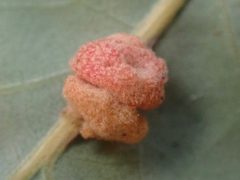
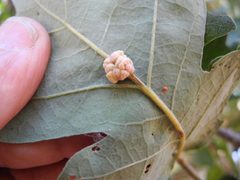
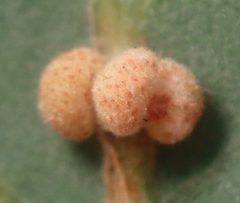
Andricus confertus is a cynipid gall wasp to California that induces distinctive pink, brain-like clustered galls on the underside of valley oak (Quercus lobata) leaves along the midrib. The reproduces parthenogenetically, with female larvae initiating gall formation in summer and emerging the following spring. The galls are composite structures formed by multiple individual galls growing in close proximity.
Pronunciation
How to pronounce Andricus confertus: /ˈændrɪkəs kənˈfɜrtəs/
These audio files are automatically generated. While they are not always 100% accurate, they are a good starting point.
Identification
The pink, brain-like, clustered galls on the underside of valley oak leaves along the midrib are diagnostic. The clustered nature distinguishes these from single galls produced by other Andricus . Gall location on the leaf midrib and association with Quercus lobata provide additional confirmation.
Images
Appearance
females are brown with lighter markings and measure approximately 2.5 mm in length. The galls are pink, convoluted, and brain-like in appearance, forming as clusters of individual galls on the abaxial leaf surface.
Habitat
Associated with valley oak (Quercus lobata) in California oak woodlands and savannas. Gall formation occurs on the abaxial surface of leaves.
Distribution
California, North America. to this region.
Seasonality
Gall induction by parthenogenetic female larvae occurs in summer. emerge the following spring.
Host Associations
- Quercus lobata - gall Valley oak; galls induced on underside of leaves along midrib
Life Cycle
Parthenogenetic . Female larvae induce galls in summer on developing valley oak leaves. Larvae develop within the galls through fall and winter. emerge from galls the following spring.
Behavior
Female use their ovipositor to inject into leaf tissue, triggering gall formation through chemical secretions that manipulate plant growth .
Ecological Role
Gall formation creates specialized microhabitats that may support insects and . The galls represent a form of plant manipulation that redirects resources for development.
Human Relevance
The distinctive galls are of interest to naturalists and entomologists studying plant-insect interactions. No significant economic impact on oak trees has been documented.
Similar Taxa
- Andricus dimorphusAlso produces clustered galls on oak leaf midribs, but on chinquapin oak (Quercus muhlenbergii) in eastern North America rather than California
- Other Andricus speciesMany Andricus induce oak galls, but A. confertus is distinguished by its pink, brain-like clustered specific to valley oak in California
More Details
Gall structure
The brain-like appearance results from multiple individual galls growing in close proximity, forming a composite cluster rather than a single gall structure.
Reproductive mode
The has been observed to reproduce parthenogenetically, with female larvae producing the next of females without male involvement.
Sources and further reading
- BugGuide
- Wikipedia
- iNaturalist taxon
- Bembicid Holdings | Entomology Research Museum
- Gall darn it! Gall insects on hickory, oak, and elm, Phylloxera caryaecaulis, Andricus palustris, Colopha ulmicola — Bug of the Week
- Cynipidae | Beetles In The Bush
- The Insects Behind the Weird Growths on Plants
- Ted C. MacRae | Beetles In The Bush | Page 8