
Copidosoma
Ratzeburg, 1844
copidosoma wasp
Species Guides
5Copidosoma is a of chalcid wasps in the Encyrtidae, comprising over 200 of polyembryonic . These deposit one or two into Lepidoptera eggs, which then proliferate into thousands of genetically identical embryos. A unique system produces two larval morphs: sterile soldiers that defend the host from competitors and reproductive larvae that consume the host and emerge as . The genus has been extensively studied for its extreme clonal and is widely used in programs against agricultural pests.
Pronunciation
How to pronounce Copidosoma: /ˌkoʊpɪˈdɒsəmə/
These audio files are automatically generated. While they are not always 100% accurate, they are a good starting point.
Identification
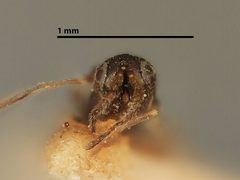
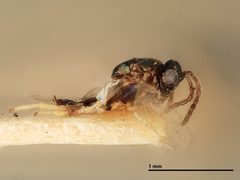
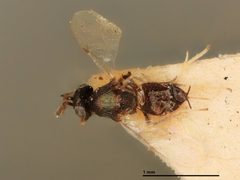
Small chalcid wasps, typically 1–2 mm in length. Members of this are distinguished from other Encyrtidae by their polyembryonic development and the presence of a soldier . -level identification requires examination of morphological characters including segmentation, wing venation patterns, and body coloration. Norwegian species can be identified using the dichotomous key provided by Guerrieri & Noyes (2013), which separates both sexes based on antennal club structure, mesoscutal , and ovipositor length.
Images
Habitat
Associated with agricultural and natural environments where Lepidoptera occur. Found in crop systems including soybean fields, potato storage facilities, wheat fields, and tomato growing regions where specific host are present.
Distribution
distribution with records from North America (California, Florida, Arkansas), South America (Bolivia), Europe (Norway, with 16 recognized including one newly described), Hawaii (introduced), and Asia (China, Japan).
Host Associations
- caterpillars (Lepidoptera) - -larval ; eggs deposited in eggs, larvae develop within host caterpillars. Specific host associations vary by group: C. cervius group parasitizes Geometridae; nacoliae group parasitizes Pyralidae and Tortricidae. C. floridanum parasitizes Plusiinae including soybean looper (Chrysodeixis includens) and tomato looper (Chrysodeixis chalcites); C. koehleri parasitizes potato tuber moth (Phthorimaea operculella); C. primulum parasitizes cotton bollworm (Helicoverpa armigera).
Life Cycle
Polyembryonic development: female oviposit into . Following host egg hatch, the wasp egg undergoes proliferation, producing up to 3,055 genetically identical embryos that form a polymorula. Embryos differentiate into two : soldier larvae (approximately 24% of in C. floridanum) that emerge early, patrol the host hemocoel, and attack competing ; and reproductive larvae that complete development, kill the host in its final instar, and pupate. emerge approximately two weeks after host death. Female wasps develop from fertilized eggs; males from unfertilized eggs. Male eggs produce fewer soldiers than female eggs, and male soldiers of C. floridanum lack aggression.
Behavior
Soldier exhibits aggressive defense , attacking heterospecific and competitors within the shared . In multiparasitized hosts, soldiers from the first-established female kill larvae from subsequently laid . Female soldiers from earlier broods tolerate older male broods from different mothers, enabling coexistence. Soldier production increases rapidly (within 16 hours) in response to detection of competitor eggs, triggered by egg recognition. This plastic response is specific to and is not induced by heat shock or bacterial .
Ecological Role
agent for agricultural pest Lepidoptera. Acts as a regulator of that damage crops. The soldier mediates competitive interactions within the , influencing community structure in shared resources.
Human Relevance
Intentionally introduced as agents in multiple regions. C. floridanum was introduced to Hawaii to control the tomato looper (Chrysodeixis chalcites). C. koehleri is used extensively for control of the potato tuber moth (Phthorimaea operculella) in stored potatoes, though control efficacy is limited. C. primulum has been deployed in China to control the cotton bollworm (Helicoverpa armigera) in wheat crops. The serves as a model organism for studying , evolution, and clonal development, with C. floridanum sequenced as part of the i5K project.
Similar Taxa
- Microplitis demolitorBoth are endoparasitoids of Noctuidae caterpillars including soybean looper, but Microplitis is a solitary braconid producing single offspring per rather than polyembryonic , and lacks a soldier .
- LitomastixFormerly treated as a distinct , now synonymized under Copidosoma (e.g., C. thebe is senior synonym of L. claviger). Historical literature may use this name for now placed in Copidosoma.
Sources and further reading
- BugGuide
- Wikipedia
- GBIF taxonomy match
- iNaturalist taxon
- NCBI Taxonomy
- Catalogue of Life
- Scientists Reveal New Method to Characterize Physiological Responses to Parasitism | Bug Squad
- Encyrtid Holdings | Entomology Research Museum
- Copidosoma floridanum Archives - Entomology Today
- This Wasp's Larvae Sometimes Grow Hundreds of Soldier Clones—But Why?
- Transcriptome analysis of a polyembryonic parasitoidCopidosoma floridanum
- The Norwegian species of Copidosoma Ratzeburg (Hymenoptera: Chalcidoidea: Encyrtidae)
- Unisexual broods and sex ratios in a polyembryonic encyrtid parasitoid (Copidosoma sp.: Hymenoptera)
- Analysis of molecular mechanism for acceleration of polyembryony using gene functional annotation pipeline in Copidosoma floridanum
- The polyembryonic development of Copidosoma gelechiae with notes on its biology
- Chromosome Number of the Polyembryonic Parasitoid Copidosoma floridanum (Hymenoptera: Encyrtidae)
- Analysis of molecular mechanism for acceleration of polyembryony using gene functional annotation pipeline in Copidosoma floridanum
- The parasitoid Copidosoma koehleri provides limited control of the potato tuber moth, Phthorimaea operculella, in stored potatoes
- Long-read genome assembly of the Japanese parasitic wasp Copidosoma floridanum (Hymenoptera: Encyrtidae)
- Analysis of molecular mechanism for acceleration of polyembryony using gene functional annotation pipeline in Copidosoma floridanum
- Effects of Diflubenzuron onPseudoplusia includens(Lepidoptera: Noctuidae) and its ParasitoidCopidosoma floridanum(Hymenoptera: Encyrtidae)
- Tritrophic Interactions Among Linear Furanocoumarins, the Herbivore Trichoplusia ni (Lepidoptera: Noctuidae), and the Polyembryonic Parasitoid Copidosoma floridanum (Hymenoptera: Encyrtidae)