
Copidosoma floridanum
(Ashmead, 1900)
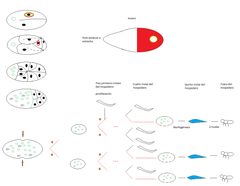
Copidosoma floridanum is a polyembryonic in the Encyrtidae, notable for producing the largest recorded of any parasitoidal insect—up to 3,055 individuals from a single . Females oviposit into the eggs of plusiine moths, and the resulting embryos undergo clonal division to form genetically identical siblings. The brood develops into two distinct : reproductive larvae that emerge as wasps, and sterile soldier larvae that defend their siblings from competitors.
Pronunciation
How to pronounce Copidosoma floridanum: /ˌkɒpɪˈdɑːsəmə flɔːrɪˈdeɪnəm/
These audio files are automatically generated. While they are not always 100% accurate, they are a good starting point.
Identification
Distinguished from other Encyrtidae by its polyembryonic reproductive mode and production of a sterile soldier . Morphologically similar to congeneric ; definitive identification requires examination of association and developmental characteristics. Male and female soldiers are morphologically identical but differ behaviorally—male soldiers are non-aggressive toward all competitors.
Images
Habitat
Associated with agricultural and natural where occur. Develops internally within host caterpillars; no free-living larval stage.
Distribution
distribution worldwide. Recorded from North America (including Florida), South America, Europe (Serbia), and other regions.
Host Associations
- Chrysodeixis includens - primary Soybean looper moth; -larval
- Trichoplusia ni - primary Cabbage looper; developmental synchronization studied
- Pseudoplusia includens - primary Soybean looper
- Plusiinae (subfamily) - groupPrimarily parasitizes in this
- Microplitis demolitor - competitorTriggers increased soldier production through multiparasitism
- Glyptapanteles pallipes - competitorSuppressed by C. floridanum through physiological mechanisms
Life Cycle
Females oviposit one or two per egg. Each egg undergoes , dividing repeatedly to produce hundreds to thousands of clonal embryos. Embryogenesis proceeds through morula stage with invasion of host embryo using adherent junctions. Development synchronizes with host molting cycle: germ band formation and gastrulation of reproductive larvae coincide with host to fifth instar. Reproductive larvae have two instars, eclosing from eggs during day 2 of host's fifth instar and molting to second instar synchronized with host cocoon spinning. Soldier larvae develop precociously, beginning embryogenesis during host first instar and ceasing during fourth instar; they never molt and die when host is consumed.
Behavior
Exhibits reproductive through a sterile soldier that defends clonal siblings from interspecific competitors. Soldier aggression is inversely related to competitors' genetic relatedness. Female soldiers attack competitors; male soldiers are non-aggressive. Caste ratio shifts plastically in response to —presence of competitor Microplitis demolitor triggers rapid (within 16 hours) increase in soldier embryo production in female , mediated by detection of competitor . Kin discrimination occurs through extraembryonic cues; soldiers attack non-kin larvae when membrane is removed or swapped. Displays spite : some larvae develop precociously as that kill relatively unrelated opposite-sex siblings before dying, freeing resources for closer relatives.
Ecological Role
agent of plusiine pests in agricultural systems. and soldier production influence dynamics within shared caterpillars.
Human Relevance
Significant agricultural biocontrol agent targeting pest such as the soybean looper. sequenced as part of the i5K project (Human Genome Sequencing Center) due to phylogenetic importance and agricultural significance. Subject of extensive research on , evolution, and .
Similar Taxa
- Copidosoma koehleriCongeneric polyembryonic ; differs in associations and geographic distribution
- Copidosoma bakeriCongeneric with similar ; distinguished by range and size characteristics
- Microplitis demolitorLarval of same ; idiobiont endoparasitoid but not polyembryonic, produces single offspring per
- Glyptapanteles pallipesCompetitor larval in same ; gregarious but not polyembryonic, physiologically suppressed by C. floridanum
Sources and further reading
- BugGuide
- Wikipedia
- GBIF taxonomy match
- NCBI Taxonomy
- Catalogue of Life
- Scientists Reveal New Method to Characterize Physiological Responses to Parasitism | Bug Squad
- Encyrtid Holdings | Entomology Research Museum
- This Wasp's Larvae Sometimes Grow Hundreds of Soldier Clones—But Why?
- Miniature Snail in a Rock Sandwich | Blog
- Transcriptome analysis of a polyembryonic parasitoidCopidosoma floridanum
- Chromosome Number of the Polyembryonic Parasitoid Copidosoma floridanum (Hymenoptera: Encyrtidae)
- Isolation of novel microsatellite markers for the social parasitoid wasp, Copidosoma floridanum (Hymenoptera: Encyrtidae)
- Embryonic morphology and growth of the polyembryonic parasitoid Copidosoma floridanum (Ashmead) (Hymenoptera : Encyrtidae)
- Development of the polyembryonic parasitoid Copidosoma floridanum in Trichoplusia ni
- Analysis of molecular mechanism for acceleration of polyembryony using gene functional annotation pipeline in Copidosoma floridanum
- Analysis of molecular mechanism for acceleration of polyembryony using gene functional annotation pipeline in Copidosoma floridanum
- Analysis of molecular mechanism for acceleration of polyembryony using gene functional annotation pipeline in Copidosoma floridanum
- Analysis of molecular mechanism for acceleration of polyembryony using gene functional annotation pipeline in Copidosoma floridanum
- Long-read genome assembly of the Japanese parasitic wasp Copidosoma floridanum (Hymenoptera: Encyrtidae)
- Effects of Diflubenzuron onPseudoplusia includens(Lepidoptera: Noctuidae) and its ParasitoidCopidosoma floridanum(Hymenoptera: Encyrtidae)
- Tritrophic Interactions Among Linear Furanocoumarins, the Herbivore Trichoplusia ni (Lepidoptera: Noctuidae), and the Polyembryonic Parasitoid Copidosoma floridanum (Hymenoptera: Encyrtidae)
- Physiological suppression of the larval parasitoid Glyptapanteles pallipes by the polyembryonic parasitoid Copidosoma floridanum
- Male soldier caste larvae are non-aggressive in the polyembryonic waspCopidosoma floridanum
- Evasion of encapsulation by the polyembryonic parasitoid Copidosoma floridanum is mediated by a polar body-derived extraembryonic membrane