
Sericomyia
Meigen, 1803
Pond Flies
Species Guides
15- Sericomyia bifasciata(Long-nosed Pond Fly)
- Sericomyia carolinensis(Two-spotted Pond Fly)
- Sericomyia chalcopyga
- Sericomyia chrysotoxoides(Oblique-banded Pond Fly)
- Sericomyia flagrans(Spot-winged Pond Fly)
- Sericomyia harveyi(Harvey's Pond Fly)
- Sericomyia lata(White-spotted Pond Fly)
- Sericomyia militaris(Narrow-banded Pond Fly)
- Sericomyia nigra(Polar Pond Fly)
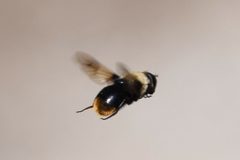
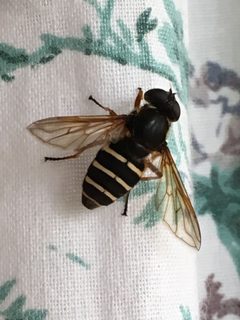
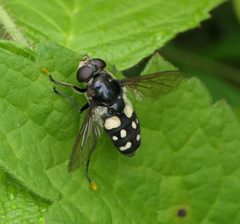
Sericomyia is a of large hoverflies in the Syrphidae, commonly known as pond flies. within this genus are notable mimics, displaying both short-pile and long-pile coloration patterns. The genus is widespread across forests of the Holarctic region, extending southward at higher elevations into the Oriental and Neotropical regions. Larvae are of the rat-tailed maggot type, specialized for aquatic life in oxygen-poor environments.
Pronunciation
How to pronounce Sericomyia: //ˌsɛrɪˈkoʊmiˌaɪə//
These audio files are automatically generated. While they are not always 100% accurate, they are a good starting point.
Identification
Distinguished from similar hoverfly by combination of: open r1, absence of stigmatic crossvein, long petiole of cell r4+5 (longer than humeral crossvein), and straight to moderately sinuate R4+5 . Larval in bog mat pools separates Sericomyia from Eristalis (putrid water, long siphon), Mallota/Mylopeta (tree holes), and Chrysogaster (pond edges with emergent vegetation).
Images
Appearance
Large-bodied hoverflies with -mimic coloration. Wing margin darkly colored. r1 open; stigmatic crossvein absent. Cell r4+5 with long petiole exceeding humeral crossvein length. R4+5 straight to moderately sinuate. with oval bearing . Male bare, narrowly to broadly .
Habitat
frequent forests and associated flowering . Larvae occur primarily in bog mat pools—shallow water bodies within peatland systems rich in decomposing vegetation. Also found in ponds with high organic decomposition and low oxygen conditions.
Distribution
Holarctic distribution centered on forests; extends southward at higher elevations into Oriental and Neotropical regions. Documented from Denmark, Norway, Sweden, and Vermont (USA).
Diet
Larvae filter microorganisms from water rich in decomposing vegetation. visit flowers for nectar and pollen; specific floral associations not documented at level.
Life Cycle
Larval stage: rat-tailed maggot form with extensible breathing siphon allowing survival in low-oxygen aquatic environments. occurs on dry land; pupal capsule hard and mouse-shaped. follows.
Behavior
during foraging has been observed in Sericomyia silentis; unlike some mimics, this does not closely match wasp flight patterns, suggesting morphological and behavioral mimicry may evolve independently.
Ecological Role
Larvae contribute to nutrient cycling in peatland and bog aquatic systems through filter-feeding on microorganisms in decomposing vegetation. function as of wildflowers in and montane .
Human Relevance
Occasional presence in water gardens and container water features. provide pollination services in northern forest . Not considered a pest .
Similar Taxa
- EristalisLarvae also rat-tailed maggots but occupy different (putrid organic-rich standing water, urban/suburban ) and possess longer breathing siphons; differ in wing venation details.
- ChrysogasterLarvae have shorter siphons and inhabit pond edges among emergent vegetation rather than bog mat pools.
- MallotaLarvae found in tree hole water collections, not bog pools.
- MylopetaLarvae restricted to tree hole , ecologically segregated from Sericomyia.
More Details
Mimicry and flight behavior
Research on Sericomyia silentis indicates that this , despite being a mimic morphologically, does not closely match the of Vespula vulgaris. This decoupling of morphological and behavioral mimicry suggests that hoverfly Batesian mimics may acquire model similarities through independent evolutionary rather than strict correlated evolution.
Larval respiration adaptation
The rat-tailed maggot form represents a key to aquatic life in oxygen-depleted environments. The into an extensible siphon maintain continuous air connection to the surface, allowing larvae to inhabit substrates that would be lethal to other aquatic insects.
Sources and further reading
- BugGuide
- Wikipedia
- GBIF taxonomy match
- iNaturalist taxon
- NCBI Taxonomy
- Catalogue of Life
- Strathmore B-Lines: Surveying Grasslands and Pollinating Insects in the Strathmore Valley - Buglife Blog - Buglife
- Bug Eric: Fly Day Friday: Rat-tailed Maggots
- Flight behaviour during foraging of the social waspVespula vulgaris(Hymenoptera: Vespidae) and four mimetic hoverflies (Diptera:Syrphidae)Sericomyia silentis,Myathropa florea,Helophilussp. andSyrphussp.