
Sericomyia flagrans
(Osten Sacken, 1875)
Spot-winged Pond Fly
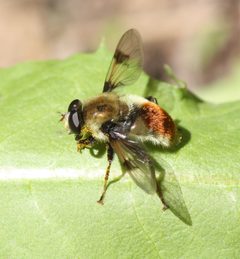
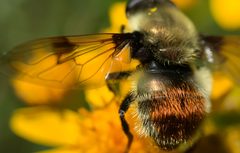
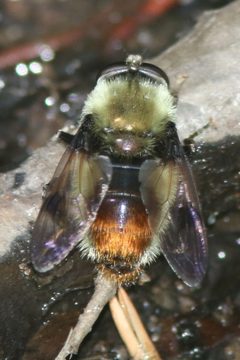
Sericomyia flagrans is a North American of flower fly (Syrphidae) commonly known as the Spot-winged Pond Fly. The Sericomyia belongs to the tribe Milesiini within Eristalinae. Larvae of this genus develop in bog mat pools, where they exhibit the characteristic "rat-tailed maggot" with an extensible breathing siphon. are that visit flowers for nectar and pollen.
Pronunciation
How to pronounce Sericomyia flagrans: /ˌsɛrɪkəˈmaɪə ˈfleɪɡræns/
These audio files are automatically generated. While they are not always 100% accurate, they are a good starting point.
Identification
can be distinguished from similar Sericomyia by wing markings; the "Spot-winged Pond Fly" suggests distinctive spotting on the wings. Within the , S. flagrans may be separated from the more widespread S. silentis (Yellow-barred Peat Hoverfly) by differences in coloration and pattern. The larvae possess the diagnostic rat-tailed maggot form: an elongated, cylindrical body with leg-like along the sides and a prominent, telescoping breathing siphon at the end.
Images
Habitat
Larvae develop in bog mat pools, a specialized wetland characterized by saturated organic substrate with low oxygen levels. These pools occur within bog where decaying vegetation creates suitable conditions for the filter-feeding larvae. forage in adjacent flowering habitats.
Distribution
North America. The has been recorded in the United States and Canada, with observation data available from citizen science platforms.
Diet
Larvae are that consume bacteria and other microorganisms from organic matter in water. feed on nectar and pollen from flowers.
Life Cycle
are deposited in bog mat pools. Larvae develop in aquatic conditions, using their extensible breathing siphon to maintain contact with the water surface while feeding on organic material below. Mature larvae leave the water to pupate on dry ground in a hardened . The pupal stage occurs terrestrially before .
Behavior
Larvae remain submerged while breathing through their telescoping siphon, which they extend to the water surface. This allows them to inhabit oxygen-poor, organically rich waters that would exclude many other aquatic insect larvae. are active flower visitors and contribute to pollination.
Ecological Role
Larvae contribute to nutrient cycling in bog through their filter-feeding activity on microbial . serve as of wildflowers in wetland and adjacent .
Human Relevance
provide pollination services to wild plants. The is not considered a pest; larvae do not develop in human-made containers or waste systems. The "Spot-winged Pond Fly" and accessible make it a candidate for public engagement in wetland conservation.
Similar Taxa
- Sericomyia silentisBoth are North American Sericomyia with bog-dwelling larvae. S. silentis has the "Yellow-barred Peat Hoverfly" and differs in coloration and pattern; S. flagrans is distinguished by spot-winged .
- Eristalis tenaxLarvae share the rat-tailed maggot form, but E. tenax larvae develop in putrid standing water, manure, and artificial containers rather than bog pools, and are robust mimics with different wing venation.
- Chrysogaster speciesLarvae are also rat-tailed maggots, but possess a much shorter breathing siphon and inhabit pond edges among emergent vegetation rather than bog mat pools.
More Details
Taxonomic History
Originally described as Arctophila flagrans by Osten Sacken in 1875 before transfer to Sericomyia.
Larval Morphology
The rat-tailed maggot form includes leg-like knobs along the body length, visible in preserved specimens.