
Sericomyia bifasciata
Williston, 1887
Long-nosed Pond Fly
Sericomyia bifasciata, commonly known as the Long-nosed Pond Fly, is an uncommon of syrphid fly described by Williston in 1887. It belongs to the Sericomyia, whose larvae are known as "rat-tailed maggots" with long breathing siphons adapted to aquatic environments. However, the larvae of this particular species remain unknown. have been observed in the northeastern part of North America.
Pronunciation
How to pronounce Sericomyia bifasciata: //ˌsɛrɪˈkoʊmiə ˌbaɪfəˈʃiːətə//
These audio files are automatically generated. While they are not always 100% accurate, they are a good starting point.
Identification
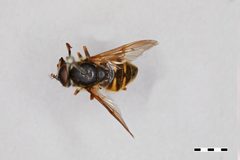
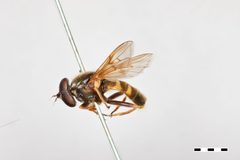
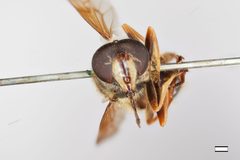
Distinguished from similar syrphid flies by the combination of: short pile (not bumblebee-mimic); yellow with medial black stripe; face elongate below by more than 3/4 eye height; scutellum with yellow pile; and abdominal banding pattern (two pairs in male, three pairs in female, finger-like and widely spaced). The elongate face is particularly distinctive.
Images
Habitat
are associated with flowers. Based on -level information, Sericomyia larvae typically inhabit bog mat pools and other aquatic environments, though the specific larval for this is unknown.
Distribution
Northeastern North America. Specific records include Vermont, United States.
Diet
feed on nectar and pollen from flowers. Larval diet unknown for this ; other Sericomyia larvae are known to filter bacteria and microbes from organic matter in aquatic environments.
Life Cycle
Complete with , larva, pupa, and stages. Larval and pupal stages are unknown for this . Adults have been observed from the northeastern part of North America.
Behavior
are flower visitors, obtaining energy from nectar and protein from pollen. Like other hoverflies, adults can remain nearly motionless in . Larval unknown; other Sericomyia larvae possess a long extensible breathing siphon (the "rat-tail") that connects to the water surface, allowing them to inhabit low-oxygen aquatic environments.
Ecological Role
contribute to pollination as flower visitors. The ' overall ecological role is poorly understood due to limited knowledge of its stages.
Human Relevance
No documented direct human relevance. As with other syrphid flies, may contribute to pollination of wildflowers and crops.
Similar Taxa
- Sericomyia silentisSimilar yellow-banded abdominal pattern, but S. bifasciata has distinctive finger-like bands that are widely spaced, and the elongate with medial black stripe differs from S. silentis.
- Eristalis tenaxBoth are syrphid flies with aquatic larvae, but E. tenax is a bumblebee mimic with dense pile, while S. bifasciata has short pile and does not mimic bumblebees. E. tenax also has a shorter relative to height.
- Other Sericomyia speciesS. bifasciata is distinguished by the specific pattern of two (male) or three (female) pairs of yellow finger-like abdominal bands with wide spacing between them, combined with the elongate and yellow scutellar pile.
More Details
Larval biology
While larvae of the Sericomyia are known as "rat-tailed maggots" with long breathing siphons for aquatic life, the larvae of S. bifasciata specifically have not been described.
Taxonomic history
First described by Samuel Wendell Williston in 1887. The remains poorly known compared to more common syrphid flies.
Sources and further reading
- BugGuide
- Wikipedia
- GBIF taxonomy match
- iNaturalist taxon
- NCBI Taxonomy
- Catalogue of Life
- Encyrtid Holdings | Entomology Research Museum
- Meloidae Holdings | Entomology Research Museum
- Strathmore B-Lines: Surveying Grasslands and Pollinating Insects in the Strathmore Valley - Buglife Blog - Buglife
- Bug Eric: Fly Day Friday: Rat-tailed Maggots