
Sericomyia chrysotoxoides
Macquart, 1842
Oblique-banded Pond Fly
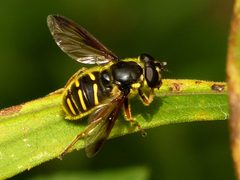
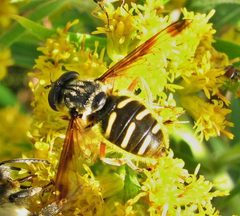
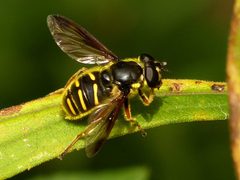
Sericomyia chrysotoxoides is a North American syrphid fly commonly known as the Oblique-banded Pond Fly. are medium-sized hoverflies with distinctive black and yellow banding. The is widespread across eastern North America and the Rocky Mountains. Larvae are aquatic rat-tailed maggots that inhabit bog mat pools.
Pronunciation
How to pronounce Sericomyia chrysotoxoides: //ˌsɛrɪkoʊˈmaɪə ˌkrɪsəˌtɒkˈsɔɪdiːz//
These audio files are automatically generated. While they are not always 100% accurate, they are a good starting point.
Identification
Distinguished from similar Sericomyia by the oblique yellow banding pattern on the . The combination of black ground color with yellow transverse bands separates it from unbanded or differently patterned syrphid flies. Males show reduced band prominence, which aids in sex determination.
Images
Appearance
are black with yellow bands across the ; the bands are less prominent in males. Body length ranges from approximately 9.6 to 15.3 mm. The coloration pattern provides the basis for the "Oblique-banded Pond Fly."
Habitat
are found in areas with abundant flowers. Larvae develop in bog mat pools and other shallow, organic-rich aquatic with standing water.
Distribution
Eastern half of North America, extending westward through the Rocky Mountains. Records include the United States and Canada, with specific documentation from Vermont.
Diet
feed on nectar and pollen from flowers. Larvae are that consume bacteria and other microbes from organic matter in water.
Life Cycle
are laid in aquatic or semi-aquatic environments. Larvae are rat-tailed maggots with an extensible breathing siphon that connects to the water surface. The siphon length is moderate compared to related —shorter than Eristalis but longer than Chrysogaster. Larvae filter organic material from the water column. Upon maturity, larvae leave the water to pupate on dry land in a hard pupal capsule.
Behavior
hover near flowers and are capable of sustained hovering characteristic of syrphid flies. Larvae remain submerged, extending their breathing siphon to the surface to access atmospheric oxygen while feeding below.
Ecological Role
serve as of wildflowers. Larvae contribute to nutrient cycling in aquatic by processing organic detritus and microbes.
Human Relevance
are beneficial in natural and garden settings. Larvae may occasionally be encountered in water gardens and container ponds, where they are sometimes mistaken for mosquito larvae or other aquatic insect larvae.
Similar Taxa
- Sericomyia silentisSimilar and appearance; S. silentis has different banding pattern and is more commonly recorded in European and some North American grassland surveys
- Eristalis tenaxShares rat-tailed maggot larval form but has longer breathing siphon and different coloration ( mimic with orange-brown rather than black and yellow bands)
- Chrysogaster speciesShares aquatic larval but has much shorter breathing siphon and different
More Details
Larval habitat specificity
Unlike some related that occupy diverse aquatic (tree holes, manure, rain gutters), Sericomyia larvae are specifically associated with bog mat pools.
Taxonomic placement
Placed in tribe Milesiini (formerly Sericomyiini), Eristalinae, based on larval morphological characteristics and features.