
Sericomyia lata
(Coquillett, 1907)
White-spotted Pond Fly
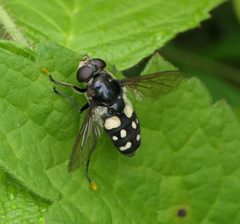
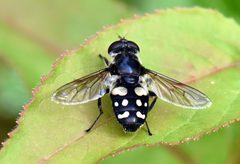
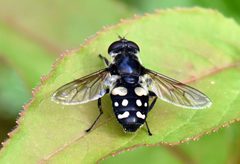
Sericomyia lata is a syrphid fly commonly known as the White-spotted Pond Fly. are medium-sized hoverflies, 11.6–15.2 mm in length, with distinctive black bodies and large white abdominal spots. The is widespread across North America, with highest concentrations in eastern regions. Like other members of its , the larvae develop in aquatic or semi-aquatic and possess the characteristic rat-tailed breathing siphon typical of Sericomyia.
Pronunciation
How to pronounce Sericomyia lata: /ˌsɛrɪkoʊˈmaɪə ˈleɪtə/
These audio files are automatically generated. While they are not always 100% accurate, they are a good starting point.
Identification
are distinguished from similar syrphid flies by the combination of black body coloration with large, conspicuous white spots on the . The size range of 11.6–15.2 mm helps separate it from smaller or larger syrphid . The white-spotted pattern differs from the yellow-and-black banding common in many hoverfly mimics of bees and .
Images
Habitat
are associated with flowers where they feed on nectar and pollen. Larvae develop in bog mat pools and other aquatic or semi-aquatic environments with organic matter.
Distribution
Widespread across North America, with highest abundance in eastern regions. Documented from the United States including Vermont, with records extending across the continent.
Diet
feed on nectar and pollen from flowers. Larval diet consists of bacteria and other microbes filtered from organic matter in aquatic .
Life Cycle
Larval stage is aquatic, developing in bog mat pools with the characteristic rat-tailed breathing siphon connecting to the water surface. Larvae filter-feed on microorganisms in organic-rich water. Mature larvae seek dry land to pupate.
Behavior
hover around flowers, a common to syrphid flies that contributes to their pollination role.
Ecological Role
function as through nectar and pollen feeding at flowers. Larvae contribute to nutrient cycling in aquatic through filter-feeding on organic matter.
Similar Taxa
- Eristalis tenaxBoth have rat-tailed maggot larvae and are medium-sized syrphid flies, but E. tenax are mimics with yellow and black banding rather than black with white spots.
- Other Sericomyia speciesShare the rat-tailed larval form and general body plan, but abdominal spot patterns and geographic distribution differ.
Sources and further reading
- BugGuide
- Wikipedia
- GBIF taxonomy match
- iNaturalist taxon
- NCBI Taxonomy
- Catalogue of Life
- Davis Bee Sanctuary: The Place to 'Bee' | Bug Squad
- Strathmore B-Lines: Surveying Grasslands and Pollinating Insects in the Strathmore Valley - Buglife Blog - Buglife
- Bug Eric: Fly Day Friday: Rat-tailed Maggots
- Bug Eric: What is, and is NOT, a Japanese Beetle
- galls | Beetles In The Bush