
Mallota
Meigen, 1822
Mimic Flies
Species Guides
8- Mallota albipilis(Yellow Mimic Fly)
- Mallota bautias(Bare-eyed Bee-mimic Fly)
- Mallota bequaerti(Spot-winged Mimic Fly)
- Mallota diversipennis
- Mallota illinoensis(Midwestern Bee-mimic Fly)
- Mallota mississipensis(Eastern Mimic Fly)
- Mallota posticata(Hairy-eyed Bee-mimic Fly)
- Mallota sackeni(brown-haltered mimic fly)
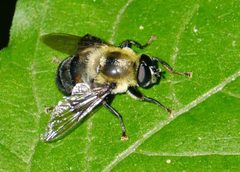
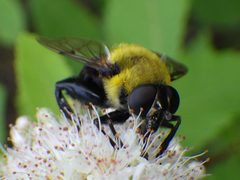
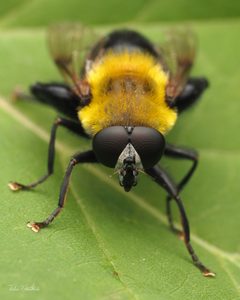
Mallota is a Holarctic of hoverflies ( Syrphidae) containing approximately 30 described . are well known for their robust, -like appearance, functioning as mimics of bumble bees (Bombus species). The genus has been documented from North America, Europe, and Asia. Larvae develop in water-filled tree holes and other decaying wood cavities.
Pronunciation
How to pronounce Mallota: /məˈloʊtə/
These audio files are automatically generated. While they are not always 100% accurate, they are a good starting point.
Identification
Mallota can be distinguished from other -mimicking syrphids by their exceptionally dense, long body hairs and robust build. They differ from the related Helophilus by lacking the distinct vertical thoracic stripes. From Eristalis (drone flies), they differ in having more extensive body hair and generally more compact body proportions. Species-level identification requires examination of microscopic characters including male genitalia and details of pile coloration and distribution.
Images
Appearance
are medium to large hoverflies with stout, hairy bodies resembling bumble bees. The and are densely pilose, often with black and yellow or reddish color patterns. The overall body form is broad and compact, with a rounded and large . Wing venation follows the typical syrphid pattern with a characteristic false (spurious vein).
Habitat
are found in woodland edges, forest openings, and areas with flowering vegetation. Larvae inhabit water-filled cavities in trees, including rot holes and other decaying wood depressions that collect rainwater. The shows association with mature or decaying forest where such larval microhabitats are available.
Distribution
Holarctic distribution, documented from North America (including the United States and Canada), Europe, and Asia. Specific have more restricted ranges; for example, Mallota posticata occurs in eastern North America, while M. cimbiciformis and M. fuciformis are Palearctic species.
Seasonality
activity occurs primarily during spring and summer months, with timing varying by latitude and . In temperate regions, period typically spans May through August.
Diet
feed on pollen and nectar from flowers. Larvae are filter-feeders in aquatic microhabitats, consuming microorganisms and organic detritus from the water column.
Life Cycle
are deposited in or near water-filled tree holes and similar cavities. Larvae are aquatic, possessing a retractable respiratory siphon that allows them to breathe while submerged. They feed by filtering organic material from the water. Mature larvae leave the water to pupate in drier conditions. The pupal stage is spent in a hardened .
Behavior
are known to use leaves as platforms for and resting. They exhibit mimicry in both appearance and , which provides protection from . The mimicry is sufficiently effective to elicit predator avoidance responses from birds and other visual predators.
Ecological Role
serve as of wildflowers and other flowering plants. Larvae contribute to nutrient cycling in forest through their filter-feeding activity in tree hole aquatic . As mimics of aposematic bumble bees, they participate in Müllerian or complexes that may benefit multiple .
Human Relevance
are beneficial as in natural and agricultural settings. They are occasionally encountered by naturalists and photographers due to their conspicuous -like appearance. The has been subject of ecological research on mimicry and -prey interactions.
Similar Taxa
- HelophilusSimilar -mimicking appearance, but distinguished by vertical yellow stripes on and generally less dense body pilosity
- EristalisDrone flies share aquatic larval and mimicry, but have less hairy, more slender bodies and different color patterns
- SomulaAnother mimic in Syrphidae, but with different wing patterns and body proportions
More Details
Mimicry research
Mallota bautias has been documented as a mimic of Bombus pennsylvanicus in experimental studies of bird responses, demonstrating the effectiveness of its protective resemblance.
Larval habitat specificity
Unlike many aquatic syrphid larvae that inhabit open water or manure, Mallota larvae are specialized for the phytotelmata (plant-held water) of tree holes, placing them in a distinctive ecological guild.
Sources and further reading
- BugGuide
- Wikipedia
- GBIF taxonomy match
- iNaturalist taxon
- NCBI Taxonomy
- Catalogue of Life
- Bug Eric: Eight Illinois Wasp and Bee Mimics in Twenty Minutes
- Bug Eric: Fly Day Friday: Rat-tailed Maggots
- Hover Flies Identified: Researchers Tackle 20,000 Syrphid Specimens in Illinois Collection
- hover flies - Entomology Today
- Reactions of some adult passerines to Bornbus pennsylvanicus and its mimic, Mallota bautias