
Mallota bautias
(Walker, 1849)
Bare-eyed Bee-mimic Fly
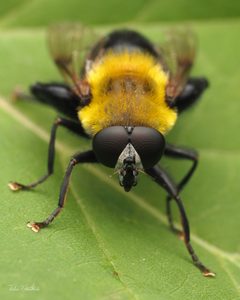
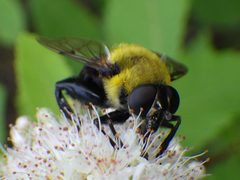
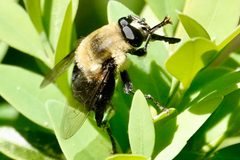
Mallota bautias is a hoverfly ( Syrphidae) native to eastern North America. The is notable for its exceptional mimicry of bumblebees ( Bombus), particularly Bombus pennsylvanicus, serving as a classic example of in which a harmless species evolves to resemble a stinging model. flies are , while larvae develop in tree holes filled with water. The species has been the subject of behavioral studies examining how avian respond to the mimic and its model.
Pronunciation
How to pronounce Mallota bautias: /mælˈloʊtə ˈbɔːtiəs/
These audio files are automatically generated. While they are not always 100% accurate, they are a good starting point.
Identification
Distinguished from other Mallota and syrphid flies by its pronounced -like appearance, resembling bumblebees in size, coloration, and overall form. The specific epithet "bare-eyed" in its suggests reduced or absent markings compared to some related species. Separation from the model species Bombus pennsylvanicus requires close examination: flies possess a single pair of wings (hindwings reduced to ), short , and lack the narrow -waist of hymenopterans.
Images
Habitat
Larvae inhabit water-filled tree holes; frequent woodland edges and areas with flowering vegetation.
Distribution
Eastern North America.
Life Cycle
Larvae develop in water that collects in tree holes, a shared with other Mallota . The larval stage is aquatic or semi-aquatic, feeding in this specialized microhabitat. emerge and visit flowers.
Behavior
Exceptional mimic of bumblebees, specifically Bombus pennsylvanicus. The mimicry extends to overall body form, coloration, and likely . This confers protection from that avoid stinging hymenopterans.
Ecological Role
function as . Larvae contribute to nutrient cycling in their specialized tree-hole aquatic . The serves as a documented example in studies of mimicry and -prey dynamics.
Human Relevance
Subject of scientific research on mimicry and avian . contribute to pollination services in natural and possibly agricultural systems.
Similar Taxa
- Bombus pennsylvanicusThe primary model for M. bautias mimicry; distinguished by two pairs of wings, longer , and presence of a stinger.
- Mallota posticataCongeneric also a bumblebee mimic; distinguished by subtle differences in coloration and markings, with M. bautias specifically noted as particularly -like.
- Other Mallota speciesShare similar larval in tree holes and general body plan; require detailed examination of facial markings and coloration patterns for separation.
Sources and further reading
- BugGuide
- Wikipedia
- GBIF taxonomy match
- iNaturalist taxon
- NCBI Taxonomy
- Bug Eric: Eight Illinois Wasp and Bee Mimics in Twenty Minutes
- Bug Eric: Fly Day Friday: Rat-tailed Maggots
- Hover Flies Identified: Researchers Tackle 20,000 Syrphid Specimens in Illinois Collection
- hover flies - Entomology Today
- Reactions of some adult passerines to Bornbus pennsylvanicus and its mimic, Mallota bautias