
Mallota posticata
(Fabricius, 1805)
Hairy-eyed Bee-mimic Fly
Mallota posticata is a syrphid fly ( Syrphidae) known for its mimicry. The is documented in Illinois and broader North America, with larvae developing in water-filled tree holes. exhibit on leaves and serve as .
Pronunciation
How to pronounce Mallota posticata: //məˈloʊtə poʊstɪˈkɑtə//
These audio files are automatically generated. While they are not always 100% accurate, they are a good starting point.
Identification
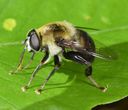
Identified as a mimic. Distinguished from similar syrphid flies by its mimicry pattern and association with the Mallota, which is characterized by larvae inhabiting tree holes rather than other aquatic environments.
Images
Habitat
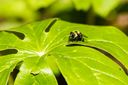
found in woodland edges and areas with touch-me-nots (jewelweed) where they bask on leaves. Larvae develop in water that collects in rotting holes in trees.
Distribution
Recorded in Illinois (National Trail Rest Area, Altamont) and present in North American collections. Documented in the Illinois Natural History Survey insect collection with digitized specimens contributing to range data.
Seasonality
Observed in mid-May in Illinois, suggesting spring activity period.
Life Cycle
Larvae are aquatic, living in water-filled tree holes. occurs on dry land. Complete with , larval, pupal, and stages.
Behavior
groom on leaves, exhibiting contorted body positions during . Mimics bumble bees as a defensive strategy against .
Ecological Role
function as . Larvae contribute to nutrient cycling in aquatic microhabitats within tree cavities.
Human Relevance
Subject of entomological research and specimen collection. Digitization of specimens has contributed to understanding range changes and conservation needs for hover flies in Illinois.
Similar Taxa
- Somula decoraAnother syrphid fly mimic, but S. decora is larger, roughly -sized, and marked with golden yellow on black, likely mimicking scoliid wasps or yellowjackets rather than bumble bees.
- Sphecomyia vittataA more extreme yellowjacket mimic with longer, thicker and matching yellowjackets; M. posticata targets mimicry instead.
- Laphria spp.Robber flies (Asilidae) that also mimic bumble bees, but belong to a different with predatory rather than pollination .
More Details
Mimicry Type
of bumble bees (Bombus), where the harmless fly gains protection from that avoid stinging insects.
Research Significance
Specimens from the Illinois Natural History Survey contributed to a 2023 study on century-long changes in hover fly distributions, highlighting the value of museum collections for conservation assessment.