
Somula decora
Macquart, 1847
spotted wood fly
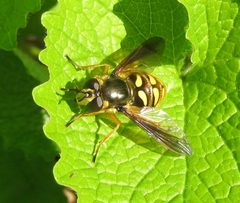
Somula decora, commonly called the spotted wood fly, is an uncommon syrphid fly found in central to eastern North America. are medium-sized, roughly -sized, with black bodies heavily marked with golden yellow. The species exhibits mimicry, likely resembling scoliid wasps or yellowjackets. Larvae develop in decaying wood, while adults visit flowers for nectar and pollen.
Pronunciation
How to pronounce Somula decora: /ˈsɔm.jʊ.lə dɪˈkɔː.rə/
These audio files are automatically generated. While they are not always 100% accurate, they are a good starting point.
Identification
Distinguished from other syrphid flies by its combination of medium size, black body with heavy golden yellow markings, and woodland . The -mimicking coloration separates it from non-mimetic flower flies. Similar to Helophilus but lacks the vertical yellow thoracic stripes characteristic of that . Differs from Temnostoma species, which have darkened leading wing edges and wave their front legs to simulate wasp . Distinguished from Sphecomyia vittata by the latter's longer, thicker antennae and more precise yellowjacket mimicry.
Images
Habitat
Woodland edges and forested areas. Associated with decaying wood for larval development. found near flowers at woodland margins.
Distribution
Central to eastern North America. Recorded from Canada and the United States. Specific records include Vermont.
Seasonality
active in spring, with observations in May. Peak activity likely coincides with blooming of woodland edge flowers.
Diet
feed on nectar and pollen from flowers. Larval diet in decaying wood is not specified in available sources.
Life Cycle
Larvae develop in decaying wood. emerge and visit flowers. Specific details of -laying, , and developmental timing are not documented.
Behavior
hover near flowers and can remain nearly motionless in . Has been observed basking on leaves of jewelweed (Impatiens ) at woodland edges.
Ecological Role
contribute to pollination through flower visitation. Larvae participate in wood decomposition processes. The is part of mimicry complexes involving and bees, potentially gaining protection from through resemblance to stinging hymenopterans.
Human Relevance
No significant direct interactions with humans documented. May occasionally be encountered by naturalists and entomologists in woodland settings.
Similar Taxa
- Helophilus speciesAlso yellowjacket mimics, but distinguished by vertical yellow stripes on and different larval (submerged decaying plant matter)
- Temnostoma speciesMason wasp mimics with darkened wing edges and leg-waving not seen in Somula
- Sphecomyia vittataMore precise yellowjacket mimic with longer, thicker and distinctive pattern
More Details
Mimicry
The is suspected to be a mimic of scoliid wasps, though yellowjackets may serve as a more likely model given seasonal timing of activity.
Conservation status
Described as uncommon in available literature; may be underrecorded due to woodland preferences.
Sources and further reading
- BugGuide
- Wikipedia
- GBIF taxonomy match
- NCBI Taxonomy
- Catalogue of Life
- It's Bugged! And You Won't Want to Miss It! | Bug Squad
- Bug Eric: Eight Illinois Wasp and Bee Mimics in Twenty Minutes
- Decorations on the Christmas tree: Egg cases of the European mantis, Mantis religiosa, Chinese mantis, Tenodera sinensis, and Carolina mantis, Stagmomantis carolina — Bug of the Week
- Decorations on the Christmas tree: Egg cases of the European mantis, Mantis religiosa, Chinese mantis, Tenodera sinensis, and Carolina mantis, Stagmomantis carolina — Bug of the Week
- Tinsel, the Christmas spider and other arthropods that decorate your holiday tree — Bug of the Week
- Amorpha borer on goldenrod | Beetles In The Bush